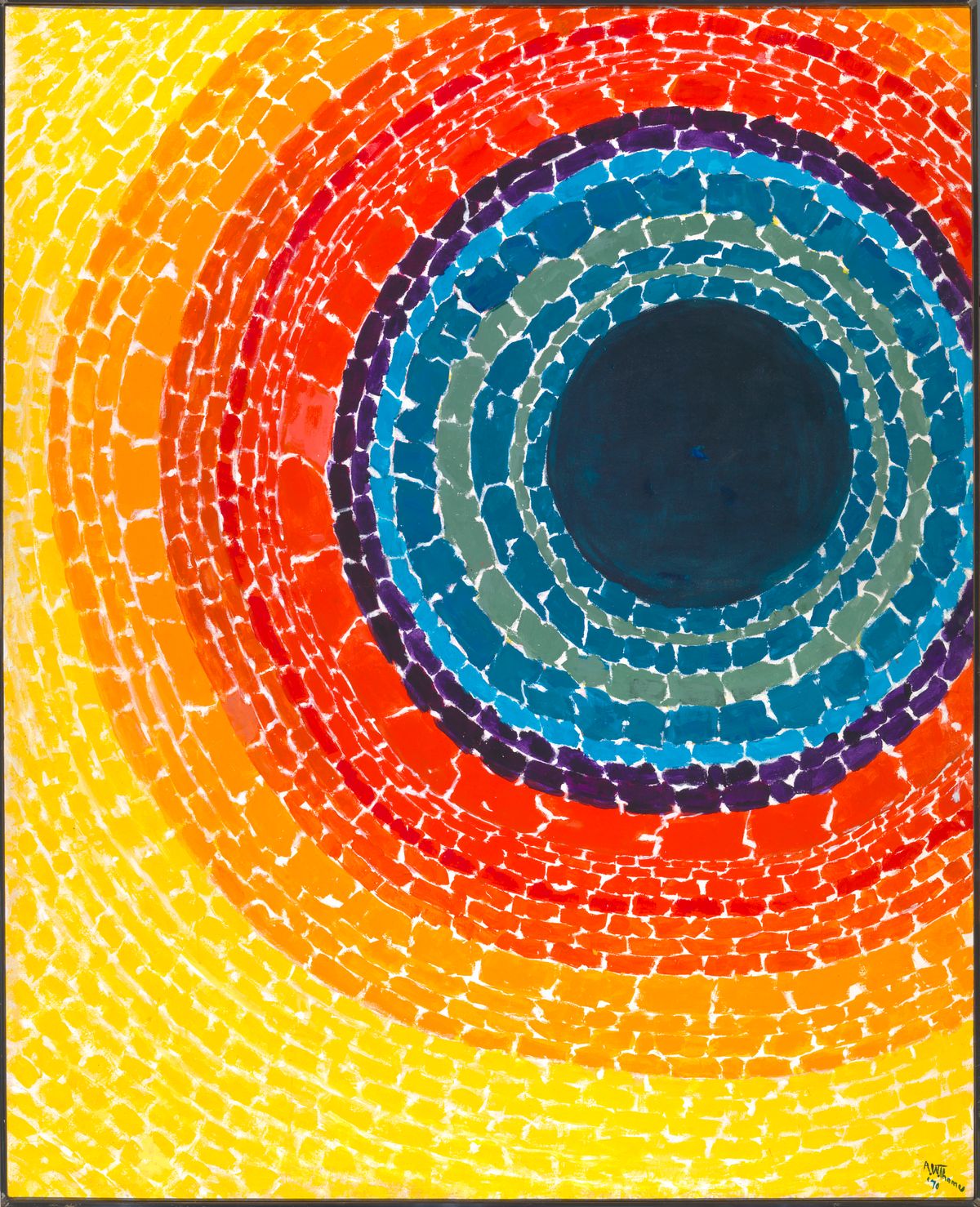
Alma Thomas is often introduced as a late-blooming painter of joy, and the phrase is partly right. Her best paintings do glow. They do open outward. They do refuse the deadening idea that seriousness in modern art must arrive through gloom. But the phrase can also make the work sound easier than it is. Thomas did not stumble into brightness after retirement as though color alone could carry conviction. She built a disciplined late style in which delight had to be organized, paced, and tested on the canvas.[1][2][3]
That structure matters because Thomas's timeline can tempt readers into a sentimental story of sudden arrival. She devoted herself full time to painting only after retiring in 1960, at the age of sixty-nine, after thirty-five years of teaching art in Washington public schools.[2][3] Yet the late breakthrough did not emerge from nowhere. By then she had already become the first graduate of Howard University's art department in 1924, remained active in Washington's art community, and continued studying at American University, where abstraction moved from possibility into method.[2][3] The late work carries the force of long preparation. What looks jubilant is backed by decades of looking, teaching, and compositional discipline.
Image context: the cover uses The Eclipse because Thomas's profile can be read through its structure in one glance. Concentric rings do not dissolve into mist; they advance in measured units. The white ground stays active between strokes, so radiance arrives through interval and repetition rather than through blended atmosphere alone.[3][4]
The late breakthrough was a rebuilt system
Thomas's shift into the mature paintings becomes clearer when placed next to the biography recorded by the Whitney and the White House Historical Association.[2][3] She had spent years painting representationally, taught generation after generation of students, and only in the 1950s, through study with Jacob Kainen at American University, moved decisively toward abstraction.[3] Then a severe arthritic attack in 1964 threatened her mobility just as a Howard University retrospective gave her a reason to keep going.[3] The result was not a small stylistic adjustment. It was a rebuilt painting system.
The White House text on Resurrection captures the turning point with unusual precision.[3] Thomas recovered, retired from teaching in 1966, and treated that year as a beginning rather than as a winding down. Resurrection was painted in that same charged window, and its concentric but irregular circles already show what the late work would become: patterned blocks of color on a bright white ground, energy pressing outward, and a square field enlarged by rhythm rather than by illusionistic depth.[3] The painting's title gives the biographical moment a theological charge, but the important fact is formal. Thomas found a way to make renewal visible.
This is why the late style should not be read as a gentle coda to a teacher's career. It behaves more like a second life in paint. The retirement story matters, but only because it released a rigor that had been building for years.
Gardens and planets share one grammar
Whitney's account of Thomas is especially useful here because it refuses to flatten her into the Washington Color School while still placing her near that orbit.[2] She worked with acrylic on large canvases and shared those painters' commitment to chromatic intensity, yet Whitney stresses that her images remained rooted in nature, especially in the abstract patterns created by the interaction of light and earth.[2] That sentence helps explain why gardens and cosmos can coexist so naturally in her work. Thomas did not treat nature and space as separate subjects. She treated both as fields of pattern.
Once that clicks, the leap from flowers to planets stops feeling strange. In Mars Dust, Whitney writes, the allover red brushstrokes evoke the planet's massive dust storms as observed during NASA's 1971-72 mission, while a cobalt underlayer and the artist's use of an elastic band as a guide produce shimmer without losing control.[2][5] Thomas is not illustrating astronomy in any literal way. She is translating observed or imagined energy into a system of repeated marks. The same mind that could watch a garden bed break into flashes of color could also imagine a planet as a vibrating surface.
The Smithsonian's traveling-exhibition page for Composing Color reinforces that point by placing The Eclipse at the front of Thomas's story.[4] The painting's colored rings feel cosmic, but they are made from short, hand-laid units that keep the surface tactile and paced. Meanwhile the Smithsonian's object page for Antares describes that 1972 canvas as a densely patterned monochrome work that conjures the intensely hot surface of the star.[7] Thomas could therefore move from multicolored burst to near-monochrome heat without abandoning her central problem. She kept asking how a painting could hold radiance in discrete increments.
The White House essay on Resurrection provides the sharpest language for what these circles do.[3] William Kloss argues that the paintings have too casually been called "targets" and suggests "sunbursts" instead, because the energy comes from them rather than traveling toward them.[3] That distinction matters. Thomas's circles do not behave like emblems of impact or aggression. They expand. They emanate. Even when a dark center anchors the composition, the work feels centrifugal.
Joy was carefully planned
If Thomas's paintings still surprise viewers, it is partly because their cheer can disguise how methodical they are. The Smithsonian conservation research makes that impossible to miss.[6] Examining nearly forty works, conservators found that Thomas's move from oil to acrylic in the 1960s let vivid hue pop against the white ground of the canvas, that she layered colors to intensify presence, and that she used complex pencil underdrawings, vertical guide lines, rulers, and written annotations to map color placement before the final surface was built.[6]
That evidence changes the emotional reading of the work. The famous dashes are not confetti. They are units of spacing. The visible white between strokes is not leftover ground. It is the interval that lets each color breathe and keeps the whole canvas in motion.[4][6] Thomas's joy arrives through order, which is why the paintings stay so alive under sustained viewing. The surface keeps oscillating between touch and plan, spontaneity and grid, pulse and placement.
The conservation page also adds one of the most human details in her late career: Thomas adapted technique as her body changed.[6] After health issues in 1974, stricter rows and columns could give way to wedges and curves, as in Red Azaleas Sing and Dance Rock and Roll Music (1976), without losing vitality.[6] This matters because it prevents the late style from hardening into formula. Thomas's method was precise, but it was never rigid. She kept revising the unit so the painting could remain mobile with her.
Why Alma Thomas still matters
Thomas's importance in American art is often summarized through institutional firsts, and those firsts do matter. Whitney notes her 1972 solo exhibition there, and the museum now describes her as a major twentieth-century painter.[2][5] The White House Historical Association places Resurrection inside the White House collection and records the formal recognition that followed her late ascent.[3] But the deeper reason the work lasts is artistic rather than ceremonial.
Thomas showed that joy could be rigorous without turning sentimental, and that abstraction could stay open to ordinary seeing without collapsing into illustration.[1][2][4] Gardens, lunar headlines, planets, trees, azaleas, and sunbursts all passed through the same disciplined filter: acrylic on white ground, measured strokes, layered hue, and a surface that never lets color become inert.[4][5][6][7] She made radiance count because she gave it structure.
That is the achievement worth carrying forward. Alma Thomas did not paint happiness as escape. She painted it as a form of organization, one built patiently enough that light, memory, and observation could keep moving across the canvas long after the first bright impression had passed.[1][2][6]
Sources
- Smithsonian American Art Museum, "Alma Thomas" - artist page describing her late abstract breakthrough, teaching career, and connection to the natural world.
- Whitney Museum of American Art, "Alma Thomas" - artist page on her 1960 retirement, Howard training, Washington teaching career, and relation to Color Field abstraction.
- White House Historical Association, ""Resurrection" by Alma Thomas" - essay on the 1966 painting, her Howard and Washington background, and the formal logic of the concentric-circle works.
- Smithsonian American Art Museum, Composing Color: Paintings by Alma Thomas - exhibition page framing Thomas as a singular twentieth-century painter and featuring The Eclipse used as this article's image.
- Whitney Museum of American Art, Mars Dust - collection entry on the 1972 painting's NASA context, cobalt underlayer, and elastic-band guided brushwork.
- Smithsonian American Art Museum, "Using Science to Uncover Secrets of Alma Thomas" - conservation research on her acrylics, layered color, pencil underdrawings, guide lines, and late technique changes.
- Smithsonian American Art Museum, Antares - object page describing the densely patterned monochrome canvas as an image of stellar heat.