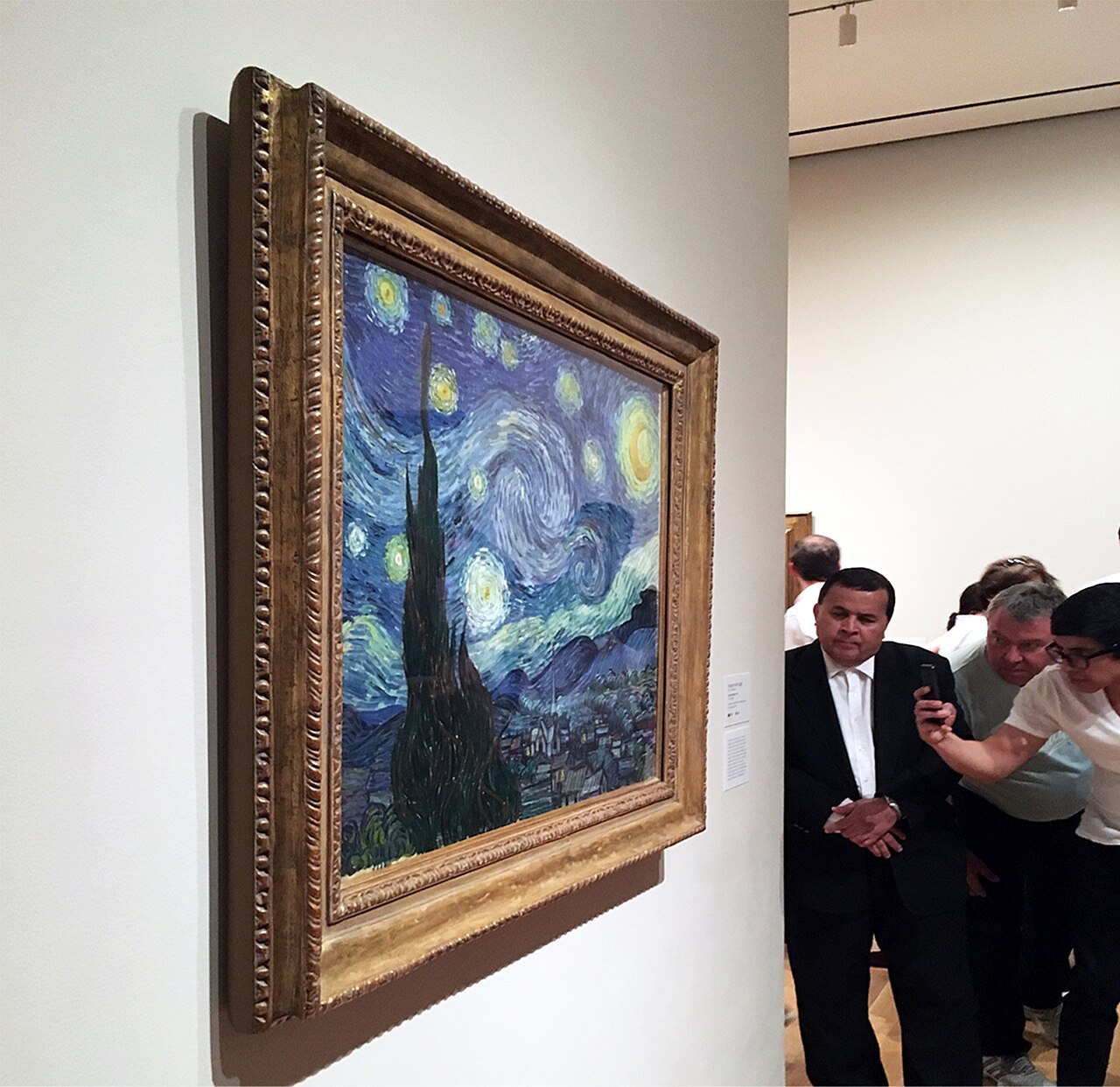
The Starry Night is often flattened into a weather report of the soul: Van Gogh suffered, therefore the sky swirls.[1][2][5] That shorthand preserves the painting's emotional temperature and misses its harder achievement. The picture is not powerful because it spills feeling without control. It is powerful because it organizes incompatible things into one structure: observed hills, an invented village, a cypress recalled from nearby studies, and a sky pushed beyond direct observation into something planned, rhythmic, and almost architectural.[2][3][5] The result is less a dream than a construction.
That difference matters because Van Gogh himself was uneasy about paintings made too far from the motif. The Saint-Remy setting is real: in June 1889 he was living at the asylum of Saint-Paul-de-Mausole, looking from his window toward the Alpilles before sunrise, and working through alternating periods of concentration and illness.[2][5] Yet the village below does not belong to that actual view, and the church steeple is not Provençal fact but a deliberate insertion.[2][5] The painting is therefore not a transcript of one night. It is a negotiated scene in which memory, observation, and invention are forced to hold together on one canvas.[1][2]
Image context: the hero image uses the painting itself because this essay depends on the exact relation among the cypress at left, the compact village below, and the sky's circular pressure above. A cropped detail would make the work look either expressive or decorative, when its force really lives in the argument between the parts.[1][2]
The cypress is the hinge, not the scenery
The first thing the eye usually remembers is the sky, but the painting's real hinge stands on the left edge: the tall black-green cypress.[1][2] It is easy to treat the tree as a theatrical silhouette added for mood. Read more carefully, and it behaves like a structural device. It begins in the earth with the village and rises almost to the highest star fields, binding the lower and upper worlds into one vertical passage. Without it, the composition would separate too neatly into calm land and agitated heaven. With it, the earth already has a flame inside it.
That vertical matters all the more because cypresses were not accidental to Van Gogh during Saint-Remy. In his June 16, 1889 letter to Willemien, he describes a recently finished landscape with "a tall and dark cypress" set against distant violet-blue hills and a vivid sky.[3] The phrasing is useful because it shows the motif already active in his thinking as a carrier of contrast: dark against light, near against far, vertical against spread. In The Starry Night, the cypress becomes more than a tree. It acts as a converter, taking the tactile density of the foreground and feeding it upward into the sky's larger motion.[2][3]
It also introduces a different stroke logic from the village below. The houses and steeple are built from shorter, steadier marks. The cypress is all lift, curl, and upward drag. It therefore belongs to the sky's rhythm without fully joining it. That in-between status is why the form feels so alive. It is not merely standing in front of the scene. It is translating the scene from one register to another.
The village is invented calm
Viewers often read the village as a pocket of peace beneath cosmic turbulence, and that reading is partly right.[1][5] The houses sit low, their walls and roofs made from relatively straight, controlled lines. Small yellow windows suggest shelter. The church steeple lifts cleanly instead of twisting. Compared with the sky's coils, the town seems almost grammatical.
But the village is not simple calm handed down by nature. It is chosen calm. Richard Thomson's MoMA essay is blunt that The Starry Night is far from naturalistic: Van Gogh altered the church, drew on previous landscape material, and built the starscape through invention.[2] The village therefore behaves like a compositional answer to the sky rather than a documentary record of what lay outside the asylum. It gives the canvas a zone of human order, but that order is itself made, inserted, and held under pressure.
This is where the painting becomes more exacting than the cliché of pure turbulence allows. If everything moved with the same velocity, the image would blur into atmospheric spectacle. The village stops that collapse. It introduces resistance. Its rectilinear logic makes the swirls above feel more unstable, but it also makes them legible. The painting needs a place where the eye can measure straightness before it returns to the curved and pulsing sky.[2][5]
The church steeple performs a particularly sharp version of that work. Provence does not naturally offer a northern Gothic-looking spike in this form.[2][5] The insertion feels almost like memory sneaking into geography, a reminder that Van Gogh was a Dutch painter building a southern landscape through his own internal archive. The steeple gives the village a second vertical to answer the cypress, but its line is thinner, man-made, and more fragile. One vertical rises from masonry and habit; the other from vegetal mass and stroke energy. The comparison quietly organizes the whole lower half of the picture.
The sky is constructed, not chaotic
The sky's swirls are famous enough that they can start to look inevitable, as if Van Gogh simply copied a spectacular night or poured paint into a trance.[1][5] The better account is more demanding. He had long wanted to paint night, and he wrote about the morning star seen from his window before sunrise.[2] Yet he could not paint that nocturnal view directly from the bedroom bars, and he was suspicious of imagination when it drifted too far from lived sight.[2][5] The Starry Night comes out of that contradiction. It is a night picture made from remembered observation and rearranged intention.
You can feel that intention in the way the sky repeats without becoming mechanical. The stars are not identical dots. They radiate in distinct halos. The moon swells as a crescent that is brighter and heavier than astronomical precision would allow. The blue bands move laterally across the canvas, while the larger spiral near center-right turns that lateral sweep into a local vortex.[1][2] These choices do not describe the heavens neutrally. They distribute emphasis, pace, and recurrence. The sky has been composed to pulse.
Khan Academy's discussion helps here because it frames the work less as an expressionist blur than as an image built from specific tensions: observation and memory, order and movement, earthly village and celestial force.[4] That balance is exactly what keeps the painting from dissolving into melodrama. The swirls are intense, but they are spaced. The stars flare, but they do so at intervals. Even the brushwork's velocity depends on control. The sky feels alive because it has been patterned.
Why Van Gogh called it a failure and why it endured anyway
One of the most revealing facts about The Starry Night is that Van Gogh did not finally trust it.[2][5] Thomson notes his discomfort with paintings made from the imagination and cites the later letter in which he grouped this "night effect" among works that felt over-arranged to him.[2] Britannica says the point more bluntly: he eventually regarded the finished painting as a failure.[5] That self-judgment is not a biographical footnote. It tells us what risk the work is taking.
Van Gogh wanted to remain answerable to the seen world. The Starry Night bends that ethic without fully abandoning it. The hills retain mass. The village still reads as dwellable space. The cypress still belongs to Saint-Remy. But the whole picture presses these elements into a more stylized order than he considered fully safe.[2][3][5] In that sense, the canvas lives on the same threshold it depicts. It stands between the world outside the window and the world remade inside painting.
That is why the work still holds up under familiarity. Reproductions have made the sky iconic, but the painting itself is more disciplined than icon status suggests.[1][2] It is built from crossings: vertical against horizontal, curve against straight line, communal shelter against open cosmic distance, remembered motif against altered place. The emotional force comes from those crossings being held together without final reconciliation.
The Starry Night therefore lasts not because it gives us madness in paint, nor because it offers a decorative night sky.[1][2][5] It lasts because it shows how far structure can carry feeling without extinguishing it. The cypress welds land to sky, the village steadies invention without domesticating it, and the heavens move as if memory itself had learned a formal grammar. What looks spontaneous is a carefully built instability.
Sources
- The Museum of Modern Art, The Starry Night - collection entry with object data and image record.
- Richard Thomson, Vincent van Gogh: The Starry Night, MoMA online course PDF - on the Saint-Remy context, constructed village, cypress motif, and Van Gogh's doubts about the painting.
- Vincent van Gogh, "780 To Willemien van Gogh. Saint-Remy-de-Provence, Sunday, 16 June 1889" - letter describing a nearby wheat field, house, and tall dark cypress against blue-violet hills.
- Khan Academy, "Van Gogh, The Starry Night" - video discussion of the painting's composition, setting, and tension between order and movement.
- Encyclopaedia Britannica, "The Starry Night" - overview of the painting's Saint-Remy setting, imagined village, and later reception.