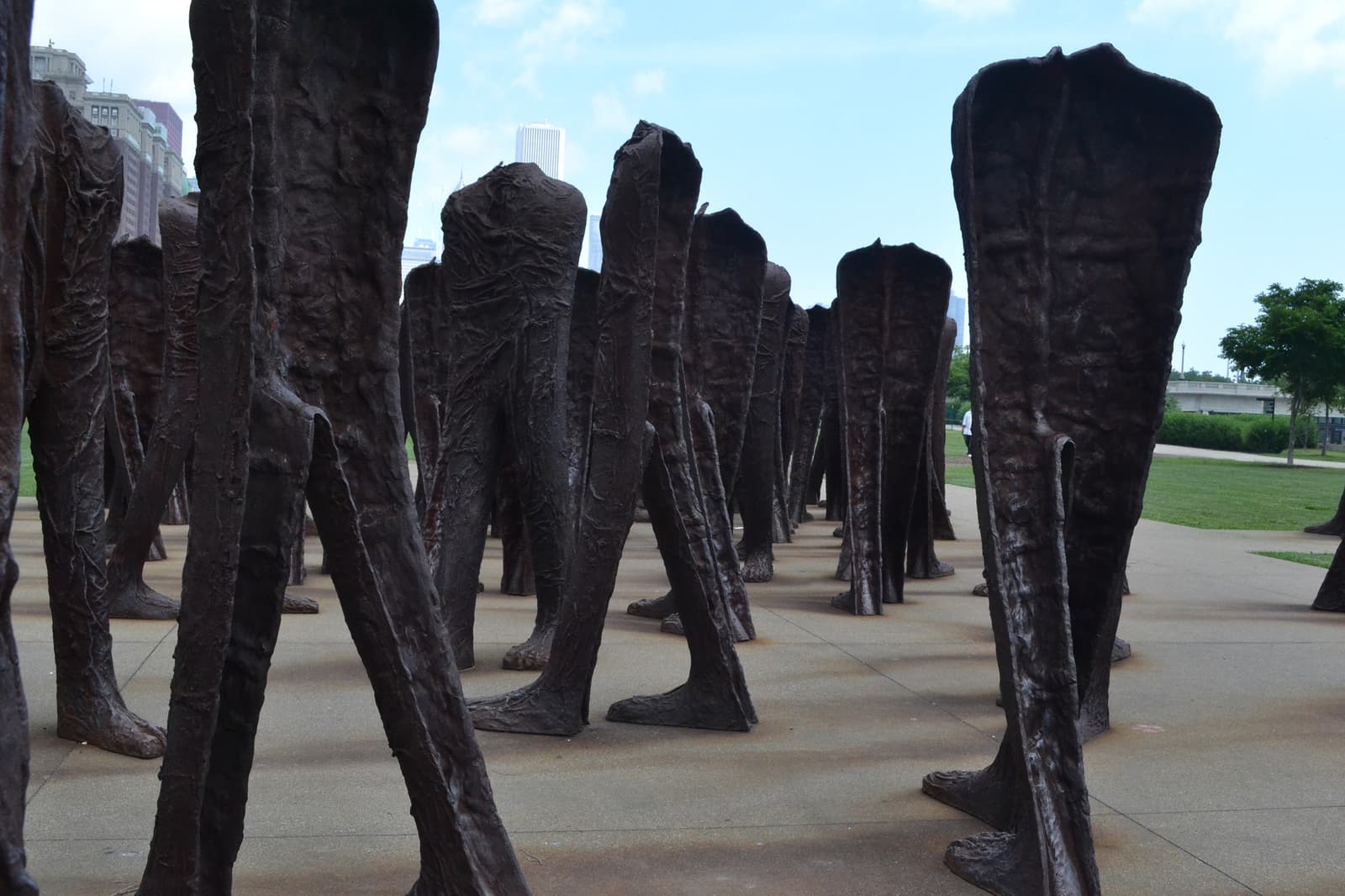
Magdalena Abakanowicz's Agora looks, at first, like an army that has forgotten its command. The figures are tall, rust-colored, headless, armless, and hollowed by weather. They stand in Chicago's Grant Park as if moving in several directions at once, some gathered into a mass and some pulling away from it. The effect is public and bodily before it is symbolic. You do not simply face the sculpture. You enter it.
That physical demand is the work's first intelligence. Installed in 2006, Agora consists of 106 cast-iron figures, each about nine feet tall, placed in groupings across the park's southern edge.[1] The title reaches back to the Greek word for a civic meeting place, but Abakanowicz makes the meeting unstable. The figures gather without faces. They seem to share a condition without sharing a destination. The public square becomes less a scene of democratic clarity than a test of how bodies behave when individuality has been reduced but not erased.[1]
The common mistake is to read the work as one blunt allegory: crowd equals conformity. Abakanowicz is sharper than that. The Chicago Park District description notes that some figures suggest movement, others stillness, and a few seem to separate from the larger group.[1] That variation matters because the sculpture does not imagine the crowd as a perfectly synchronized machine. It imagines a crowd as a pressure field, a place where likeness and difference keep grinding against each other.
The Figures Refuse Portraiture
The missing heads do the obvious work first. They deny portrait, speech, expression, gaze, and all the small facial signals by which sculpture usually builds sympathy. Without heads, the figures cannot meet the viewer as individuals in the familiar humanist way. Their backs, torsos, legs, and surfaces have to carry the argument.
That refusal belongs to a long arc in Abakanowicz's practice. The National Museum of Women in the Arts describes her as a pioneer of fiber-based sculpture and installation who moved from monumental hanging textiles, the Abakans, toward fragmented headless human forms in the 1970s, then into public commissions in bronze, wood, stone, clay, and other materials.[2] Britannica makes the same structural point from another angle: her later works often use repeated forms based on bodies, animals, or trees, similar in appearance and gesture but individually distinct.[3]
That is exactly the tension Agora enlarges. These bodies do not become anonymous because they are identical. They become anonymous because the features that normally anchor social recognition have been removed. Once that happens, small differences become more charged: a stride, a turn, a gap, a surface ridge, a hollow interior, a figure's slight withdrawal from the pack. The work trains the viewer to notice difference after portraiture has failed.
Iron Turns Vulnerability Into Weather
The material change matters. Abakanowicz's early reputation came through fiber: rope, burlap, sisal, canvas, and woven forms that made textile behave as sculpture.[2][3] In Agora, the surface is cast iron. That could make the work seem harder, more monumental, more permanent. Yet the iron does not cancel the vulnerability of the bodies. It gives vulnerability a public skin.
The figures look armored only from a distance. Up close, their surfaces are scarred, porous, wrinkled, and mottled. They suggest bark, flayed cloth, industrial residue, and bodies that have been hardened by exposure rather than protected from it. The hollow torsos intensify that feeling. They are massive enough to resist the park, but emptied enough to feel incomplete.
This is where the work's relation to Abakanowicz's biography should be handled carefully. The Chicago Park District page links her crowd imagery to her experience of World War II, Soviet domination, collective hate, collective adulation, marches, parades, and the suspicion that instincts and emotions can overpower intellect inside the mass.[1] The National Museum of Women in the Arts similarly notes that her art was affected by Nazi and Soviet occupation and its aftermath, while warning through the work itself that autobiography does not exhaust the sculptures' ambiguity.[2]
That boundary is important. Agora should not be reduced to a historical illustration of one trauma. It is stronger as a form that carries historical pressure without closing into one caption. The figures can recall wartime crowds, state parades, refugee movement, urban commuting, ritual procession, or the everyday numbness of passing through a city among strangers. The work stays alive because it lets those readings overlap without letting any single one settle the crowd.
Walking Is the Viewing Method
Abakanowicz's public sculpture often depends on quantity. The Metropolitan Museum's 1999 roof-garden release described her grouped, headless figural works as part of a broader late practice that drew cultural and political debate; Britannica lists Agora among her large permanent outdoor installations after earlier groups such as Katarsis, Becalmed Beings, and Space of Stone.[3][4] Quantity is not scale alone. Quantity changes how a viewer behaves.
With one figure, you could circle, compare, and possess the object visually. With 106 figures, the group exceeds quick comprehension. The viewer has to move through intervals: between legs, along backs, beside hollows, across openings where one body blocks another. The sculpture therefore makes walking part of reading. Its meaning arrives by parallax, not by frontal inspection.
That is why the site matters. Grant Park is already a civic space shaped by paths, skyline, traffic, tourism, festivals, and ordinary crossing. Agora does not float above that environment as a pure museum object. It interrupts the park's movement with another movement, a crowd that cannot get out of the way. The figures are not pedestrians, but they make pedestrians newly aware of themselves as a moving public.
The photograph used here catches that working condition.[5] It shows rows of figures receding across pavement, not isolated against a blank background. That matters because Agora is not a studio object enlarged outdoors. It is an installation whose argument depends on bodies, spacing, city air, and the viewer's own path. A clean cropped image of one figure would weaken the work by making the crowd manageable.
The Crowd Has No Center
Many public monuments organize attention around a hero, axis, pedestal, or event. Agora refuses that grammar. There is no central figure to interpret the others, no leader with a raised arm, no privileged face, no easy entry plaque that explains the emotional order of the group. The installation is all middle.
That all-middle structure is what makes the work unsettling. In a conventional monument, the viewer is often asked to admire from outside. Here, the viewer becomes one more body negotiating a field of bodies. The sculpture does not accuse the viewer directly, but it removes the comfort of detachment. To understand the crowd, you have to join its space.
The headlessness is therefore not only a loss of identity. It is a redistribution of attention. Because there are no faces, the viewer looks at spacing, backs, direction, posture, rhythm, and the relation between one hollow body and the next. The crowd becomes legible as arrangement rather than as expression. That is the work's harsher public lesson: collective life is often organized through position before it is organized through understanding.
At the same time, Abakanowicz does not flatten the figures into pure victims. Their scale gives them force. Their stride suggests agency even when destination is unclear. Some seem to move against the mass, or at least at an angle to it.[1] The work's pathos depends on that ambiguity. These are not simply people crushed by the crowd. They are figures whose individuality persists as pressure, contour, and deviation after the face has disappeared.
That is why Agora remains a strong public artwork rather than only a memorable Chicago landmark. It makes the crowd physical without making it simple. It turns a meeting place into an anxious passage. It asks whether bodies can remain distinct when history, city life, and collective emotion push them into repetition. Abakanowicz's answer is neither comfort nor despair. The figures keep standing, keep moving, keep refusing to become one body. The crowd is real, but so is the gap between each figure.
Sources
- Chicago Park District, "Agora | Artwork" - official page for the 2006 Grant Park installation, including artist, location, 106 nine-foot cast-iron figures, title meaning, funding, construction, and crowd context.
- National Museum of Women in the Arts, "Magdalena Abakanowicz" - artist profile covering fiber-based sculpture, Abakans, headless fragmented figures, public commissions, and historical context.
- Encyclopaedia Britannica, "Magdalena Abakanowicz" - biographical overview of Abakans, repeated body-based forms, later outdoor installations, and Agora as 106 headless and armless cast-iron figures.
- The Metropolitan Museum of Art, "Abakanowicz on the Roof" - 1999 press release on Abakanowicz's figural groups, Abakans, materials, public sculpture, and cultural-political debate.
- Wikimedia Commons, "File:Endless March (40402890).jpeg" - Frank Skornia's 2013 real photograph of part of Agora in Grant Park, used as the article image source.