The most durable thing about Cybernetic Serendipity is not that it put computers in an art gallery. That sounds tidy now, almost inevitable. Its real achievement was messier and more useful: it made the computer feel like a gallery problem before "computer art" had settled into a category.
Mounted at London's Institute of Contemporary Arts in 1968 and curated by Jasia Reichardt, the exhibition gathered art, music, poetry, film, machines, engineering demonstrations, games, and responsive objects under one experimental roof.[1][2] The ICA's own archive frames it as the first international exhibition in the United Kingdom devoted to the relationship between the computer and the arts, with more than 130 participants and about 60,000 visitors.[1] Those numbers matter, but they do not explain the charge of the show. The charge came from the refusal to keep art on one wall and computation in another room.
Reichardt's title was precise. "Cybernetic" pointed toward systems of control, feedback, communication, and behavior. "Serendipity" protected the show from becoming a sales pitch for technological mastery. The exhibition was not a clean prediction that computers would soon replace artists. It was a public test of what happened when artists, engineers, composers, programmers, poets, designers, and viewers let machines interrupt their usual roles.[1][3]
Not a Computer Art Showcase
One easy mistake is to read Cybernetic Serendipity as an early version of a digital-art survey. That flattens it. The exhibition's strength was not medium purity. It was cross-contamination. The ICA documentation describes a show concerned with the "computer and the arts," but the material range was much wider than screen output or plotted graphics.[1] Studio International's 1968 special issue, published alongside the exhibition, likewise treated the computer as one part of a larger cultural question about generative procedures, cybernetics, music, drawing, language, and machine collaboration.[3][4]
That distinction changes the historical reading. A digital-art survey asks whether the computer can make art. Cybernetic Serendipity asked what sort of situation appears when the computer enters an already unstable field of modern art, design, communication theory, and public spectatorship. It treated computation less as a tool and more as a condition: something that rearranged authorship, chance, timing, perception, and response.
The result was uneven by design. Some works looked like graphic experiments; some sounded like procedural music; some behaved as kinetic sculpture; some invited visitors to play. The point was not to prove that all of them were equally mature as artworks. The point was to let the gallery become a testing ground for relations among instruction, machine action, and human attention.
Feedback Became Theater
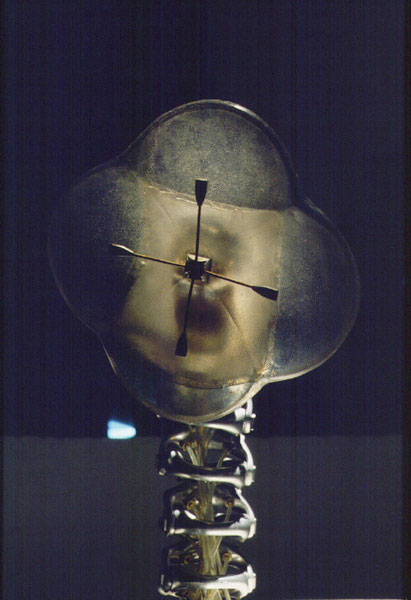
Edward Ihnatowicz's SAM makes that shift visible. The archival photograph used here shows the responsive robotic sculpture in the exhibition space rather than as a clean technical diagram.[2] That matters. SAM was not only an object to inspect. It was a behaving presence, a machine whose interest depended on detection, motion, and the viewer's changing sense that the artwork was noticing the room.
In a conventional sculpture gallery, the viewer moves and the object stays put. In SAM, that contract bends. The machine's responsiveness turns looking into a loop: the viewer watches the machine, the machine responds to stimulus, and the viewer adjusts behavior in return. Whether the mechanism was simple or sophisticated by later standards is not the main issue. The exhibition made response itself theatrical.
That is why the show still feels contemporary. Many later arguments about interactive art, installation media, responsive architecture, interface design, generative systems, and AI aesthetics begin with a similar problem: the artwork is no longer only a finished surface. It is a rule-bound situation that unfolds through contact. Cybernetic Serendipity gave that problem public form before the vocabulary around it had hardened.
The Exhibition Was Also a Publishing Machine
The 1968 Studio International issue is part of the work's afterlife, not just a record of it. Ragnar Digital's collection page treats Cybernetic Serendipity: The Computer and the Arts as a publication-object tied directly to the exhibition, and the online Studio International version preserves the sense that the show was making an argument through documentation as much as through installation.[3][4]
That matters because computational art is hard to preserve as a purely visual memory. A plotted drawing can be photographed. A responsive machine can be photographed. But the operational part - the instruction, timing, data path, sensor, relay, program, or behavior - often escapes the image. The publication helped stabilize a dispersed exhibition by giving it diagrams, essays, names, categories, and reproducible descriptions. It turned a room of experiments into a shareable field.
This is also where the exhibition's imperfections become historically useful. The show mixed artists and engineers in ways that could blur questions of credit. It brought institutional glamour to technologies that were still expensive, corporate, military, or academic in origin. It could be playful and structurally naive at the same time. But those frictions are not reasons to downgrade it. They are the very frictions later media art would keep working through: who owns the system, who authors the behavior, who maintains the apparatus, and who gets invited to participate.
Why It Reads Differently in an AI Moment
The ICA's later programming has explicitly returned to Cybernetic Serendipity as a reference point for thinking toward artificial intelligence.[5] That return is understandable, but it should be handled carefully. The 1968 show was not "about AI" in the contemporary product sense. Its importance is more structural. It showed how quickly art discourse changes when machines are treated as partners in selection, generation, reaction, and display.
Seen from 2026, the exhibition offers a useful antidote to two weak habits. The first is technological triumphalism, where every new machine is treated as an inevitable artistic revolution. The second is nostalgic dismissal, where early computer art is mocked for looking crude. Cybernetic Serendipity is stronger than both habits because it was not mainly a style. It was a staging of uncertainty.
The works did not need to look like mature contemporary media art to matter. They needed to change the questions available in the gallery. Could a poem be generated rather than composed line by line? Could music emerge from procedure? Could a sculpture behave? Could a viewer become part of a feedback circuit? Could an exhibition include engineers without turning into a trade fair? Could chance be organized without being domesticated?
Those questions remain active because the show made them physical. It did not simply announce that computers were coming. It asked visitors to stand near machines that drew, sounded, responded, processed, or played, and then to decide whether the old boundaries of art still made sense. That is why Cybernetic Serendipity remains more than a milestone in computer-art history. It is an early model of the gallery as a system under stress - a place where a machine could be a tool, collaborator, performer, problem, and mirror all at once.
Sources
- Institute of Contemporary Arts archive, "Cybernetic Serendipity: A Documentation" - official archive page for the 1968 exhibition, including dates, curator, participant count, attendance, and exhibition framing.
- Catherine Mason, "Cybernetic Serendipity: History and Lasting Legacy." Studio International, 2018 - historical essay with archival installation image of Edward Ihnatowicz's SAM and context for the ICA exhibition.
- Studio International, "Cybernetic Serendipity: The Computer and the Arts" - online version of the 1968 special issue tied to the exhibition and its computer-arts framing.
- Ragnar Digital, "Cybernetic Serendipity: The Computer and the Arts" - collection record for the exhibition publication, with bibliographic and object context.
- Institute of Contemporary Arts, "Cybernetic Serendipity: Towards AI" - later ICA program revisiting the exhibition's legacy in relation to artificial intelligence.