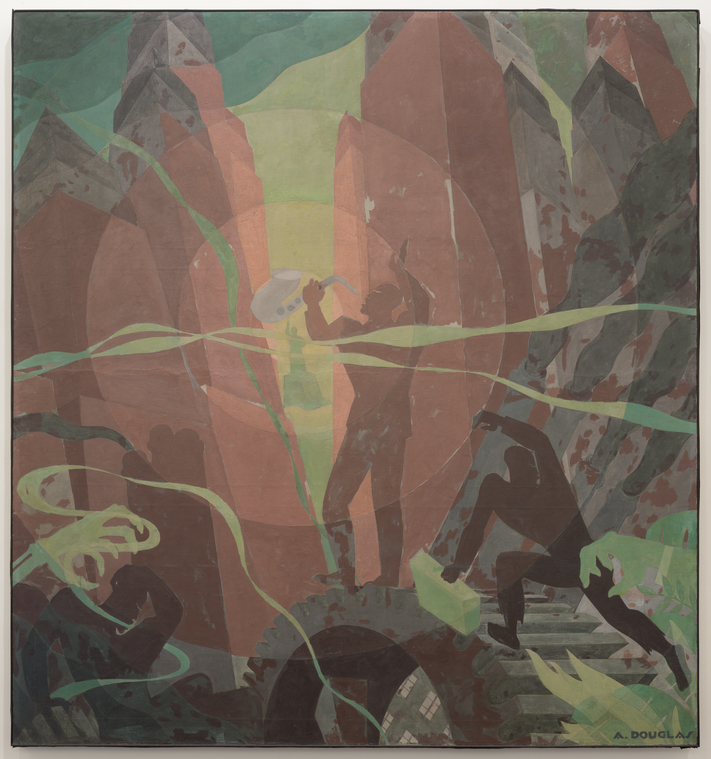
Aaron Douglas's Song of the Towers looks, at first, like a triumphant arrival scene. A Black saxophonist rises near the center. The Statue of Liberty stands in the distance. Industrial towers and smokestacks frame the city as a place of height, music, and public possibility. Yet the painting is not simply a celebration of Harlem modernity. Its power comes from refusing to let arrival feel settled. The city moves, but it also presses. The song lifts, but the machine keeps turning.[1][2]
That double rhythm is why this panel deserves close looking on its own. Song of the Towers is the fourth panel in Douglas's 1934 Aspects of Negro Life cycle for the 135th Street branch of the New York Public Library, now the Schomburg Center for Research in Black Culture.[1][2] The full cycle moves through African setting, slavery, Reconstruction, southern terror, migration, Harlem, and Depression-era modernity. In the NYPL audio guide, Tammi Lawson describes the final panel as Jazz Age arrival: smokestacks, Liberty, a figure on a treadmill-like wheel, a briefcase, and the speed of city life all converge in one image.[2] The key word is converge. Douglas does not separate freedom, labor, music, and pressure into neat historical chapters. He stacks them inside one modern city.
Image context: this is a real photographic reproduction of an oil-on-canvas mural panel in NYPL's Schomburg Center collection, not a diagram, chart, or generated visual. The image is right for the article because Douglas's argument is compositional: radiating bands, silhouette, machinery, skyline, and music all have to be read together rather than as isolated symbols.[1][2]
The saxophone is not decorative
The saxophonist is the panel's most seductive figure because he gives the city a voice. Douglas's silhouetted musician leans into sound as if the instrument were both personal expression and public signal. The surrounding circular bands make that sound visible. They are not background ornament; they behave like vibration, broadcast, and historical echo at once.
This matters because Douglas was not adding jazz as atmosphere. The National Gallery of Art describes him as one of the major visual artists of the Harlem Renaissance and notes that his mature language joined African art, cubism, and art deco into what became a visual signature of the movement.[3] In Song of the Towers, that signature does not merely style a subject. It gives music a structural role. The saxophone becomes the form through which Harlem's modern Black culture can be seen as force: not a local entertainment detail, but an organizing energy inside the city.[3][4]
The Met's Harlem Renaissance transcript helps clarify the broader stakes. Its discussion of Douglas stresses his interest in a journey from African homeland to a modern Black community in the United States, with struggle, labor, tragedy, possibility, and triumph held together rather than sorted into clean optimism.[4] The saxophonist carries that compression. He is not outside history, playing above it. He stands inside the machinery of migration, work, aspiration, and public visibility.
Liberty is visible, but not sufficient
The Statue of Liberty might seem to solve the mural by naming freedom. Douglas does not let it. Liberty appears in the distance, legible and important, but she is not the dominant body in the panel. She is one sign among several: promise, national symbol, harbor marker, city emblem, and perhaps a standard against which the rest of the picture is measured.[1][2]
That restraint is crucial. If Liberty ruled the image, Song of the Towers would become a simple civic allegory: migration north equals access to freedom. Instead, Douglas sets Liberty beside smokestacks, mechanical wheels, dense towers, and a human figure caught in labor's rotation. The promise remains, but the conditions of modern urban life crowd around it. Freedom is present as a symbol before it is secure as lived experience.
This is where the panel's place in the cycle matters. NYPL's guide describes the preceding panels as moving through enslavement, southern labor, violence, Reconstruction, and the northward call of migration.[2] The final panel cannot then pretend that Harlem arrival erases the past. It must ask what freedom becomes after the train reaches the city. Douglas's answer is neither despair nor easy uplift. It is motion under pressure.
The wheel turns arrival into labor
The most unsettling figure in Song of the Towers is the worker bound to the circular machine. The posture is compact and almost trapped, as if the body's forward motion has been converted into a repetitive system. Lawson's NYPL audio-guide description names the treadmill-like quality directly: the person is in the city, carrying the briefcase, and things are moving.[2] That movement is ambiguous. It can mean opportunity. It can also mean being absorbed into a work rhythm that never quite releases the body.
Douglas's genius lies in keeping that ambiguity visible. The circular bands around the musician and the circular form of the wheel answer each other. One circle suggests sound expanding; the other suggests labor cycling. Both are modern. Both are forms of energy. But one opens outward while the other keeps returning the worker to the same point.
That visual rhyme prevents the mural from becoming a postcard of the Harlem Renaissance. The city is not only nightlife, style, and cultural arrival. It is also wage labor, industrial discipline, crowded systems, and the Depression-era question of whether modernity will liberate the worker or make motion feel compulsory. Leah Dickerman's account of the cycle is useful here because it treats Aspects of Negro Life as Douglas's answer to a federal call for an "American scene."[5] In this panel, the American scene is not a countryside or a flag ceremony. It is the machine-age city as Black historical threshold.
The towers make progress vertical and severe
The title's towers are not neutral architecture. They rise like industrial organs: smokestacks, shafts, and hard verticals that organize the mural's air. Their height gives the panel momentum, but it is not the soft upwardness of spiritual ascent. It is engineered height: pipes, stacks, buildings, pressure.
That matters because Douglas's style is often so beautiful that viewers can underread its severity. The silhouettes are elegant. The colors are controlled. The circles give the image a musical pulse. But the formal control is not decorative politeness. It is how Douglas makes historical pressure readable without turning the mural into illustrated prose. The city is simplified because simplification lets relations sharpen: musician to machine, Liberty to smokestack, sound to labor, arrival to constraint.[1][2][3]
The National Gallery's biography places Douglas's visual language in relation to modernist abstraction and art deco as well as African art.[3] Song of the Towers shows why that synthesis mattered. Art deco's streamlined geometry can make modern machinery look glamorous; Douglas uses that glamour but refuses to surrender to it. The towers look powerful, but their power is not innocent. They are the architecture of opportunity and the architecture of discipline at the same time.
A public mural that still feels unresolved
NYPL's audio guide notes that the four Aspects of Negro Life panels were made on canvas rather than directly on a wall, and that the Schomburg Center's Latimer Gallery was later created so the murals could be seen by the public.[2] That display history is not incidental. Douglas made a public history image for a library: a place of archive, instruction, and community memory. The mural had to be legible, but legibility did not mean simplification into morale.
The Met transcript makes a similar point about the Harlem Renaissance as more than a local style label. Its speakers frame the movement as a Black modernist effort to add self-defined histories, forms, and futures to American culture rather than merely asking to be included in an existing story.[4] Song of the Towers is powerful because it does exactly that. It does not beg the city to recognize the saxophonist, the worker, or the migrant. It builds a city in which their relation is the subject.
That is why the panel still feels alive. The painting does not ask whether the city is good or bad. It asks what kind of modernity Black arrival has entered. The answer is a chord rather than a slogan: Liberty seen but distant, music rising but disciplined by design, labor moving but caught in rotation, towers promising ascent while hardening into machine form.
Song of the Towers lasts because Douglas understood that a modern Black future could not be painted only as release. It had to include the systems waiting at the point of arrival. The saxophone gives the mural breath. The wheel gives it strain. The towers give it height. Together, they make Harlem modernity feel neither defeated nor solved, but charged: a city song played from inside the machine.[1][2][3][4][5]
Sources
- The New York Public Library Digital Collections, "Aspects of Negro Life: Song of the Towers" - item record for Aaron Douglas's 1934 oil-on-canvas panel, with Schomburg Center collection data and image source.
- The New York Public Library, "Aaron Douglas's Aspects of Negro Life Murals" - Schomburg audio-guide transcript on the four canvas murals, their historical sequence, the final panel's Jazz Age city imagery, and the Latimer Gallery display context.
- National Gallery of Art, "Aaron Douglas" - artist biography on Douglas's Harlem arrival, The New Negro context, and the synthesis of African art, cubism, and art deco that became a Harlem Renaissance visual signature.
- The Metropolitan Museum of Art, "Harlem Is Everywhere: Episode 1, The New Negro" - transcript on the Harlem Renaissance, Great Migration context, and Douglas's role in visualizing African American historical movement and modern Black community.
- Leah Dickerman, "Aaron Douglas and Aspects of Negro Life," October 174 (2020) - article on Douglas's 1934 four-panel mural cycle for the 135th Street branch library and its answer to the Public Works of Art Project's American-scene mandate.