Lee Miller's career is easy to split into convenient lives: model, muse, Surrealist, fashion photographer, war correspondent, witness, survivor. The split is tidy and wrong. The sharper reading is that Miller kept moving one visual intelligence through different assignments. She learned how surfaces lie, how chance can open a picture, how bodies become symbols, and how the camera can make the ordinary look suddenly unstable. Then the war gave that intelligence no safe place to hide.[1][2][4]
That is why Miller matters as more than a vivid biography. She does not belong to art history only because Man Ray photographed her, Picasso painted her, or later museums recovered her reputation. Her work matters because it makes Surrealism answer to fact. Getty's exhibition framing is useful here: Miller was both a source of inspiration for other artists and a creative photographer whose work embraced Surrealism across portraiture, fashion, and journalism.[2] MoMA's artist page keeps the same breadth in view by placing her under Surrealism, photojournalism, and studio photography at once.[1] Those categories can look contradictory only if we assume the strange and the factual must live in separate rooms.
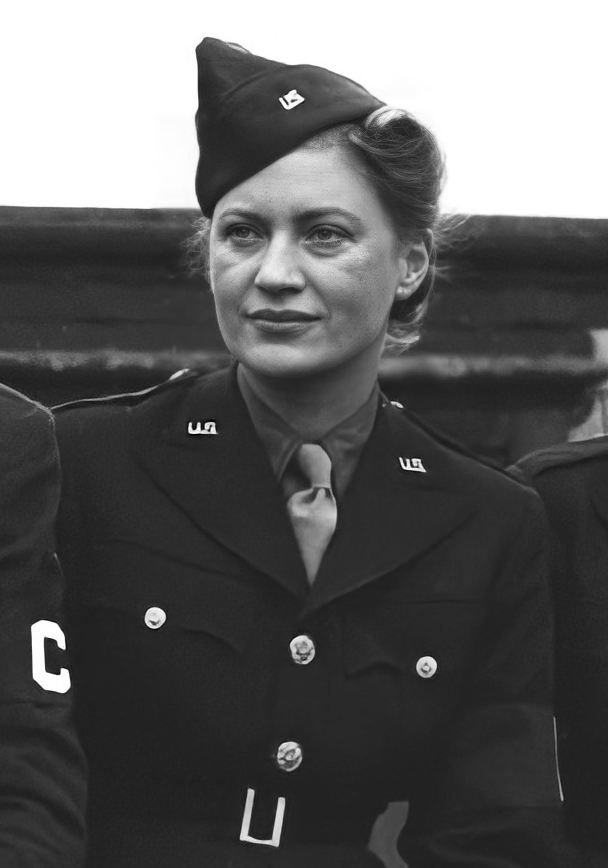
Image context: the lead image is a real archival photograph, not a diagram, chart, or generated visual. It shows Miller in 1943 as a female war correspondent covering the U.S. Army in Europe, and it anchors the profile's core claim: the wartime Miller was not a late detour from the Surrealist Miller, but the point where her eye for rupture met events that had already ruptured the world.[6]
The Muse Who Crossed Behind the Camera
Miller's early fame came from being seen. MoMA's account of her career begins with the 1927 Vogue cover that launched her as a model and follows her move toward Paris, Man Ray, and the declaration that she would rather take a photograph than be one.[1] That sentence is often repeated because it sounds like emancipation, but its real force is technical. Miller did not simply change sides from object to subject. She learned how images are constructed, how beauty can be arranged, and how a face can be turned into cultural currency.
That background could have trapped her. Instead, she used it as training. In Paris, she entered Man Ray's studio and the Surrealist circle, where chance, doubling, distortion, and darkroom accident were not embarrassing residues but working methods.[1][2] MoMA and Getty both stress her connection to solarization, the tone-reversal process associated with Man Ray and Miller's darkroom work.[1][2] The point is not priority alone. Solarization is a useful emblem for her career because it makes an image turn against its own surface. Light becomes outline. Familiar flesh becomes edged, spectral, and slightly hostile. A photograph stops behaving like simple likeness.
That habit stayed with Miller after she left Paris. In New York, Cairo, London, and eventually Europe at war, she kept finding scenes where ordinary visual order had cracked. A fashion picture could contain unease. A desert view could become estranged geometry. A hospital glove rack could look like rows of severed hands. Surrealism, for Miller, was not decoration pasted onto life. It was a way of noticing when reality had already become uncanny.[1][3][5]
Fashion Was Not an Escape Hatch
The fashion work matters because it trained Miller in artifice without making her a servant of it. She understood staging, lighting, surface, costume, and editorial appetite. Britannica notes that after returning to New York she ran a studio with her brother, did celebrity portraiture, advertising, Surrealist work, and Vogue photography; later in London she became a prolific contributor to British Vogue.[4] Those contexts gave her a command of magazine language before the war forced that language into harder use.
It would be too easy to say that war made fashion irrelevant. Miller's stronger achievement is that she brought magazine fluency into places where glamour failed. During the Blitz, she photographed Britain under fire, and the war years redirected Vogue from elegance alone toward evidence, labor, ruins, and survival.[4][5] The page had to hold different kinds of looking: formal composition, editorial sequence, human risk, and factual record. Miller was ready for that mixture because she had never treated photography as a neutral window.
Smithsonian's reconstruction of her wartime career makes the continuity especially visible. It describes Miller processing her own images of war-torn London in Vogue's offices, contributing photographs to Grim Glory, and then moving from sanctioned non-combatant stories into the harder reality of St. Malo when the assignment turned out not to be a liberated-town feature but a battle.[5] The episode matters because it shows how little her career can be reduced to style. When the facts became dangerous, Miller did not retreat into the protection of aesthetic distance.
St. Malo Tested the Eye
The Lee Miller Archives FAQ is blunt about the gendered limits around war reporting. It notes that women reporters were generally allowed to cover non-combatant stories, while Miller's second assignment at St. Malo unexpectedly put her in a four-day battle; the U.S. Army even placed her under house arrest afterward for violating accreditation terms.[3] The institutional boundary is revealing. Miller's presence near combat was treated as an administrative problem precisely because she had moved beyond the role assigned to her.
St. Malo also tested the moral use of a Surrealist eye. The danger in applying Surrealism to war is that devastation can become picturesque strangeness. Miller's best wartime work resists that. She was drawn to fragments, shocks, and grotesque juxtapositions, but the oddness does not make violence theatrical. It makes violence harder to normalize. Smithsonian's account of her St. Malo manuscript describes a firsthand text built from ruined streets, bodies, waiting, and the ugly intimacy of battle.[5] That is not dream logic replacing fact. It is fact arriving in fragments because the event itself has shattered ordinary perception.
This is where Miller differs from a photographer who merely imports avant-garde style into reportage. She does not turn war into a Surrealist game. She recognizes that war has produced its own terrible surrealism: roomless windows, dismembered objects, bodies and domestic interiors forced into the same field. The camera's job is not to make that condition prettier or stranger than it is. The job is to keep the viewer from smoothing it back into heroic narrative.
Dachau Made Belief a Visual Problem
Miller's front-line work reached its hardest ethical point at the liberated camps. Britannica records that she photographed the liberation of Dachau and Buchenwald, producing some of the early photographic evidence of Nazi atrocities.[4] Smithsonian adds the editorial pressure behind those images: she and David E. Scherman were among the first press members to enter Dachau, and Vogue later published the camp photographs under the imperative heading "Believe It."[5]
That word matters. The camp photographs were not only records of what had happened. They were arguments against disbelief. Miller understood that atrocity could exceed ordinary credibility, especially for readers encountering it at magazine distance. The problem was not simply to show horror. It was to make the image withstand denial. A photographer trained in the instability of appearances now had to use that training in reverse: not to unsettle reality into dream, but to force reality through the defenses of people who might call it unbelievable.
This is why the familiar story of Miller in Hitler's bathtub should not be treated as a detachable icon. Britannica places the photograph after Dachau, when Miller and Scherman went to Hitler's Munich apartment; Scherman photographed her in the bathtub with muddy boots on the bathmat.[4] Smithsonian notes the same sequence and emphasizes that it occurred on April 30, 1945, the day Hitler died.[5] The image is theatrical, but not empty theater. It stages the collision between private hygiene, military mud, domestic banality, and historical guilt. The Surrealist object lesson has become a war photograph.
Recovery Without Simplification
Miller's posthumous recovery has its own caution. Britannica says Antony Penrose and his wife discovered a huge archive of negatives, prints, contact sheets, documents, and writings after Miller's death, and that his work helped restore a career largely forgotten by the art world.[4] Smithsonian tells the same rediscovery story through the attic manuscript of St. Malo and the family effort to preserve Miller's legacy.[5] Without that recovery, she might have remained too easy to misfile as Man Ray's muse, Vogue beauty, or wartime anecdote.
But recovery can create another simplification. Miller does not need to be rescued by making every stage of her life triumphant. The better profile keeps the contradictions alive. She was photographed and she photographed. She made fashion and war images. She used Surrealist methods and documented literal atrocities. She appears in one of the most staged wartime portraits of the twentieth century, yet her strongest work insists on the brute presence of fact.
That is the reason her art still cuts through. Miller knew that the camera could seduce, distort, certify, and accuse. She had lived on both sides of that machinery. When history became unbearable, she did not abandon the strange eye she had developed in the studio and the darkroom. She made it face the front line. The result is a career in which Surrealism stops being an escape from reality and becomes a discipline for seeing reality after it has broken its own rules.[1][2][3][4][5][6]
Sources
- The Museum of Modern Art, "Lee Miller" - artist page identifying Miller's dates, online works, exhibitions, and associated terms including Surrealism, photojournalism, and studio photography.
- J. Paul Getty Museum, "Surrealist Muse: Lee Miller, Roland Penrose, and Man Ray" - exhibition page on Miller as model, source, and creative photographer whose work spans portraiture, fashion, journalism, and Surrealism.
- Lee Miller Archives, "FAQs" - institutional notes on Miller's wartime accreditation, St. Malo, women correspondents, darkroom practice, and the archive's stewardship context.
- Naomi Blumberg, "Lee Miller," Encyclopaedia Britannica - biography covering Miller's Surrealist work, Vogue career, Blitz and front-line reporting, Dachau, Hitler's bathtub, later life, and archive recovery.
- Eli Wizevich, "The Real Story Behind the 'Lee' Movie and Lee Miller," Smithsonian Magazine (September 27, 2024) - reported overview of Miller's multiple careers, St. Malo manuscript, war coverage, Dachau, and posthumous legacy.
- Wikimedia Commons, "File:War correspondents-Lee-Miller.jpg" - source page for the 1943 U.S. Army photograph of Lee Miller used as this article's cover image.