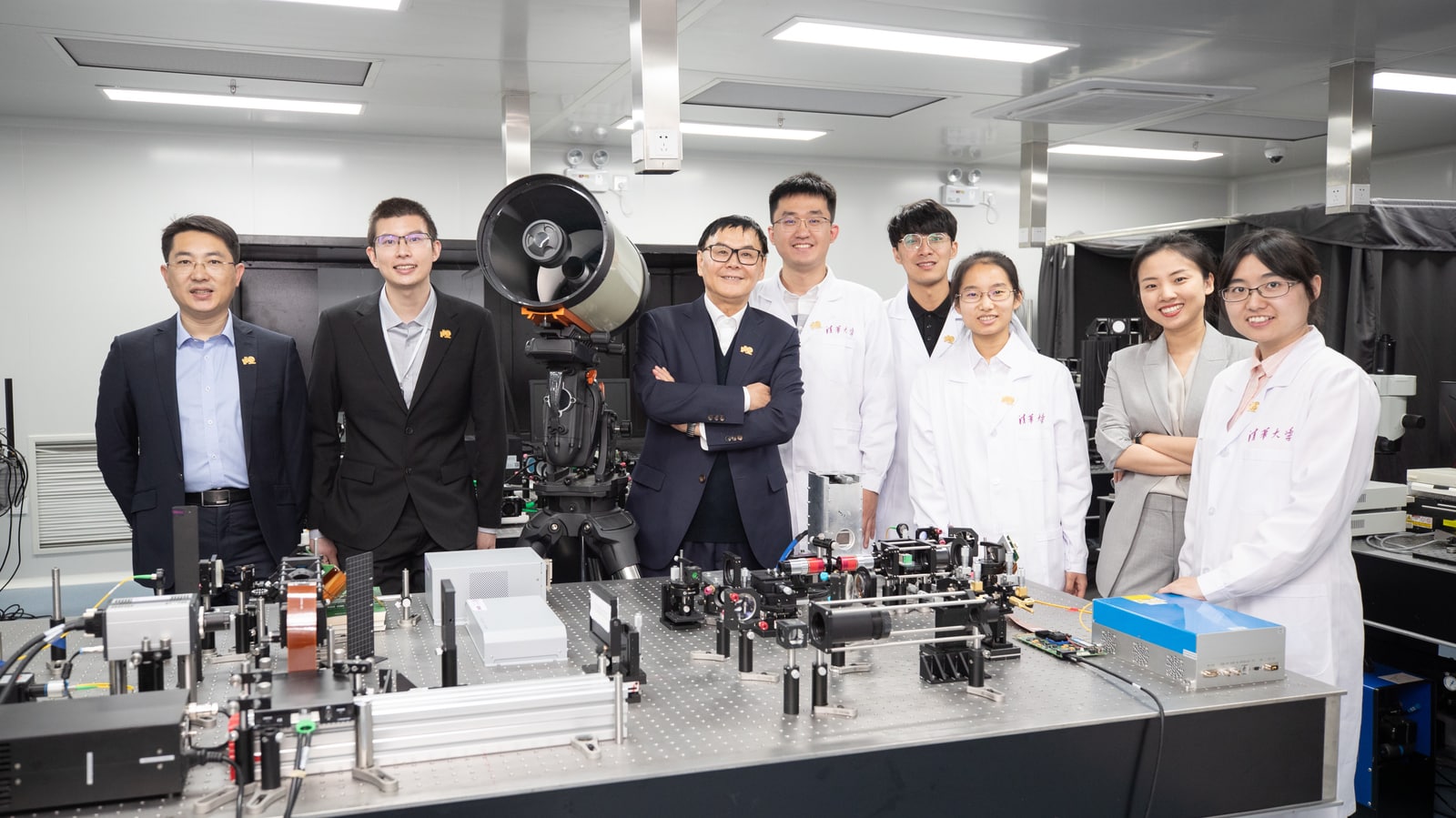
Light can carry a calculation through an optical circuit, but making that circuit larger introduces a stubborn problem: physical errors can accumulate along the way. Speed alone does not make a useful neural network. The machine must preserve enough of the intended calculation to reach the right answer.[1]
Tsinghua University's Taichi research approached this problem by changing how the work is divided. Its April 2024 chiplet paper explored a distributed optical architecture; a second paper, published online in August, addressed learning directly on physical optical systems.[1][4] Read together, these experiments reveal an important part of China's AI hardware research: the search for a computing stack whose organization suits its physical medium.
Give the light a wider workload
The original Taichi design combines two optical techniques. Diffraction supplies highly parallel processing, while interference supplies reconfigurable computation. The researchers join them in an encoding, feature-processing, and decoding arrangement, with a distributed protocol that breaks larger tasks into smaller pieces.[2]
Tsinghua describes this as expanding across width. A large problem becomes a collection of subproblems assigned to optical chiplets, with their results brought back together. This addresses the difficulty of pushing a complicated calculation through an increasingly deep chain of imperfect physical operations.[2]
For a reader accustomed to processor specifications, the consequential part is the division of labor. The architecture determines which work reaches each optical component and how the answers become useful again. A fast component needs that surrounding organization before it can tackle a larger task.
The chiplets also combine physical functions that would otherwise be easy to discuss separately. Taichi's contribution includes the relationship between those functions: how an input is encoded, transformed, and recovered. That relationship is why the work belongs in a discussion of computing infrastructure alongside the device itself.[2]
Keep the experiment attached to the number
The April paper reports energy efficiency of 160 trillion operations per second per watt, and 91.89% accuracy on a 1,623-category Omniglot character-classification task. These are results from the authors' optical computing experiments. They establish a concrete demonstration of larger-scale photonic computation; they do not measure the cost of serving a contemporary language model.[1]
The companion data release makes the experimental boundary unusually tangible. In Dryad, the team supplies prepared versions of CIFAR-10, mini-ImageNet, Omniglot, and Bach chorales. Its documentation says images were resized or cropped, training and testing splits reorganized, and inputs adapted to the optical hardware's requirements.[3]
That preparation is part of the system. A benchmark's familiar name does not guarantee that two machines received identical inputs or followed identical evaluation procedures. Anyone attempting a comparison needs the actual preparation and split, alongside the model and measurement method.
The deposit is therefore useful for more than reproduction. It exposes the point where a general dataset becomes a workload the device can accept. For an emerging computing platform, that conversion is an engineering achievement—and a dependency that must travel with the reported result.[3]
Let the physical system participate in learning
The August work tackles a different dependency. Training an optical neural network through a digital simulation requires a sufficiently faithful description of the physical apparatus. A mismatch between the modeled system and the real one can undermine the intended calculation.[4]
The researchers' fully forward mode method uses spatial symmetry and optical reciprocity to obtain learning information through forward propagation. Data and error signals pass through the physical system; measured light fields provide the information used to calculate gradients and update parameters.[4]
The distinction matters. Training still involves an objective, an error, and parameter updates. The contribution is a physical route to the information those updates need, reducing dependence on numerical modeling. The paper demonstrates the method in both free-space and integrated optical systems.[4]
Tsinghua's Chinese-language announcement, dated August 9, 2024, calls the training chip Taichi-II and explicitly distinguishes the earlier inference work from this training advance. It also describes movement toward industrialization from prototype devices.[5] That is a dated statement of research direction, rather than evidence that a complete commercial platform was already available.
The platform is the next object to measure
My reading of the two studies is that their strongest shared contribution is organizational. One arranges a larger workload across optical components; the other makes the physical system more directly involved in learning. Each reduces a particular obstacle between an attractive device and a useful machine.
The next persuasive demonstration would carry an unfamiliar workload through the entire process: input preparation, training or model mapping, optical execution, and output recovery. It would report elapsed time and energy for that complete task, explain what surrounding equipment was counted, and show whether the result survives repeated operation.
Those measurements would also make the supply-chain questions concrete. Which components need custom fabrication? Which adjustments require laboratory expertise? Which steps can software repeat reliably on another unit? These are questions for assessing deployment, not shortcomings established by the two papers.
Taichi gives that assessment something substantial to start from. Its 2024 experiments show how optical AI can grow by reorganizing computation and learning around the hardware. The longer journey is making that organization reproducible enough for someone outside the originating laboratory to use.
Sources
- Zhihao Xu et al., “Large-scale photonic chiplet Taichi empowers 160-TOPS/W artificial general intelligence,” Science, April 12, 2024; original research abstract and publication record.
- Tsinghua University, Department of Electronic Engineering, “Introducing Taichi,” 2024; distributed architecture, hybrid chiplets, and laboratory team photograph.
- Zhihao Xu et al., Taichi experimental dataset, Dryad, April 2, 2024; prepared inputs, resizing, and training/testing split documentation.
- Zhiwei Xue et al., “Fully forward mode training for optical neural networks,” Nature, published online August 7, 2024; full paper in PubMed Central.
- Tsinghua University, “Tsinghua interdisciplinary team advances intelligent optical computing training,” August 9, 2024; Chinese-language first-hand announcement of Taichi-II and its relationship to the earlier inference work.