A red light interrupts the Qinghai–Tibet Highway. Beside it, Tibetan antelopes are waiting to cross. In a September 2, 2026 report from Wudaoliang, People’s Daily described police watching long-range camera feeds and remotely stopping traffic for the migrating herd. The signal was already doing useful work. An officer still decided when it should change.[1]
That scene gives China’s wildlife AI a precise job to grow into: notice an approaching herd early enough for people to make room. The useful output would be time—a quieter interval in which the animals can continue their journey.
Look beyond the asphalt
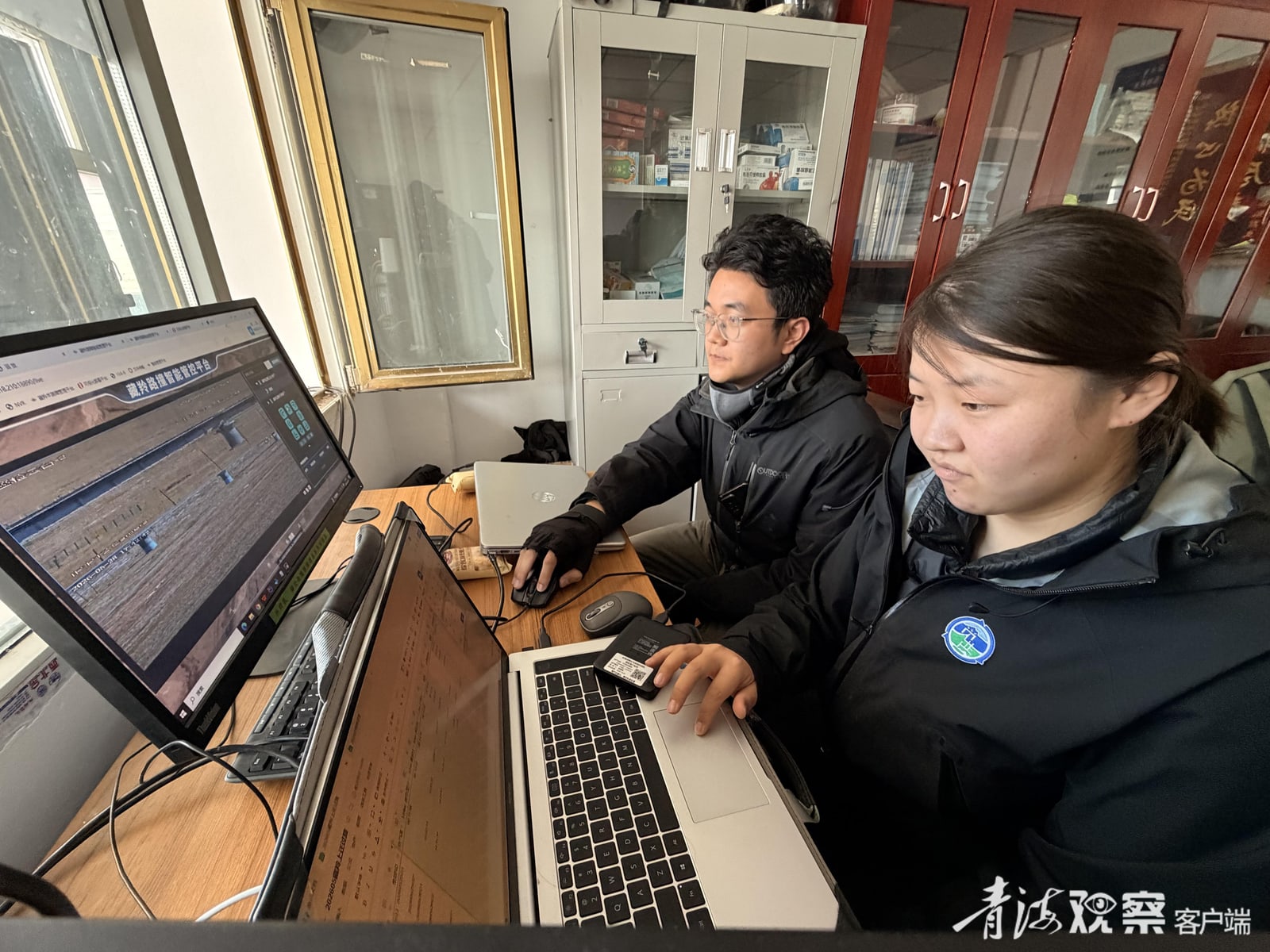
A June 8 Qinghai Daily field report, reproduced by the Chinese Academy of Sciences’ Northwest Institute of Plateau Biology, described an expansion from two cameras to eleven. The earlier pair watched the road; the larger network also covered the gathering area near Wubei Bridge. Researchers were collecting footage across weather conditions and times of day to train recognition and counting models.[2]
The change in viewpoint is revealing. A camera trained only on the carriageway can record that an animal has arrived. Watching the approaches offers a chance to intervene before arrival. My reading of this project is that its most consequential design choice may be where the cameras look. A more accurate detector cannot recover a warning opportunity that falls outside its view.
A crossing begins before the first hoof reaches the road
The ecological reason for looking outward predates the AI project. Lin Xia and colleagues’ 2007 Oryx paper examined the migration corridor during railway construction, using observations from 2003 and 2004. Their work documented how passage use depended on construction disturbance, vegetation recovery, wolves and the physical character of the crossing.[3]
Even recording the movement required adaptation. In the 2004 observation period, rain and snow limited camera recording; researchers supplemented the footage with telescope counts. A bridge could offer a route through infrastructure while the conditions around it still discouraged passage.[3]
Those findings suggest a broader definition of a successful warning system. Counting bodies on the road measures only one stage. The waiting area, the approach and the point where animals finally resume movement also belong in the account. If a herd turns away before entering the camera’s designated crossing zone, a spotless record of completed crossings could conceal the missed opportunity.
A later study makes the traffic problem more specific. Han Ru, Jinliang Xu and Shoufang Jiang observed antelopes along the highway in June–July 2018 and published their findings in January 2022. Crossing success was lower at higher traffic volumes. They also compared passing vehicles, stopped vehicles and stops in which someone got out. The last condition produced the strongest behavioral disturbance within the affected roadside area.[4]
The authors called the study preliminary and short-term. It supplies evidence that traffic management matters; it does not establish an all-season rule for an AI controller.[4] The practical implication is nevertheless clear: an intervention should create space without turning the waiting herd into a roadside attraction.
A working signal and an unfinished claim
By the 2026 return migration, remote operation had reduced officers’ need to stand outside stopping vehicles, according to the September report. Staff still sometimes went to the road to maintain order.[1] Moving the observation point indoors can therefore be a meaningful improvement even while the decision remains with an officer.
The AI claim needs its own date stamp. The June account proposed automatic recognition, counting and warnings, with a warning-function trial planned for the return migration.[2] The September account establishes remotely operated lights. It does not establish that an algorithm was triggering them.[1]
That distinction matters when assessing deployment. A camera installation, a trained model, an alert reaching an operator and a successful traffic intervention are separate accomplishments. Evidence for one should lead to a question about the next. Here, the documented control arrangement provides a place for future AI alerts to be useful, without requiring us to assume that those alerts already work.
Judge the pause it makes possible
The next convincing evaluation would follow an approaching herd through the whole encounter. How much warning arrived before the animals reached the road? Did staff receive it in time? Did traffic stop where it should? Did the herd cross, hesitate or retreat? These are proposed measures of usefulness, not reported results from the project.
Missed approaches would matter alongside false alarms. So would weather, visibility and the burden of repeatedly asking an officer to inspect an uncertain detection. A model could count accurately in selected footage yet offer little help at the moment someone needs to act.
Wudaoliang makes the promise unusually tangible. Better recognition would earn its place by helping create a timely, quiet pause in a busy road. The final evidence would be a herd able to keep moving.
Sources
- Qiao Dong, “Traffic lights on the Tibetan antelope migration route,” People’s Daily, September 2, 2026; reporting on police-operated signals.
- Qinghai Daily, field report on antelope monitoring, June 8, 2026; CAS-hosted Chinese original, camera expansion, proposed AI trial and photograph.
- Lin Xia et al., “The effect of the Qinghai-Tibet railway on the migration of Tibetan antelope Pantholops hodgsonii in Hoh-xil National Nature Reserve, China,” Oryx 41(3), 2007, pp. 352–357.
- Han Ru, Jinliang Xu and Shoufang Jiang, “Experimental Observation and Analysis of Traffic Impact on Tibetan Antelopes on the Qinghai-Tibet Highway,” Advances in Civil Engineering, January 17, 2022.