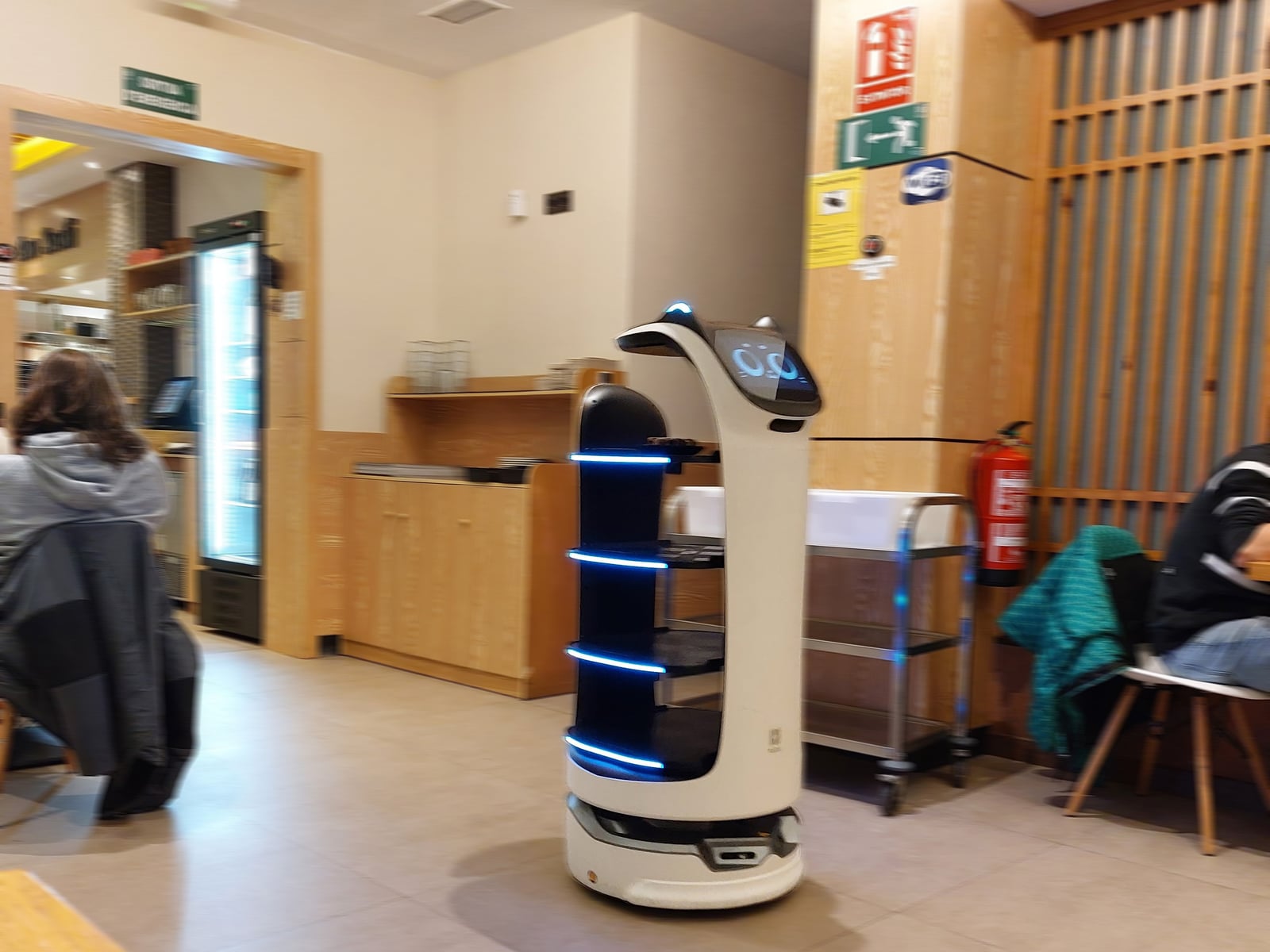
A BellaBot makes its division of labour visible. Beneath a face with cat ears, its body is a stack of trays: a moving shelf that brings objects within human reach. Pudu's Chinese product page specifies a total carrying capacity of 40 kilograms, with 10 kilograms per tray. The useful work is transportation; the hands belong to somebody else.[1]
That familiar machine offers a way into the Shenzhen company's more ambitious research. Through its Pudu X-Lab, Pudu has been adding arms, dexterous hands and learning systems to mobile robots.[3][4] Follow those additions through its releases, and a specific problem emerges: reaching a destination is only part of completing a delivery. The robot may also need to collect the object, operate the building and put the object down.
The intelligence already under the trays
The original delivery task contains plenty of engineering. BellaBot supports visual and laser approaches to simultaneous localization and mapping, or SLAM: working out where the machine is while representing its surroundings. Its documented sensor arrangement includes three depth cameras and lidar, used to detect obstacles around the robot. Infrared sensing on the trays and a management app add information about the delivery itself.[1]
This makes the robot a carefully bounded participant in a room. It can move a load through shared space while leaving handling to people. That boundary also gives the business a useful starting point for research: known destinations, repeated journeys and identifiable moments when a person must take over.
Pudu's September 19, 2024 introduction of the first D7 made that research direction explicit. The X-Lab machine combined a humanlike upper body and arms with an omnidirectional wheeled base. The company named sorting, item transport and elevator operation among its intended tasks, and described a hierarchy connecting higher-level planning with immediate sensory actions.[3]
Pudu called this a semi-humanoid. The design choice matters more than the label. On suitable floors, a wheeled base can place hands where work is waiting. The resulting research question is how to coordinate the approach and the reach. The 2024 announcement anticipated commercialization in 2025; that forecast, on its own, supplies no evidence about subsequent customer reliability.[3]
An elevator button makes the case for hands
FlashBot Arm, announced on March 31, 2025, attached this ambition to an existing delivery product. Pudu described two lifting arms, dexterous hands and a closed cargo compartment on a wheeled chassis. Its stated hotel use case was unusually revealing: a building might lack the connected elevator infrastructure that a conventional delivery robot requires, or face restrictions on renovation.[4]
A hand offers another route through that building. Pudu presented button pressing, object pickup and delivery as parts of a continuous workflow. It also described language-model-based task decomposition and coordinated control of the base, arms and hands.[4]
The implication is practical. A button designed for a person can become a robot interface without being rebuilt. But the robot inherits the work that the person used to perform: approaching at a usable angle, making contact and checking that the intended action happened. Adding a hand expands the machine's possible jobs while increasing the number of things it must perceive and verify.
What the delivery fleet can teach
Pudu's Chinese account of PuduFM 1.0, released on May 11, 2026, explains its attempt to connect those abilities. The company describes a Physical Intuition Model that predicts relevant physical states and guides a vision-language-action system. The proposed coordination extends to both chassis motion and manipulation.[5]
One qualification in that account deserves attention: Pudu explicitly acknowledges that navigation data cannot transfer directly into manipulation training. It argues that the recordings still offer useful robot-view evidence about depth, lighting, movement and spatial structure. For contact skills, it describes additional sources including human activity, simulation and teleoperation, with human corrections feeding further training.[5]
This is a more informative account of the company's advantage than a fleet count alone. Experience moving past a cup supplies a different lesson from experience lifting it. Pudu's opportunity is to connect those lessons; the existence of the fleet does not establish that the connection works.
The factory adds a test of coordination
On June 1, 2026, Pudu introduced a new industrial D7 built around PuduFM 1.0. Its release described shelf picking, replenishment and material handling, with a specified payload of up to 14 kilograms and an operating height of up to two metres. It also described tactile feedback and a combined system for movement, approach planning, grasping and adjustment.[6]
These are manufacturer specifications and capability claims. The release does not provide a task-by-task trial protocol with attempt counts and intervention rates from which to estimate dependable completion. In particular, a payload rating says how much a machine is specified to handle; it does not say how often it will successfully retrieve an unfamiliar object.[6]
For this company's trajectory, the revealing next evidence would follow an entire job. How often does the robot arrive in a position from which it can grasp? What happens after a failed pickup? How much assistance does a new shelf or container require? Those observations would connect the model's proposed physical understanding to the customer's actual work.
Pudu's delivery roots give its embodied-AI programme a concrete purpose. There is already a journey to make and an object to move. The next advance becomes useful when the machine can take responsibility for more of the encounters along that journey—from the waiting tray to the elevator button to the final placement.
Sources
- Pudu Robotics, BellaBot product documentation (Chinese original, accessed October 29, 2026) — navigation, sensors, tray sensing and carrying specifications.
- Marc Auledas-Noguera, “Robot de serveis Pudu 2022,” Wikimedia Commons (photographed April 21, 2022) — original restaurant photograph, attribution and CC BY-SA 4.0 licence.
- Pudu Robotics, “Pudu Robotics Unveils their PUDU D7 Semi-Humanoid Robot” (September 19, 2024) — Pudu X-Lab, first-generation design, control hierarchy and commercialization forecast.
- Pudu Robotics, “Pudu Robotics Unveils FlashBot Arm” (March 31, 2025) — delivery-platform lineage, elevator use case, manipulation and coordinated control.
- Pudu Robotics, “Pudu Robotics officially releases its embodied intelligence foundation model PuduFM 1.0” (Chinese original, May 11, 2026) — proposed architecture, navigation-data limitations and manipulation-data strategy.
- Pudu Robotics, “PUDU Embodied Unveils the Next-Generation PUDU D7” (June 1, 2026) — industrial model, stated hardware capabilities and PuduFM integration.