Before GEAIR could pollinate a tomato flower, researchers made the flower easier to reach. The Chinese breeding project, published online in Cell on August 11, 2025, combined edited plants with a mobile robot trained to recognize and pollinate them. Its distinctive move was to treat the shape of the crop as part of the engineering problem.[1]
That idea has acquired a new body. In September 2026, the team presented GEAIR 2.0, whose two arms can cooperate when a leaf blocks the target flower.[5][6] Following the project between those versions reveals a practical route into agricultural AI: make a difficult biological task more accessible, then give a machine the perception and movement to perform it.
Opening the flower changes the job
For a breeder making a deliberate cross, pollen must come from the chosen parent. A flower that can fertilize itself complicates that control. In the tomato system described by the Institute of Genetics and Developmental Biology, workers had to remove the male organs and work around an enclosed stigma, the surface that receives pollen.[2]
The researchers targeted GLO2, a gene involved in stamen development. The resulting flowers were male-sterile, and their enclosing stamens opened so the stigma became accessible without having to grow longer.[2] Those changes solve related but distinct problems. Male sterility removes the flower's own functional pollen from the crossing operation; exposure gives the pollinating tool somewhere to land.
The biological intervention therefore changes the sequence of work. A robot approaching the edited flower has fewer preparatory manipulations to reproduce. It can concentrate on locating the receptive target and delivering pollen. This is the central logic of the team's crop–robot co-design: a useful machine can emerge from changing both the worker and the object of its work.[4]
A visible target still needs a careful approach
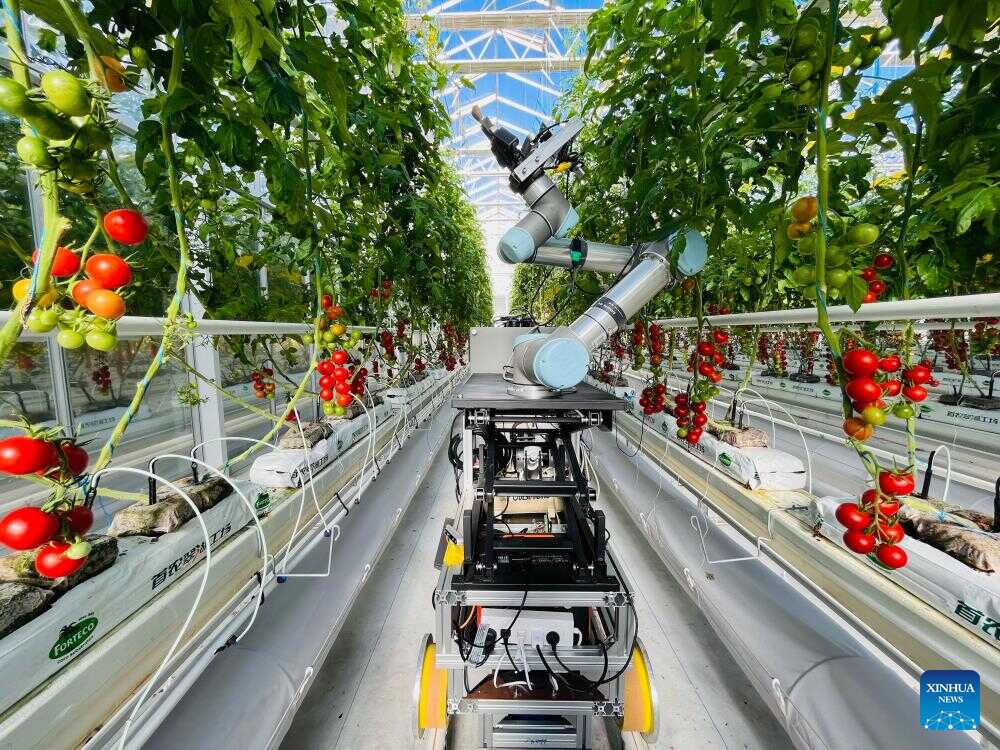
GEAIR's learned visual recognition connects the flower to an action. Finding a target in an image is one step; positioning a tool and transferring pollen completes a different part of the job. The original paper describes training the mobile robot for those edited tomato flowers and reports pollination efficiency comparable to manual work.[1]
The institute's August 2025 account places the robot in a commercial greenhouse. It reports about 15 seconds per flower and 77.6% ± 9.4% success for a single pollination pass, with repeated passes available.[2] These are results for that greenhouse system and its prepared plants. A per-flower operating time cannot tell a grower how many successful crosses a machine will deliver over an entire season.
The distinction matters because movement carries overhead. The useful denominator for a nursery would include travel between plants, failed approaches, replenishment and occasions when someone must intervene. That is an assessment of what deployment evidence should capture, rather than a claim that the published seconds-per-flower measurement included all those activities. Faster contact with a flower helps; reliable work across the greenhouse requires the surrounding routine to hold together.
What transfers to another crop
The original study also edited soybean to produce male-sterile flowers with exposed stigmas. Its abstract describes this as a possible opening for robotic hybrid breeding; the robot pollination demonstration it reports is in tomato.[1] Keeping those stages separate makes the soybean result more intelligible. Researchers had transferred an enabling plant trait, which is a substantial step toward transferring the whole operation.
In their accompanying Cell commentary, plant scientists Fabienne Gehrke and Holger Puchta emphasize the value of fitting crop traits to automated cultivation. They also describe the combined tomato breeding demonstration as limited in scale and conducted in controlled environments. Their account identifies the soybean saving as a reduction in manual pollination time.[4]
There is a useful lesson in that intermediate result. If reshaping a flower already makes a human breeder's task easier, its value can be evaluated before a robot handles every step. Biological design and robotic performance have separate contributions, even when the eventual ambition combines them.
The next obstacle is a leaf
The institute's September 7, 2026 report records the launch of the humanoid GEAIR 2.0 at the China Beijing Seed Industry Conference held September 4–5. It presents the new machine as an integrated platform for breeding, production and harvesting.[5] That announcement establishes a broader intended role; it does not supply comparative operating results for every advertised task.
A more concrete description came in Xinhua's September 8 reporting from the conference. Researcher Xu Cao explained that, when a leaf obscures a flower, one arm can move the leaf while the other proceeds with pollination. He also said the system was undergoing tests and pilots in agricultural parks, principally in specific applications such as hybrid pollination.[6]
The leaf makes the progression easy to understand. Editing opened the flower, but an exposed stigma can still sit behind foliage. Two-arm cooperation addresses another layer of access. Each improvement changes the physical conditions under which perception can lead to successful contact.
My reading of GEAIR is that its strongest contribution lies in this division of effort. The breeder designs a workable cross, plant biology makes the target accessible, and the machine learns how to reach it. Evidence from longer pilots will show how often that cooperation survives ordinary variation between plants. The small flower remains the right place to look: it is where the project's several kinds of intelligence finally have to meet.
Sources
- Xie et al., “Engineering crop flower morphology facilitates robotization of cross-pollination and speed breeding,” Cell (2025), PubMed abstract — tomato and soybean results.
- IGDB, Chinese Academy of Sciences, “GEAIR robotic breeder system” (Chinese original, August 12, 2025) — flower design and greenhouse results.
- Xinhua, “Chinese Researchers Develop World's First AI-Based Breeding Robot for Hybrid Pollination,” reproduced by the Chinese Academy of Sciences (August 12, 2025) — photographic record and IGDB credit for the November 29, 2024 greenhouse image.
- Fabienne Gehrke and Holger Puchta, “CRISPR meets AI-based robotics: Advancing sustainable agriculture,” Cell Preview (October 16, 2025), author-hosted PDF at Karlsruhe Institute of Technology — interpretation of crop–robot co-design and the limits of the breeding demonstration.
- Institute of Genetics and Developmental Biology, “Multiple intelligent-breeding achievements presented at the 33rd China Beijing Seed Industry Conference” (Chinese original, September 7, 2026) — GEAIR 2.0 launch and stated scope.
- Xinhua, “From observing seedlings to computing them: How does AI assist breeding?” (Chinese original, September 8, 2026) — Xu Cao's account of two-arm leaf handling and ongoing tests and pilots.