As of 2026-05-30 UTC, the important signal in China's "AI + Education" Action Plan is not that schools will get more AI tools. The sharper market read is that Beijing is treating AI literacy as deployment infrastructure: a way to turn the broader AI Plus agenda from model supply and policy slogans into a trained user base, a teacher layer, an education-data substrate, and a pipeline of application scenes that can be copied across provinces and sectors.[1][4]
That matters because China's AI race is often described through labs, open-weight releases, cloud prices, and chip constraints. Those are still real. But the April 2026 education plan points at a different bottleneck: a country can subsidize compute and encourage agents, yet still fail to get durable productivity if students, teachers, workers, and local institutions do not know how to specify tasks, judge outputs, protect data, and rebuild workflows around the tools. In that sense, AI literacy is not a soft add-on. It is an adoption layer.
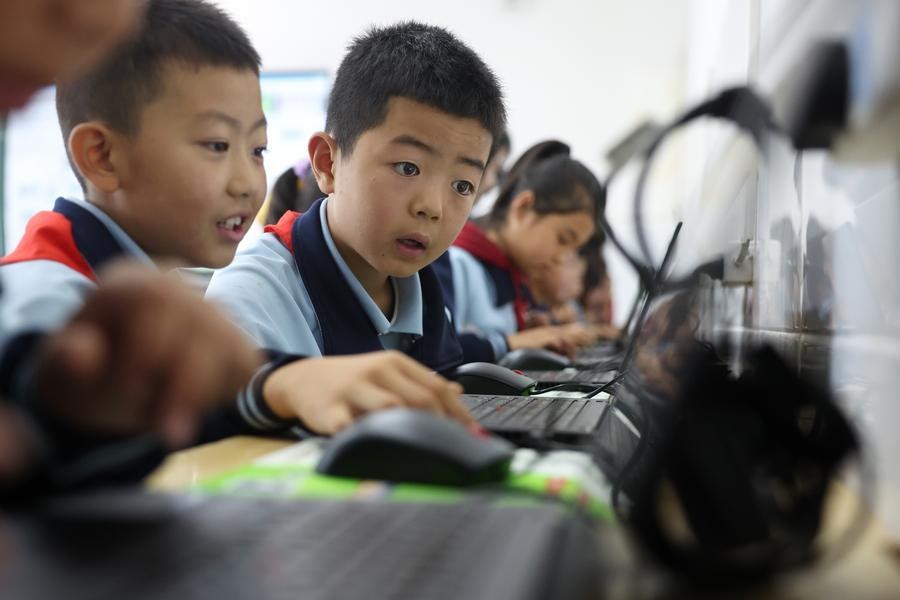
Image context: the cover uses a real Xinhua classroom photograph of students in an artificial-intelligence lesson. It replaces the earlier conference-signage visual because the argument is strongest when the policy is seen at the adoption layer: students, teachers, machines, classroom routines, and the everyday setting where AI literacy becomes measurable practice.[6]
The plan turns education into an AI Plus channel
The Ministry of Education's full notice says the plan was issued by five bodies: the Ministry of Education, the National Development and Reform Commission, the Ministry of Industry and Information Technology, the Ministry of Science and Technology, and the National Data Administration.[1] That lineup is the first clue. This is not only a curriculum document. It is an interagency deployment document for talent, infrastructure, applications, and data.
The text sets a 2030 target: a deep-integration pattern between AI and education should be basically formed, with an all-stage school education system and society-wide general AI education system, improved talent scale and quality, long-term AI literacy mechanisms, changes in teaching, research, and governance, and a batch of high-value, replicable application scenarios.[1] The date matters because it lines up with the broader State Council AI Plus timeline. The August 2025 State Council opinion sets 2027 and 2030 adoption milestones for next-generation intelligent terminals and agents, with 70 percent-plus penetration by 2027 and 90 percent-plus by 2030.[4]
Read together, those documents imply a two-clock policy design. The first clock pushes AI applications into science, industry, consumption, public welfare, governance, and global cooperation. The second clock trains the people and institutions expected to use, supervise, and improve those applications. If the first clock runs without the second, the result is expensive software theater. If the second clock works, it lowers the friction of AI Plus adoption across the economy.
The details are more operational than the headline
The plan is strongest where it gets concrete. At the basic-education level, it calls for opening and improving AI courses, cultivating intelligent thinking, and strengthening curiosity, innovation, and complex-problem-solving capacity.[1][3] At the university level, it pushes AI into public foundational courses, interdisciplinary programs, and discipline-specific transformation. At the vocational level, it links AI to traditional industry programs so workers are trained for industrial upgrade rather than only for generic software use.[1][3]
The press conference transcript is useful because it makes the infrastructure layer explicit. Officials described the plan as turning a blueprint into a "construction drawing" and framed the 2026 digital-education push around AI for school education, lifelong education, science and technology innovation, international exchange, teacher development, and education governance.[3] Zhou Dawang, from the ministry's science, technology, and informatization department, said the plan includes a national education intelligent-computing service platform, an education and research corpus, education-specific large models, teacher tools, pilot bases, and future classrooms or training centers.[3]
Those are not small details. They define the supply chain for education AI: computing resources, cleaned domain data, model development, scenario pilots, teacher adoption, and terminal deployment. The plan is trying to avoid thousands of disconnected school-level purchases by building common resources that local systems can reuse. That is a macro signal for Chinese AI vendors too. The buyer is not only the parent, the student, or the school. The buyer may be a province, platform, vocational college, teacher-training system, or national service layer.
Beijing is trying to make AI use measurable
The English-language government summary of the April announcement adds several useful adoption markers. It says universities are required to make AI a basic public course and develop subject-specific textbooks; vocational education should train skilled workers for industrial transformation; lifelong learning should include micro-courses and micro-credentials; and teacher requirements include a national AI literacy standard, tiered training, assessment, and inclusion of AI knowledge in teacher qualification exams and certification.[2]
It also reports local examples that show the policy is not starting from zero. Fudan University had introduced more than 100 AI-related courses with more than 13,000 students, plus 41 "X + AI" dual-degree programs. Beijing said AI adoption across school levels had reached 87.7 percent by the end of 2025, and that every primary and secondary student in the city takes at least eight class hours of AI courses per academic year.[2]
Those numbers are not a national outcome measure, and they should not be read as proof of learning quality. They are better read as early evidence that the policy can produce countable implementation surfaces: course counts, student coverage, teacher standards, training hours, credentials, and model/service platforms. That matters for AI-China because many AI deployment claims fail at the measurement layer. A school system at least gives the state a place to count adoption and impose certification.
The macro bet is human capital plus demand formation
The Digital China 2025 plan gives the surrounding economic frame. It listed AI Plus, infrastructure upgrades, the data industry, and digital talent as core work, set a goal for core digital-economy industries to contribute more than 10 percent of GDP, and targeted more than 300 EFLOPS of computing power by the end of 2025.[5] It also reported 8.5 trillion yuan in first-quarter digital-industry revenue, up 9.4 percent year on year.[5]
The education plan plugs into that macro stack in two ways. First, it expands human capital for AI production: more AI-aware students, teachers, vocational workers, university researchers, and interdisciplinary graduates. Second, it shapes demand for AI products: schools, training centers, public platforms, assessment systems, and educational governance tools become procurement surfaces. In a country where local governments and public institutions can move markets, that demand signal is not trivial.
The commercial implication is that education AI in China should not be watched only through consumer tutoring apps or classroom gadgets. The stronger signal is platformization. A vendor that can provide education-specific models, teacher workbenches, data-governance tooling, compute integration, assessment systems, or vocational simulation environments may be closer to the policy center than a company with a flashy homework chatbot.
What would prove the plan is working
The useful watchlist is practical. By late 2026 and 2027, look for national or provincial procurement around education intelligent-computing platforms, public AI courses, teacher AI standards, future classrooms, vocational AI training environments, and education-specific model pilots. Also watch whether the national education platform becomes a distribution channel for approved tools, because that would turn AI literacy from a curriculum theme into a software marketplace.
The falsifier is also clear. If the plan produces course-count inflation without teacher capability, reusable models, data governance, or measurable workflow change, it will become another procurement wave. The policy text itself recognizes the risk by stressing value alignment, safety ethics, avoiding low-level duplicate construction, and building common infrastructure.[1][3] Those are not decorative phrases. They are admissions that scale can waste money if every locality buys its own thin wrapper.
The best reading, then, is neither hype nor dismissal. China's April 2026 AI education plan is a macro instrument. It tries to make AI Plus legible to students before they enter the labor force, to teachers before they become blockers or unpaid integrators, to vocational programs before factories ask for new skills, and to public platforms before local procurement fragments the stack. If it works, the country's AI advantage will not be only cheaper inference or faster model releases. It will be a population and institution layer trained to make AI useful.
Sources
- Ministry of Education of the People's Republic of China, "教育部等五部门关于印发《'人工智能+教育'行动计划》的通知" (April 2, 2026; official full text of the AI + Education Action Plan, 2030 goals, talent, infrastructure, application, and governance measures).
- State Council English site / China Daily, "China aims to build an AI literacy system" (April 15, 2026; English summary of the plan, teacher standards, course requirements, Fudan and Beijing adoption examples).
- Ministry of Education, "介绍《'人工智能+教育'行动计划》有关情况(图文直播)" (April 10, 2026; press conference transcript on all-stage AI education, national education intelligent-computing platform, corpus, education models, teacher tools, and pilot scenarios).
- State Council of the People's Republic of China, "国务院关于深入实施'人工智能+'行动的意见" (August 26, 2025; official AI Plus opinion with 2027, 2030, and 2035 milestones and sector priorities).
- State Council English site / Xinhua, "China releases plan to advance Digital China development" (May 17, 2025; Digital China 2025 plan, AI Plus, digital talent, data market, 300 EFLOPS compute target, and digital-industry revenue figures).
- Xinhua, "China moves to bring AI into classrooms as it accelerates digital push" (April 11, 2026; includes a real classroom photograph of an AI lesson in northwest China's Gansu Province).