As of 2026-05-30 UTC, the strongest AI-China signal is not another model leaderboard. It is the way Beijing is connecting industrial datasets, intelligent robots, agent standards, and manufacturing upgrade policy into one operational stack. The World Intelligence Expo 2026 opened in Tianjin on May 28 with more than 700 exhibitors, 130,000 square meters of exhibition area, seven zones, and more than 200 planned product, technology, achievement, and research-report releases across embodied AI, intelligent connected vehicles, low-altitude economy, smart manufacturing, and smart living.[1]
That expo would be easy to treat as a showcase. The better read is supply-chain formation. Vice Minister of Industry and Information Technology Ke Jixin used the event to emphasize AI + manufacturing; National Data Administration head Liu Liehong tied high-quality datasets to advanced manufacturing; and the named dataset targets were not generic internet corpora but automobile manufacturing, shipbuilding, rail transit, non-ferrous metals, and petrochemicals.[1] In other words, the state is naming the industrial memory that models and agents will need before factory AI can move past demos.
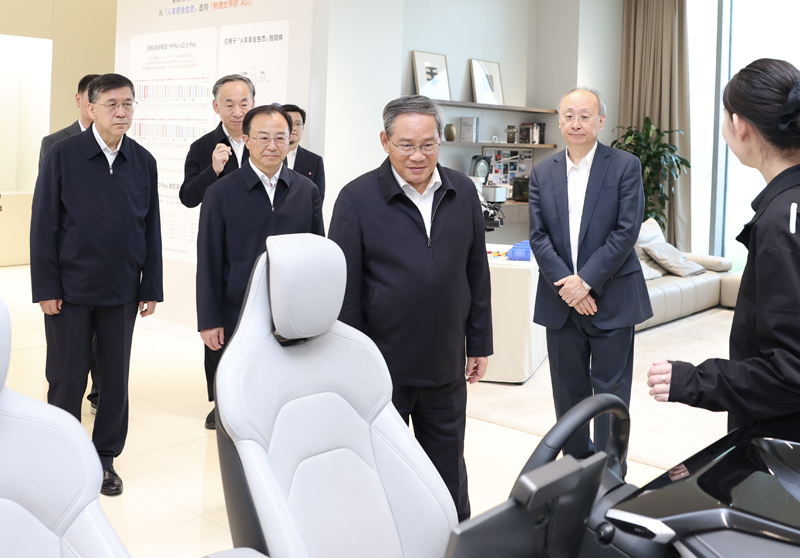
Image context: the cover uses a real Xinhua/State Council photograph of Premier Li Qiang visiting a Beijing sci-tech enterprise during a May 18, 2026 inspection tour.[2] It is a photographic public-release image, not a diagram, chart, generated visual, or symbolic AI composite. The cockpit and robotics setting is directly relevant because the article argues that China's industrial AI push is becoming a loop between machines, datasets, policy, and production workflows.
From model access to factory memory
China already has abundant model access: Qwen, DeepSeek, Kimi, Hunyuan, ERNIE, Doubao, MiniMax, and many other systems compete across open weights, cloud APIs, consumer apps, and enterprise workbenches. The industrial bottleneck is different. A manufacturer does not only need a stronger general model. It needs clean task histories, equipment signals, defect records, CAD and process knowledge, inspection images, maintenance notes, supplier data, and a governance layer that lets AI touch production without creating invisible risk.
That is why Liu's dataset language at the Tianjin expo matters. If high-quality datasets are "both a technical resource and an innovation engine," the state is saying that industrial AI capacity sits below the chat interface.[1] The competitive asset is not only the model checkpoint. It is whether the model can see enough trustworthy factory context to make a useful recommendation, trigger a workflow, classify a defect, or help a robot plan an action.
The May 18 inspection tour makes the same point from the robotics side. Li Qiang visited sci-tech enterprises in Beijing, inspected intelligent-robot R&D achievements and products in different scenarios, and described intelligent robots as a key vehicle for the deep integration of AI and advanced manufacturing.[2] His remarks named complete machines, key components, intelligent decision-making and control systems, R&D design, manufacturing, operations management, and after-sales service.[2] That is a full lifecycle chain, not a consumer-gadget story.
Robots are becoming the visible endpoint
For industrial AI, robots are the most visible endpoint because they force the stack to become real. A chatbot can be wrong and still look fluent. A robot in a factory, vehicle cockpit, warehouse, inspection line, or service bay has to coordinate perception, planning, actuation, safety boundaries, and fallback. It needs the model layer, but it also needs sensors, components, control systems, domain data, testing procedures, and an operating environment that humans can supervise.
This is why China's industrial AI push should be read through the phrase "control loop." The loop begins with process and sensor data, turns that data into datasets and model inputs, sends outputs into robots or agentic workflow systems, records what happened, and feeds the result back into the next round of training, tuning, evaluation, or process redesign. If one part is weak, the loop breaks. Good models without clean datasets produce brittle automation. Robots without workflow integration become stage props. Datasets without deployment paths become archives.
The State Council's 2025 AI Plus guideline provides the national clock. By 2027, China wants deep AI integration across six key sectors and penetration of next-generation intelligent terminals and AI agents above 70 percent; by 2030, it wants that penetration above 90 percent and the intelligent economy to become a significant growth driver.[3] Those targets are broad, but industrial AI is one of the areas where they can become measurable: how many workshops adopt AI-assisted inspection, how many robot systems can be upgraded through software, how many plants use industry datasets, and how many workflow agents pass from pilot to routine operation.
Agent rules are part of the stack
The governance layer is arriving at the same time. On May 8, 2026, Chinese authorities issued implementation guidelines for standardized AI-agent application and innovation. The CAC text defines agents as systems with autonomous perception, memory, decision-making, interaction, and execution capability, then calls for foundations such as task understanding, planning, tool use, long-term memory, interoperability, group collaboration, and safety tools for detecting, intervening in, blocking, and recovering from non-compliant agent behavior.[4]
That language belongs in an industrial-AI stack update because factory agents cannot be judged only by whether they produce a good answer. They need interface standards, tool boundaries, quality evaluation, security assurance, trusted certification, and sector rules for fields such as medical care, transport, media, and public safety.[4] The same pattern applies to manufacturing: an agent that can operate a workflow, schedule maintenance, summarize defects, or coordinate a robot needs a rulebook around what it may observe, modify, and escalate.
The interesting delta from earlier AI-China coverage is therefore not "China wants AI everywhere." That has been visible for years. The delta is that 2026 policy is turning agent capability into deployment grammar. The model is one component. The rest of the sentence includes datasets, terminals, robots, standards, safety tools, and business-process placement.
The compute target sets the floor, not the edge
The Digital China 2025 plan gives the infrastructure floor. It set a goal for computing power to exceed 300 EFLOPS by the end of 2025, called for AI Plus application, digital talent, infrastructure upgrades, and a unified data market, and reported 8.5 trillion yuan in first-quarter 2025 digital-industry revenue, up 9.4 percent year over year.[5] Those numbers do not prove industrial AI productivity. They show that the state is trying to give local governments and firms enough compute, data-market plumbing, and policy cover to attempt it.
The watch item is whether this floor becomes a disciplined production stack or just a procurement wave. Useful confirmation would look like industry-specific dataset releases, factory benchmark suites, robotics evaluation protocols, agent interface standards, and case studies where AI changes defect rates, downtime, design-cycle speed, or after-sales resolution. Weak confirmation would look like more expo demos without data access, unclear safety boundaries, or no measurable workflow improvement.
The falsifier is straightforward: if industrial AI remains a collection of model press releases, robot stage demos, and disconnected local pilots, then the control-loop thesis fails. The stronger version requires repeatable data capture, trustworthy datasets, governed agents, deployable robots, and a feedback path from real production back into the AI system.
For now, the May 2026 signal is coherent. Tianjin put the industrial application surface on display, Li Qiang's Beijing visit framed intelligent robots as the manufacturing integration vehicle, AI Plus supplied the 2027 and 2030 adoption clock, agent guidelines supplied the execution rulebook, and Digital China supplied the compute-and-data backdrop.[1][2][3][4][5] China's industrial AI race is moving below the model layer, into the places where factories remember, machines act, and workflows can be measured.
Sources
- State Council English site / Xinhua, "World Intelligence Expo highlights AI-industry integration, global collaboration" (May 29, 2026; Tianjin expo scale, exhibition zones, AI + manufacturing remarks, high-quality industrial dataset targets, and product-release count).
- State Council English site / Xinhua, "Chinese premier stresses promoting deep integration of AI, advanced manufacturing" (May 18, 2026; Li Qiang inspection tour, intelligent robots, manufacturing lifecycle remarks, and source photograph).
- State Council English site / Xinhua, "China issues guideline to accelerate 'AI Plus' integration across key sectors" (August 27, 2025; AI Plus 2027 and 2030 penetration targets for intelligent terminals and AI agents).
- Cyberspace Administration of China, "智能体规范应用与创新发展实施意见" (May 8, 2026; official agent development and governance guidance covering agent capabilities, toolchains, standards, safety, interoperability, and sector applications).
- State Council English site / Xinhua, "China releases plan to advance Digital China development" (May 17, 2025; Digital China 2025 plan, AI Plus, data market, 300 EFLOPS compute target, and digital-industry revenue figures).