As of 2026-05-29 UTC, the useful AI-China signal in MinerU-Popo is not that another OCR model can read a page. The sharper claim is that document AI is running into a boundary that page-level recognition cannot solve by itself: a parser may correctly detect paragraphs, tables, images, and bounding boxes on individual pages while still failing to rebuild the logical document a retrieval system actually needs.[1]
That distinction matters because much of the document-AI race has been scored at the page or element level. A benchmark can ask whether text was recognized, a table matched, a formula survived, or reading order looked plausible. Those are necessary tests. They are not the whole production problem. Real enterprise and research documents are multi-page objects. A table can break across pages. A section title can govern material that starts later. A figure caption can be split from its image. A paragraph can be cut by pagination while still belonging to one thought. MinerU-Popo is interesting because it treats those failures as a post-processing layer rather than as isolated OCR mistakes.[1][5]
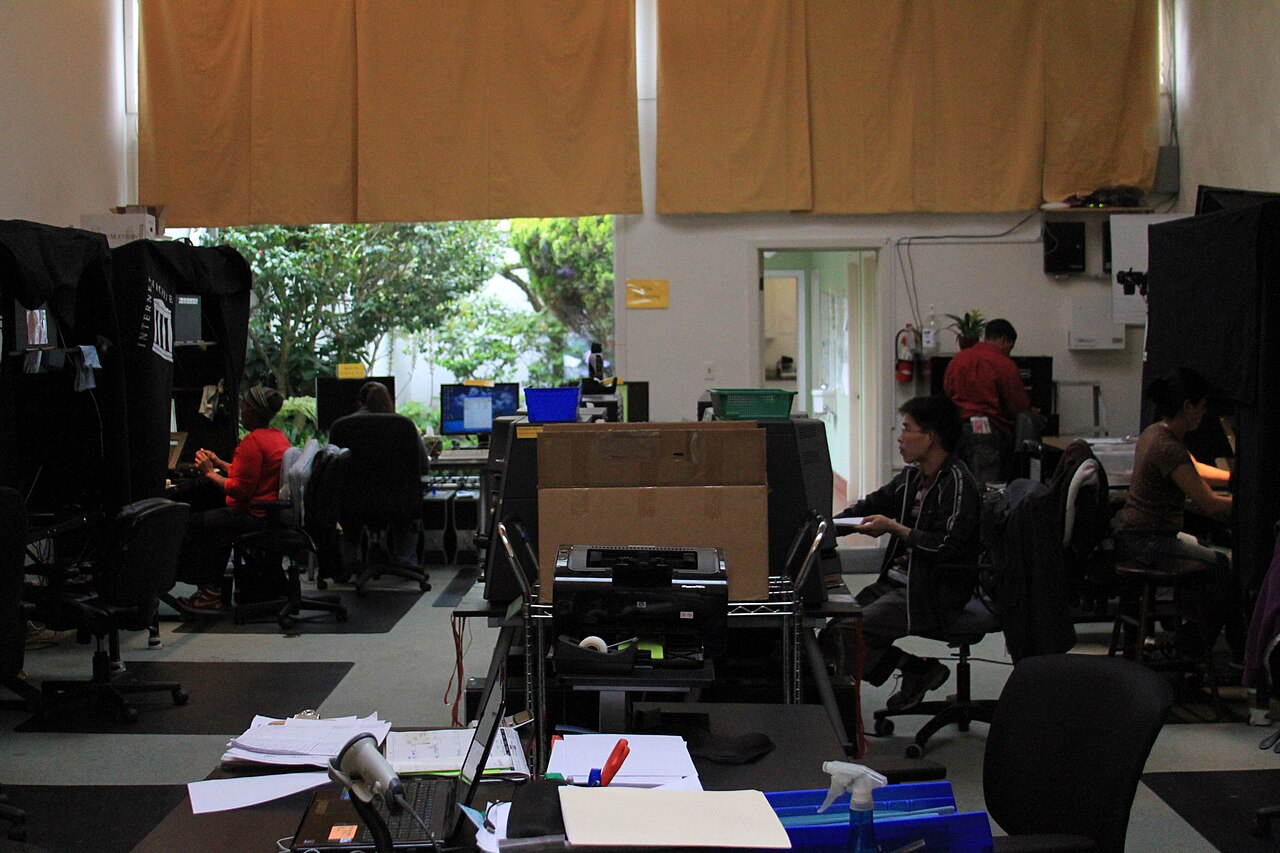
Image context: the cover uses a 2011 Wikimedia Commons photograph of the San Francisco Internet Archive Scanning Center by Jason Scott. It is a real archival/photographic image, not a generated visual, chart, or diagram. The visual point is practical: document AI lives downstream of huge scanning and ingestion operations, where the object being digitized is not one clean page but a messy long record.[8]
The benchmark target has moved from page text to document structure
The MinerU-Popo paper describes the current VLM-based OCR pattern clearly: modern systems can extract page-level elements with bounding boxes and textual content, but downstream RAG applications require coherent document-level information.[1] The authors name the missing relationships directly. Cross-page continuity, disrupted paragraphs, broken tables, title hierarchy, and image-text association all require reasoning over multiple pages rather than just recognizing what sits inside one page image.[1]
That is a strong framing because it changes what a good score should mean. If the output is only a pile of page-local Markdown fragments, the retrieval layer inherits the cleanup problem. Chunking may split a table from its header. A search result may retrieve the second half of a paragraph without the first half. A model answering over the corpus may cite a figure while losing the figure's explanatory text. The OCR system can look competent in isolation while the RAG system becomes brittle.
MinerU-Popo's answer is to convert page-level OCR outputs from diverse parsers into a coherent document-level structure. The paper decomposes the task into four subtasks: text truncation recovery, table truncation recovery, title hierarchy reconstruction, and image-text association.[1] That decomposition is the important engineering move. It says the post-parser should not be a bag of regex repairs. It should be a model-governed layer with named responsibilities and measurable failure modes.
Popo is a post-processing model, not a replacement parser
The "Popo" in MinerU-Popo stands for post-processing OCR outputs. That matters. The paper is not presenting a monolithic parser that throws away the existing document-AI stack. It is proposing a universal post-processing framework that can sit after page-level parsers and repair the logical structure they fail to preserve.[1]
This is strategically plausible for AI-China because China already has a crowded document parsing lane. MinerU itself converts PDF, image, DOCX, PPTX, and XLSX inputs into Markdown and JSON for downstream retrieval, extraction, and agent workflows; it advertises VLM plus OCR engines, 109-language OCR recognition, formula-to-LaTeX conversion, table-to-HTML conversion, scanned-document detection, CPU/GPU paths, local API and CLI deployment, and support for multiple domestic AI chips.[2] Baidu, Tencent, Z.ai, PaddlePaddle, and other Chinese teams are also pushing OCR and document-understanding systems. The next advantage is less likely to come from declaring one parser universal. It is more likely to come from making the parser outputs composable.
MinerU-Popo points in that direction. It reuses existing OCR outputs, builds a task-oriented data engine with task-specific filtering, fine-tunes a lightweight post-processing model based on Qwen3-VL-4B using 30K generated examples, and introduces dynamic chunking with overlap-based synchronization for long documents.[1] The model then assembles aligned outputs into a tree-structured document representation, enriched with node chunking and summaries for retrieval and analysis.[1]
That tree representation is the key product boundary. A document tree can carry hierarchy and relationships that flat Markdown often loses. It lets a system know that a title governs children, that a table continuation belongs to the prior table, that a figure and nearby description should travel together, and that chunking should respect logical nodes rather than blind token windows. This is exactly where document parsing becomes infrastructure for agents rather than a preprocessing utility.
The metric story is getting more honest
The original MinerU paper framed document extraction as a computer-vision problem where existing open-source solutions struggled with the diversity of document types and content, despite progress in OCR, layout detection, and formula recognition.[4] That paper leaned on models and finely tuned preprocessing and post-processing rules to improve extraction quality across diverse documents.[4] MinerU-Popo makes the later-stage lesson more explicit: once page recognition improves, the remaining errors concentrate in structure.
MinerU2.5-Pro reinforces the same data-centric shift. Its April 2026 paper argues that state-of-the-art document parsing models, despite different architectures and parameter scales, show consistent failure patterns on hard samples. The authors attribute the bottleneck less to model architecture alone than to shared deficiencies in training data, then keep the 1.2B-parameter MinerU2.5 architecture unchanged while expanding and refining the data engine.[3] The paper describes a move from under 10 million to 65.5 million samples through diversity-and-difficulty-aware sampling, cross-model consistency verification, and judge-and-refine annotation loops.[3]
Read with MinerU-Popo, that is a coherent development path. The first wave asks: can the parser extract page content well enough? The next wave asks: did the data engine cover the hard samples that expose real failures? The post-processing wave asks: after extraction, can the system restore document logic well enough for retrieval, analysis, and agent work?[1][3][4]
OmniDocBench gives the surrounding benchmark context. Its paper argues that document extraction underpins LLM and RAG data needs, and that older evaluations were too narrow or unrealistic.[5] The public repository now describes a benchmark with 1,651 PDF pages, 10 document types, 5 layout types, 5 language types, rich block-level and span-level annotations, reading-order annotations, end-to-end and module-level evaluation, and metrics including normalized edit distance, BLEU, METEOR, TEDS, and detection measures.[6] It also shows active 2026 updates, including v1.6 and v1.7 changes, more challenging pages, and fresh model evaluations.[6]
That matters because document-AI claims can otherwise collapse into a single score. MinerU-Popo's narrow value is that it gives teams a way to evaluate one of the hidden score gaps: whether page-local success survives the transition into document-level structure.
Why this belongs in the AI-China stack
OpenDataLab describes itself as a data-centric AI research group inside Shanghai AI Lab's Data Platform Center, with research directions including multimodal large models, data synthesis and detection, intelligent understanding of scientific documents, and AI4Science.[7] The group explicitly names MinerU as a leading open-source PDF parsing tool and places it alongside open data and scientific-document understanding work.[7]
That institutional setting is important. China's frontier model race is not only about chat models and app demos. It is also about the substrate that turns private, scientific, legal, medical, financial, industrial, and archival material into structured model input. A national or enterprise AI stack needs ingestion, parsing, filtering, evaluation, serving, and retrieval. MinerU-Popo is small compared with a model launch, but it sits in a valuable place: between raw page extraction and downstream knowledge work.
The practical adoption boundary is also clear. MinerU-Popo should not be read as proof that all document parsing is solved. Its claims are paper-reported and need independent reproduction across messy corpora, scanned forms, bilingual material, handwritten notes, long tables, diagrams, and domain-specific layouts. It also depends on the quality of upstream OCR outputs. A post-processor can repair structure; it cannot reliably recover facts that the parser never saw or saw incorrectly.
The stronger conclusion is narrower. MinerU-Popo makes the next question harder to dodge. When a vendor says a document model performs well, ask whether the score covers only page-level extraction or also document-level continuity. Ask whether hierarchy, table continuation, figure association, chunk construction, and RAG latency were evaluated. Ask whether the output is a visually plausible Markdown file or a structured object that can survive retrieval, citation, and agent execution.
That is why this release matters. It moves Chinese document AI from "can the model read the page?" toward "can the system rebuild the document contract?" In production, that second question is where the expensive failures usually live.
Sources
- Bangrui Xu et al., "MinerU-Popo: Universal Post-Processing Model for Structured Document Parsing," arXiv:2605.24973, submitted 2026-05-24 - post-processing framework, four subtasks, Qwen3-VL-4B fine-tuning, dynamic chunking, tree representation, and RAG claims.
- OpenDataLab,
opendatalab/MinerUGitHub repository - current product scope, supported input and output formats, VLM/OCR engines, 109-language OCR, deployment modes, hardware notes, domestic chip support, and 2026 release notes. - Bin Wang et al., "MinerU2.5-Pro: Pushing the Limits of Data-Centric Document Parsing at Scale," arXiv:2604.04771, revised 2026-04-09 - data-centric parsing bottleneck, unchanged 1.2B architecture, 65.5M-sample data engine, and annotation strategy.
- Bin Wang et al., "MinerU: An Open-Source Solution for Precise Document Content Extraction," arXiv:2409.18839, submitted 2024-09-27 - original MinerU technical report on high-precision extraction, PDF-Extract-Kit models, and preprocessing/post-processing rules.
- Linke Ouyang et al., "OmniDocBench: Benchmarking Diverse PDF Document Parsing with Comprehensive Annotations," arXiv:2412.07626, accepted by CVPR 2025 - benchmark motivation, diverse document sources, layout categories, attribute labels, and end-to-end evaluation framing.
- OpenDataLab,
opendatalab/OmniDocBenchGitHub repository - benchmark page counts, document and layout type coverage, annotation categories, reading-order annotations, evaluation metrics, and 2026 version updates. - OpenDataLab, "Data-Centric AI Research" - Shanghai AI Lab OpenDataLab overview naming MinerU, data-centric AI, intelligent scientific-document understanding, multimodal models, and AI4Science research directions.
- Wikimedia Commons, "File:San Francisco Internet Archive Scanning Center.jpg" by Jason "Textfiles" Scott - real 2011 photograph used as the article image.