Li Wang remembers phoning her colleague Zhe-kun Zhou as soon as she split open a piece of siltstone and saw a seed cone inside. Zhou’s team had already found leafy shoots in central Yunnan that looked like dawn redwood. Wang had spent years studying the leaves of that tree, even climbing into the crowns of two living specimens to collect material for her microscope. The cone offered a way to check what the leaves had suggested. [1][2]
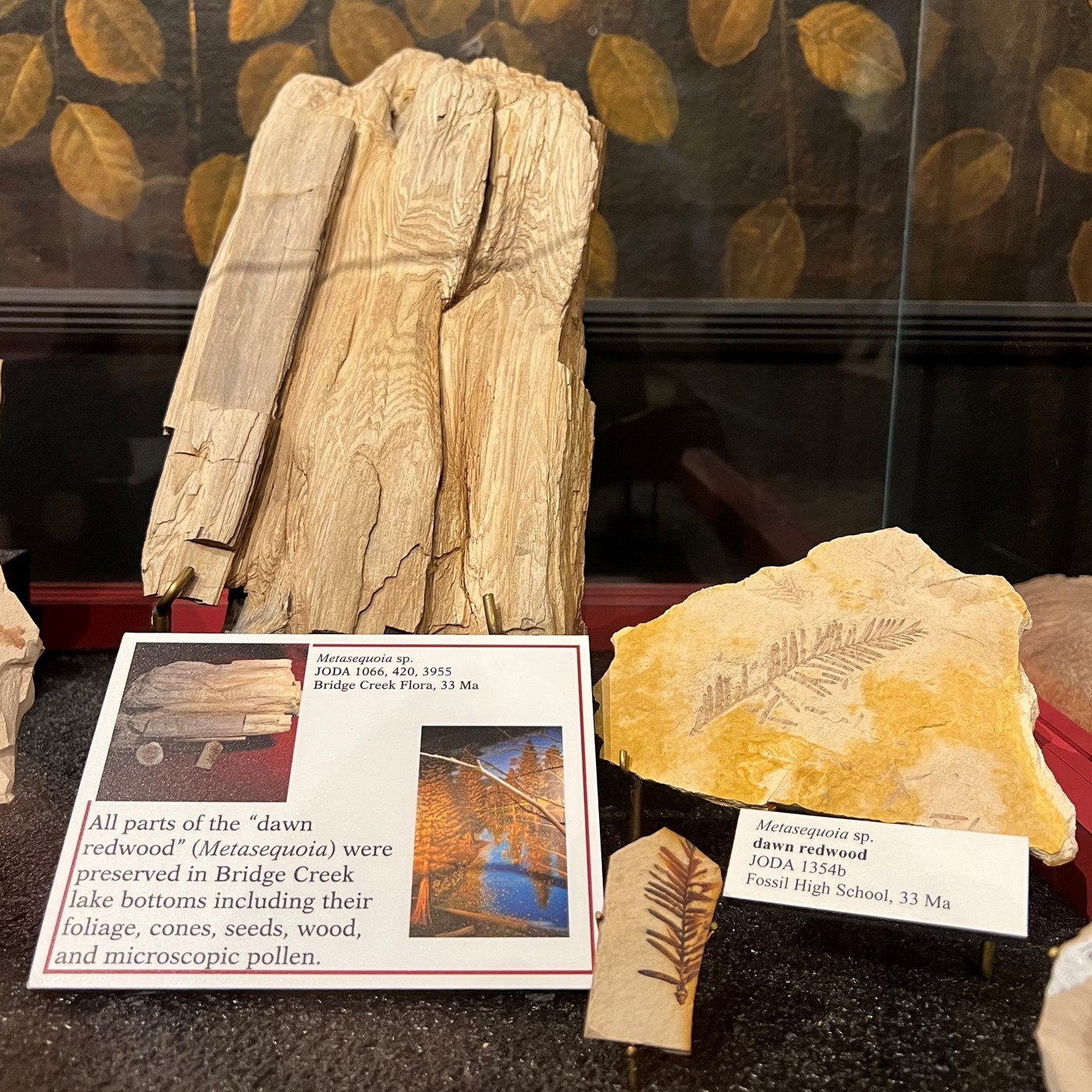
At Sanzhangtian, a village in southwestern China, the rocks preserve pieces of a forest that grew during the middle Miocene, roughly 16 to 11 million years ago. A dawn redwood sheds whole leafy shoots. Find one pressed flat and it looks rather like a feather. Several conifers can give that impression. To identify one, it helps to look away from the outline and follow a single leaf inward to the point where it joins the twig. In dawn redwood, another leaf joins directly across from it. [1][2][3]
A quarter turn
A seed cone gives the botanist another set of attachments to inspect. Imagine looking straight down its stalk. Two scales sit opposite each other. The next pair up the stalk turns through a right angle, occupying the gaps between the first two. Botanists call this arrangement decussate. Flatten the cone in sediment and some scales will hide others, but where the attachments survive, the pattern can still be read. The Sanzhangtian cones carried those successive pairs, and the leafy shoots preserved both their arrangement and details of the thin outer skin of the leaves. Wang and her coauthors could check one organ against another. [2]
Cone scales had settled a remarkably similar question in the 1940s, when the puzzle ran the other way. Botanists already had a name, Metasequoia, for fossils described by Shigeru Miki in Japan. What they had trouble placing was a living tree in China. A collector thought it might be water pine, another conifer that loses its slender leaves. A branchlet with two cones reached the botanist W. C. Cheng. The paired scales caught his eye, and he sent an assistant back to collect more material at different times of year. When fragments reached H. H. Hu in 1946, Hu could lay them alongside Miki’s published description. A name coined for fossils now had a living member. [4]
How far a name can reach
In their 2019 paper the Yunnan team called the fossils Metasequoia sp. (cf. Metasequoia glyptostroboides). The small print matters. “Sp.” leaves the species open. “Cf.” invites comparison with the named species, in this case the dawn redwood still growing wild in central China. The team had enough material to recognize the genus and describe a close resemblance across millions of years. Giving the fossil the living species’ full name would have asked more of those preserved surfaces. [2]
That distinction also matters to the history of the forest. The cones put dawn redwood in a place outside its present native range. Wang and her colleagues proposed that increasingly dry winters and springs, as the Asian monsoon intensified, helped eliminate it from the region. To investigate that idea they had to look beyond the cone, to the seasonal distribution of rainfall and the places where the tree survives. The angle between two pairs of scales can establish which trees once grew in a valley. It takes a different kind of evidence to explain why the valley lost them. [1][2]
Sources
- Li Wang, “My luck with Metasequoia,” Arnold Arboretum (2019). Field account and specimen photographs.
- Li Wang and colleagues, “The disappearance of Metasequoia (Cupressaceae) after the middle Miocene in Yunnan, Southwest China,” Review of Palaeobotany and Palynology (2019). Institutional research record.
- Chinese Academy of Sciences, “Metasequoia Fossil Discovered in Southwest China” (2019). Locality and age of the Sanzhangtian deposits.
- H. H. Hu, “How Metasequoia, the ‘Living Fossil,’ Was Discovered in China,” Arnoldia. Hu’s account of the specimens examined by Cheng and himself.
- National Park Service, “Battle of the Bark.” Dawn redwood specimens at John Day Fossil Beds National Monument.