Five horned dung beetles is a modest count for a place as busy as Trafalgar Square. These five turned up in sediment from the last interglacial, roughly 120,000 years ago. Five was the minimum Russell Coope could establish for the species Copris lunaris. There is a practical trick to counting broken beetles. Five left wing cases require five beetles. Add a right wing case and the minimum stays at five. [1][2]
The same London deposit yielded dozens of individuals of other dung beetle species. A large dung supply is one reasonable inference. A mean July temperature is a much harder one. To estimate it, Coope drew on beetles from eight English sites, including London, and made a deliberate choice about which insects could speak for the weather. [1]
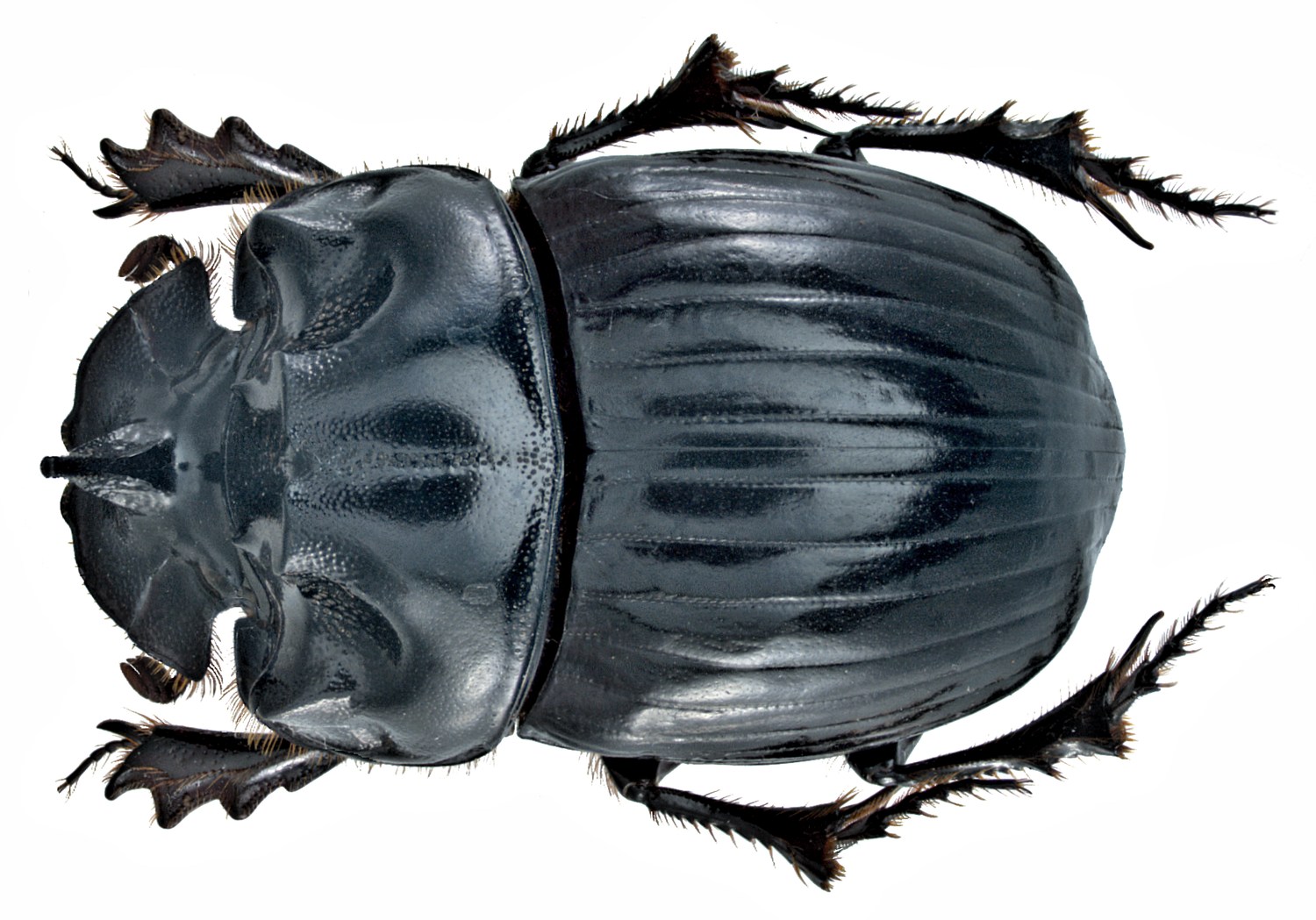
Which beetles get a vote?
Consider a beetle that feeds on a particular tree. Where the tree can grow helps determine where the insect can live. Count the tree's pollen as evidence for the climate, then count its specialist beetle, and the second observation may largely repeat the first. For his temperature calculation Coope selected predators and general scavengers. A predator that takes small animals in the litter can find dinner under several kinds of tree. Its distribution offers a more independent comparison with the pollen record. [1]
Identification sets another limit. Among the London pieces were three left wing cases and two plates from just behind a beetle's head. Coope saw a resemblance to beetles from Nepal. Years later, taxonomists described the London animal as a distinct fossil species, Eodrepanus coopei, and designated one of the plates as its name-bearing specimen. It resides in Birmingham's Lapworth Museum. A curator can put a precise name on that plate today. Assigning it the temperature range of a living Nepalese relative would still require a separate piece of evidence about how the two lived. [1][2]
Finding a July that fits
For a species with living populations, researchers can attach climate records to places where collectors have found it. Two numbers describe each place for this purpose. One is the average temperature of its warmest month. The other is the difference between its warmest and coldest monthly averages. Together the places outline a range of seasonal conditions in which the beetle has been observed. [1][4]
Imagine two species recovered together. One lives through a wide range of winters but reaches its northern limit where summers turn cool. The other tolerates cooler summers but disappears where winters get severe. Each alone leaves plenty of climates in play. Superimpose their ranges and some of those possibilities fall away. Repeat with the other eligible species from the deposit. The surviving overlap is the mutual climatic range. A beetle with a broad distribution can add little to the calculation even if the sample contains a hundred of its wing cases. [1][4]
Coope's 2000 study put July in southern England during the early part of the last interglacial about 4°C above the modern July average he used for comparison. Winters appeared close to the modern values. That seasonal distinction matters. Adding four degrees to every month would give the ancient animals a mild winter for which the beetles supply little evidence. [1]
Winter also deserves its own check. In Alaska, Scott Elias and colleagues tried the method on beetle communities whose climate could be measured directly. Along the coast, the beetles gave a reasonable estimate for the warmest month but consistently made the coldest month too cold. The team suggested that an occasional severe cold spell could weed out sensitive species even where the average winter was mild. That experiment gives a reason to weigh summer and winter estimates separately whenever someone offers a single figure for how warm an interglacial felt. [4]
Back in London, the dung beetles retain a job of their own. Five Copris lunaris and dozens of their dung-feeding neighbors put animals depositing dung within reach of the beetles. The predators and scavengers help put a July temperature on the landscape those animals shared. Both readings begin with the same handfuls of sediment, and each depends on knowing what a particular beetle needed to get through the year. [1]
Sources
- Russell Coope, “The climatic significance of coleopteran assemblages from the Eemian deposits in southern England” (2000).
- Enrico Barbero, Claudia Palestrini and Angela Roggero, “Systematics and phylogeny of Eodrepanus” (2009), including the description of the Trafalgar Square material.
- Udo Schmidt, photograph and collection details for a male Copris lunaris (2014), Wikimedia Commons.
- Scott A. Elias, John T. Andrews and Katherine H. Anderson, “Insights on the Climatic Constraints on the Beetle Fauna of Coastal Alaska, U.S.A.” (1999).