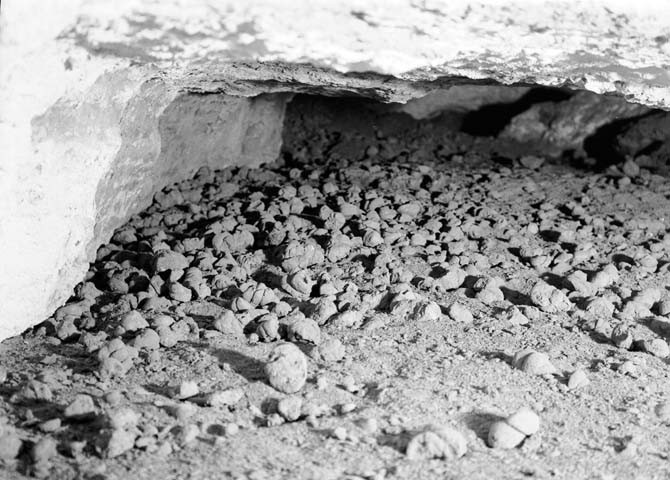
In a September 1938 photograph of Rampart Cave, the floor looks strewn with cobbles. The rounded lumps are dung. Generation after generation of Shasta ground sloths (Nothrotheriops shastensis) helped build that floor in the western Grand Canyon. The surprise came when excavators cut down through it. Partway through several feet of sloth droppings they encountered a band of plant debris about thirteen inches thick. For thousands of years, a different animal had been furnishing the cave. [1]
Willis Evans, a junior foreman who had worked at a sloth cave near Las Vegas, recognized the deposit’s significance in 1936. Geologist Edward Schenk led the first excavation. The dry cave had kept an unusual assortment of material intact, down to sloth hair and skin. Even so, for anyone interested in what a ground sloth did on an ordinary afternoon, a piece of dung had one advantage over a skeleton. It still held pieces of lunch. [1][2]
An interruption in the floor
The lowest dung accumulated from more than 40,000 to about 24,000 radiocarbon years before present. Then came the packrats. These rodents carry plant material home and build middens, heaps of debris that their urine can cement together. Their seam lay between the lower dung and a second sloth deposit dating from about 13,000 to 11,000 radiocarbon years before present. The sequence puts sloths back in the cave after the coldest part of the last ice age. [1]
Imagine lifting a ball from each of the two dung layers. They might contain the same food, look equally dry and crumble the same way in the hand. A label that said only “Rampart Cave” would make them sound interchangeable. Their positions on opposite sides of the packrat seam put thousands of years between them. The seam also gives the gap some substance. While evidence of sloth visits falls away, there is still a record of animals bringing vegetation indoors. How far a sloth would have had to travel during that interval to find suitable forage is a question the cave floor leaves open. [1]
What passed through a sloth
In a study published in 1961, Paul Martin, Bruno Sabels and Dick Shutler Jr. sampled dung at six-inch intervals and recovered pollen. Flowering seasons mattered to the interpretation. Two visits to the same patch of ground at different times of year can expose a browsing animal to different pollen. A change between handfuls of dung could register the season in which the sloth visited. A claim about a changing landscape would have to account for that possibility. [3]
Richard Hansen approached the meals through bits of plant tissue. His 1978 study examined pieces from more than 500 droppings and included material from the nearby Muav Caves for comparison. Desert globemallow alone accounted for just over half his estimate of the Rampart diet. Nevada mormontea came next. Common reed also turned up among the desert shrubs. Each fragment had passed two filters before Hansen put it under the microscope. A sloth had selected a mouthful, and enough of the tissue had survived digestion for a botanist to recognize it. A figure like globemallow’s 52 percent tells us something quite precise about the reconstructed diet. Estimating how much of the canyon floor globemallow covered would take another kind of sample. [2]
Hansen could still collect six of the principal food plants near the cave. He used their nutritional values to estimate the quality of the ancient meals. As the record approached its end, his estimate of digestible energy actually rose. That makes a dwindling supply of nutritious food a difficult explanation to read directly from the youngest droppings. The quantity of forage available to a whole population, or the fate of the animals after their last recorded visit, lies beyond what any one meal preserves. [2]
A fire that began in 1976 burned for months and consumed roughly two-thirds of the dung. Pieces collected before the fire survive, including specimens at the Arizona State Museum. A researcher can still take one of those pieces and ask which plant a sloth ate. To ask what the next sloth ate, a few inches higher in the deposit, takes something harder to keep in a museum drawer. It takes the floor around it, or somebody’s careful record of where each piece lay. [1][4]
Sources
- National Park Service, “Pleistocene Life and Landscapes—Grand Canyon,” including the 1938 photograph and the excavation sequence.
- Richard M. Hansen, “Shasta ground sloth food habits, Rampart Cave, Arizona,” Paleobiology (1978).
- Paul Schultz Martin, Bruno E. Sabels and Dick Shutler Jr., “Rampart Cave coprolite and ecology of the Shasta ground sloth,” American Journal of Science (1961).
- Arizona State Museum, “Digging in Storage,” collection entry for ground sloth dung from Rampart Cave.