A Yorkshire rhubarb grower can spend a whole summer looking at stalks fit for a crumble and leave every one of them standing. The following summer, the same again. For a plant destined for the forcing shed, those broad green leaves have a job to finish. The pink stalk a pastry chef will eventually lift from a pan of syrup depends on how much sunlight the plant can collect before the grower takes the light away. [1]
The harvest left in the field
A rhubarb stick is a leaf stalk. Pull it in summer and the leaf comes with it. Leave the plant intact and its leaves keep feeding the root, where carbohydrates accumulate. The Yorkshire Forced Rhubarb specification describes what happens when a grower tries to take both crops. Picking outdoors costs the plant reserves and encourages smaller buds on its crown. In the forcing shed that translates into thinner sticks and fewer of them. A good winter stalk begins with a summer sale forgone. [1]
The decision about when to bring the roots indoors happens underground, too. Growers take the temperature of the soil and keep a running count of the cold the roots have experienced. Each variety needs its own amount of chilling before it will grow well in warmth and darkness. In Pudsey, grower Robert Tomlinson recalls picking in early December in years past. By the time he spoke to Living North, milder weather had pushed his first picking until after Christmas. A restaurant planning a winter tart can put a date on the menu more easily than a farmer can put one on the crop. [1][2]
What the picker needs a candle for
Once the roots are ready, a machine loosens them from the field. Tomlinson's crew forks them onto trailers and beds them down by hand on the bare floor of the shed. There is good reason to take care on that short journey. The buds that will send up the new stalks sit exposed on the crown. The product specification even calls for roots to travel in a single layer so the weight of one cannot crush the next. [1][2]
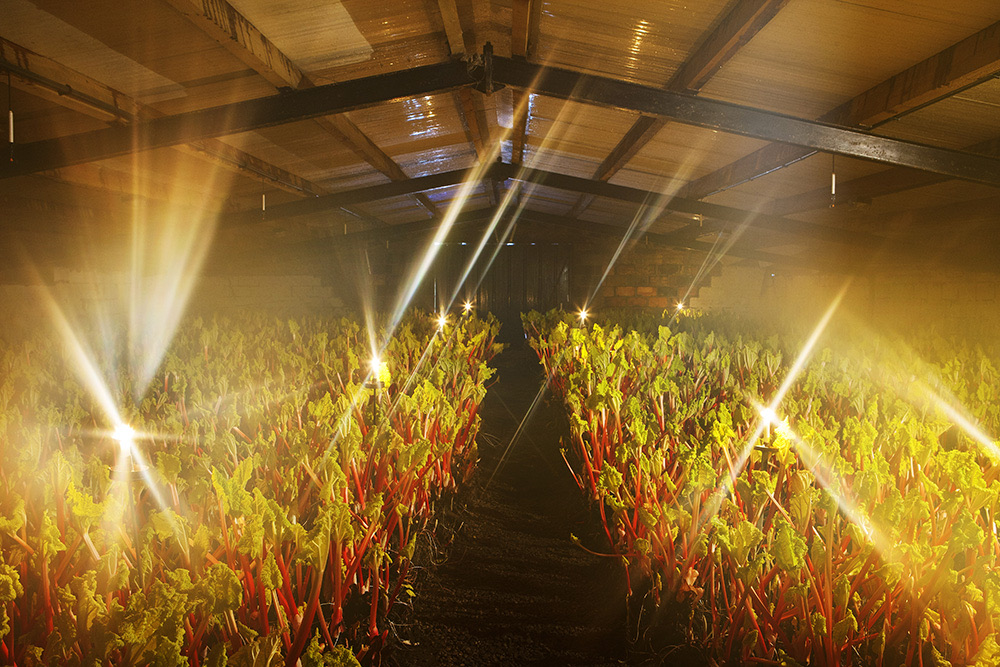
Inside, the grower supplies heat and water. The root supplies the energy. In the dark the stalks lengthen and the little leaves at their tips stay pale. Tomlinson describes a wait of about four weeks after the heater goes on before he takes a candle in to pick the first sticks. The flame gives the picker enough light to choose among them while the younger shoots carry on growing in near darkness. The difference reaches the kitchen as a tender stalk with a gentler tartness than its field-grown counterpart. [1][2]
The piece on top of the custard
The Savoy Grill's published rhubarb tart gives the cook several chances to decide what a stalk is worth. One batch goes into a smooth purée hidden beneath vanilla custard. Another is roasted until soft and churned into sorbet. For the top of the tart, the cook cuts batons, poaches them in syrup, then lets them cool before peeling and dicing them. Even the poaching liquor ends up on the plate, set with agar and blended into a gel to fill the gaps between pieces. [4]
Of those four preparations, the dice would be my first forkful. The purée gives up its shape to put a streak of sharpness underneath the cream. The gel carries the flavour of rhubarb after the stalk itself has been lifted out. Only the little piece balanced on the custard lets you feel what the grower delivered. It holds a cut edge until you press it with the side of a fork. Two summers in the field for something that gives way so easily.
Sources
- Yorkshire Forced Rhubarb product specification, especially the outdoor growing, chilling and lifting stages. UK protected food name register.
- Living North, interview with Pudsey grower Robert Tomlinson on his family's forcing sheds and winter harvest.
- Clive Nichols, “Forced Rhubarb,” photographic series at E. Oldroyd & Sons.
- Savoy Grill, “Rhubarb and Custard Tart,” recipe published by Gordon Ramsay Restaurants.