At Meissl & Schadn in Salzburg, a person dining alone can order a mountain. Ask for the Mönchsberg and the kitchen will make a single Salzburger Nockerl, a peaked dumpling of whipped egg that comes out of the oven brown on the slopes, ready for a dusting of sugar. The full order is a range of three. After a long dinner, the usual arrangement is to put the dish in the middle and pass the spoons. The Mönchsberg solves the problem of wanting dessert when everyone else wants coffee. [1][2]
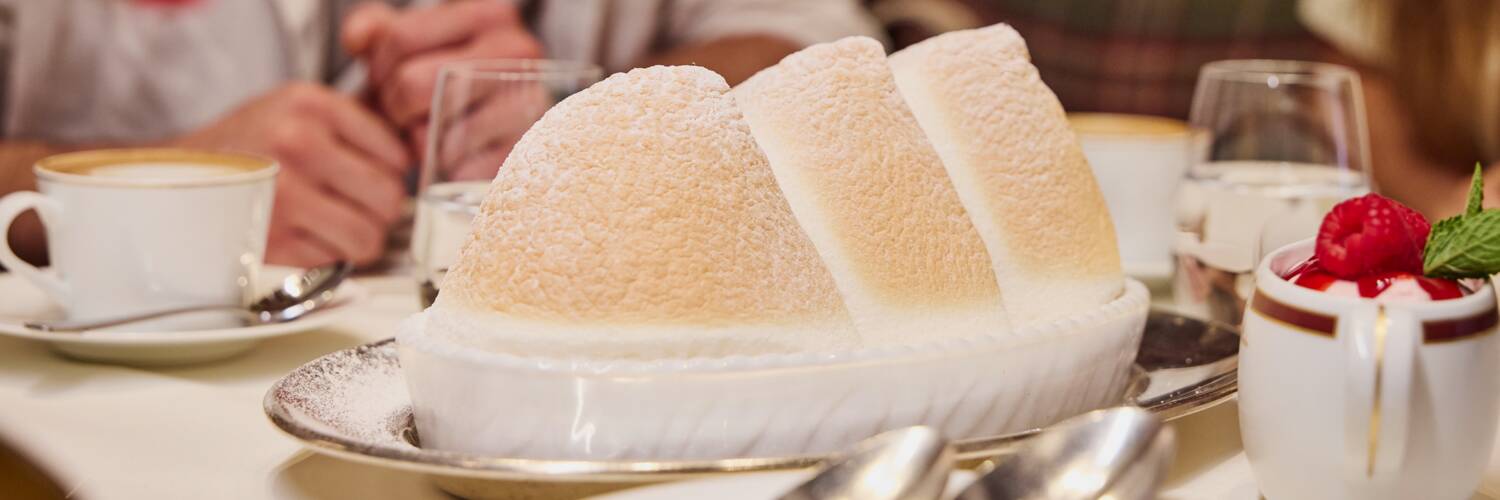
Salzburg’s tourism office can name all three hills for you, from the Mönchsberg to the Kapuzinerberg and the Gaisberg. The Austrian register of traditional foods, which has room to entertain a disagreement, also finds the Rainberg and the Nonnberg in the literature. What everyone recognizes is the weather. A little powdered sugar settles on the ridges, and enough of the golden surface shows through to suggest the first snow of the season. [2][3]
Under the snow
There is a reward for taking the serving spoon all the way to the bottom. Meissl & Schadn starts its oval baking dish with tart red preserves and a little pouring cream. Both disappear under the dumplings. The first shallow spoonful gets you sugar and warm egg foam. Take a cut down the slope and draw the spoon along the dish, and the same mouthful picks up the sharp fruit. The cook has already put the sauce exactly where the person dividing the dessert will find it. [1]
The hills get their shape twice. In the bowl, eight egg whites whipped with sugar give the restaurant’s mixture enough body to stand up even after the cook folds in four yolks and a little flour. Then a pastry scraper cuts out the three portions and sets them side by side. They go into a hot fan oven for about eight minutes. The brown ridges tell you where the heat reached the surface. Inside, all that volume still depends on the air the cook beat into the whites. This accounts for the most pressing instruction in the recipe, the one that belongs as much to the waiter as to the pastry cook. Get the dish to the table straight away. [1][4]
How many hills fit in a pan?
For a dessert so closely identified with its outline, the Nockerl has accommodated some remarkably different ways of cooking it. In her 1897 cookbook, Marie von Rokitansky described pyramids fried in clarified butter. The cook had to turn them twice, as one might turn an omelet, before dusting them with sugar. Imagine trying to flip one of the soft heaps in Meissl & Schadn’s baking dish. The pointed silhouette would have been familiar to Rokitansky, even if the work required to keep it intact was quite different. [2]
Even the arithmetic is flexible. Austria Tourism’s recipe makes four pyramids in a buttered dish and calls for just three or four folds once the flour goes in. It gives the baker permission to leave the mixture a little uneven. It also gives four people a peak apiece. Between that pan and the solitary Mönchsberg there is a pleasing courtesy to this dessert. However many people at dinner still want something sweet, the kitchen can send each of them a small hill, with its own browned summit to break into first. [1][4]
Sources
- Meissl & Schadn, the Mönchsberg serving and the restaurant’s recipe for Salzburger Nockerln.
- Eva Sommer, “Salzburger Nockerln,” Austria’s register of traditional foods, on historical recipes, the hills and table service.
- Tourismus Salzburg, “Salzburg Culinary Classics,” the city’s account of the three peaks and Helge Kirchberger’s photograph.
- Austria Tourism, “Salzburger Nockerl,” a four-portion version and its instructions for folding and serving.