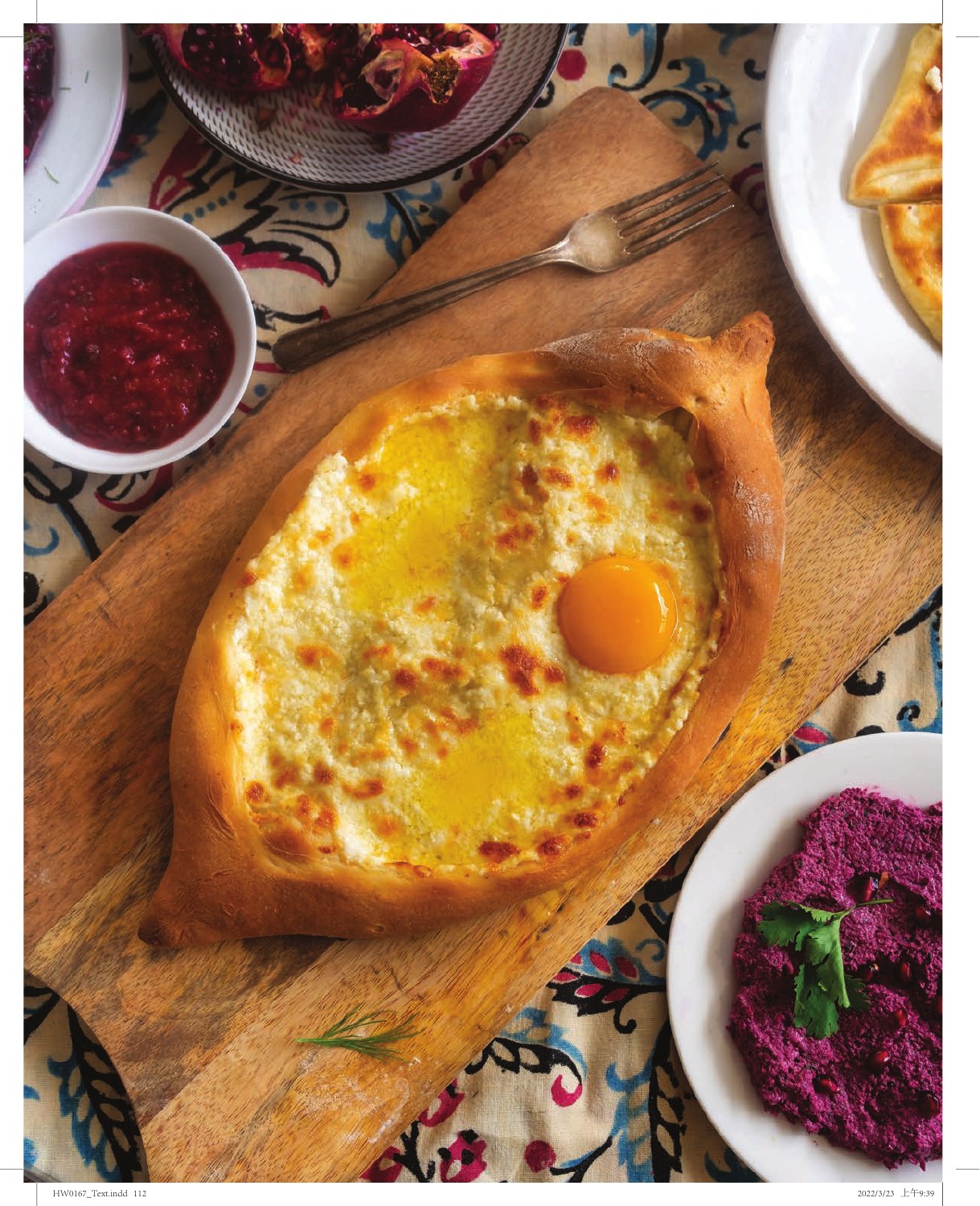
Take the pointed end first. On an Adjaruli khachapuri, the cheese stops a little short of the tip, leaving a handle of browned bread that you can pull off without spilling anything. Drag the torn face through the yolk. A streak of yellow runs into the white cheese, and the crumb picks up both. Georgian House gives diners a little illustrated lesson in this business of tearing and dipping. The same menu can dispatch two other kinds of khachapuri in a line apiece. This one needs pictures. [1][2]
The boat comes from Adjara, on Georgia’s Black Sea coast. Its open middle gives the baker access to the filling right up to the moment the bread leaves the oven. It gives the diner much the same privilege once it reaches the table. Between those two moments the yolk has to travel intact. [2]
There’s cheese in the rim, too
Pull off the next piece a little farther down the side. A baker can tuck cheese inside that rounded lip, so the crust you have been using to fish out the filling comes with a little filling of its own. In Budmo!, Anna Voloshyna shows how it gets there. She folds dough over a layer of cheese, pinches the long seam shut and turns the parcel over. Then she takes a knife to the smooth side. The cut stops short of either tip. As she rolls the cut edges back, each one carries a seam of cheese with it. There’s room for another helping in the hollow she’s just opened. [3]
Kat Craddock reaches a similar shape from the other direction. In her Saveur recipe she starts with a circle scattered with cheese and rolls two sides toward each other, leaving a strip of daylight between them. A double twist at either end holds the rolls together. The customary cheeses are imeruli and sulguni. For her version, Craddock pairs low-moisture mozzarella with tart feta. Along the rim, the mozzarella pulls into a thread while the feta leaves a little sharpness behind. [2]
The egg gets its own turn in the oven
An egg laid on raw dough would have to survive the entire bread bake. By the time the crust browned, there would be little yolk left to dip into. Voloshyna lets the crust turn golden, presses a hollow in the cheese with a spoon and slips in a yolk. It gets scarcely half a minute of oven heat. The butter goes on when the bread is ready for the platter. [3]
Using a whole egg changes the baker’s cue. Craddock watches for the white to set on the already hot cheese. The bakers at King Arthur use a cooler oven and offer two finishing times depending on how firmly their diners like their eggs. Both recipes give the bread a head start. How long the egg spends in the oven determines what you can do with that first piece of crust. [2][4]
There’s a small pleasure in leaving some of the yolk unmixed for a moment. One dip can be almost all salty cheese, the next thick with yolk and melting butter. By the time you work your way down the sides, the distinction is mostly gone. Save the other pointed end. It will reach the last streak on the plate.
Sources
- Georgian House, English menu. Illustrated instructions for eating Adjaruli khachapuri and the restaurant’s regional bread selection.
- Kat Craddock, “Adjaruli Khachapuri (Georgian Cheese Bread),” Saveur.
- Anna Voloshyna, “Adjarian Khachapuri,” photographed recipe excerpt from Budmo!, Rizzoli.
- King Arthur Baking, “Khachapuri (Georgian Cheese Bread).”