A man walks past, barely speaking. His eyes keep turning. Walt Whitman tries out a few words for what he sees in them, crosses some out, draws a line across the page. A spider has been casting threads a few lines above him. The spider made it into Leaves of Grass. The man vanished. If you know “A Noiseless Patient Spider” as a poem about the soul alone in the universe, it comes as something of a surprise to find that it was once this crowded. [1][2]
Whitman had long used notebooks for such encounters between unlikely neighbors. The Library of Congress has one with trial lines for Leaves of Grass predating the first edition. Later he even used wrappers from the 1855 edition as paper for notes toward a dictionary. A finished book could furnish the stationery for an unfinished one. During the Civil War his note-taking acquired another use. Looking for his wounded brother George, Whitman met other soldiers and began taking down their accounts. Listening to a stranger could mean setting aside space on a page for what the stranger had to say. [3][4]
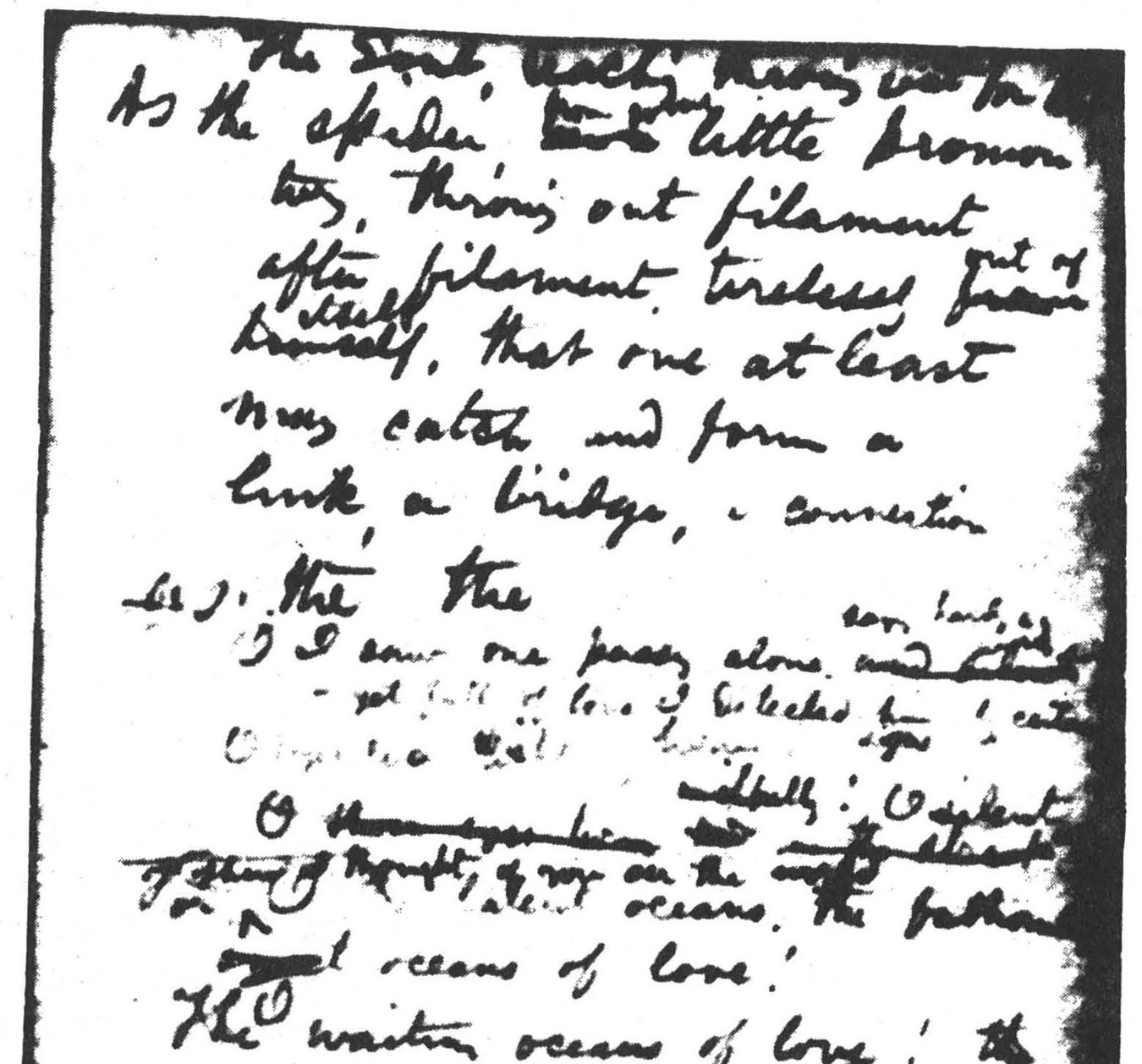
The man with the turning eyes poses a different problem. On the wartime notebook page that Paul Diehl reproduces, the speaker thinks he can detect a stranger’s capacity for love from signs. The stranger gets no speech confirming the guess. Nor can we say for certain in what order Whitman set down the pieces of this draft. Diehl points to a line about reaching for love squeezed in at the top. Read it first, and everything below seems to illustrate it. Imagine Whitman adding it later, and you can hear a writer trying to name what a spider casting silk and two men within glancing distance might have in common. Both readings fit the available space. [1]
Consider what Whitman eventually allowed his observer to know. In the first of the published poem’s two stanzas, the speaker twice uses the verb “mark’d.” He can vouch for the ledge where the spider stands and the silk it pays out. Try saying “filament, filament, filament” in a single breath. The tongue has to start the little operation over each time, even as the breath carries all three words easily along. The line gives a reader something remarkably like the spider’s occupation for a couple of seconds. By the end of the stanza the speaker has watched quite a while. He still hasn’t seen a thread catch. [2]
When these lines first appeared in a London magazine in 1868, they sat under a number, the third part of “Whispers of Heavenly Death.” A reader encountered death in the heading before reaching the spider. The familiar separate title gives a new reader a smaller place to begin, down on the ledge beside the animal. In either setting the white space after the fifth line does delicate work. Across that gap Whitman changes whom he is talking to. “And you O my soul” has the intimacy of someone turning to a companion who has been watching over his shoulder. For a moment even a solitary person seems to have company. [1][2]
Then comes the hard part of addressing any companion. Who gets to say what will happen to them? Three times in the last two lines Whitman says “till.” Each time the word lets him picture a successful crossing a little more precisely. There might be a bridge to walk on. An anchor might take hold. With the last attempt he is back to the weight of a thread, and all he can give it for a destination is “somewhere.” The repeated word puts every one of these happy outcomes just ahead of the moment in which he speaks. [2]
I like to think of the passerby here. In the notebook Whitman could look into another man’s face and hazard a guess about what he wanted. In the published poem he takes responsibility for the wanting himself. The soul he calls to is his own. Across from it he leaves enough room for another person, and enough silence for that person to keep walking. [1][2]
Sources
- Paul Diehl, “‘A Noiseless Patient Spider’: Whitman’s Beauty—Blood and Brain,” including the notebook photostat and the magazine printing.
- Walt Whitman, “A Noiseless Patient Spider,” from the 1891–92 Leaves of Grass. Representative Poetry Online, University of Toronto.
- Library of Congress, “Journalist and Teacher,” including Whitman’s trial lines and notebook for a dictionary.
- Library of Congress, “Wound Dresser,” on George Whitman and the poet’s encounters with Civil War soldiers.