What is the Latin for parsley? At dinner in Robert Browning’s “Soliloquy of the Spanish Cloister,” someone has apparently thought this worth asking. The monk who has to sit through Brother Lawrence’s conversation can stand the weather, barely. He can stand the prospect of a poor cork harvest. By the time he gets to the parsley, he has a question of his own, about the Greek for a pig’s snout. Try reading the stanza aloud and deciding where to change voices. Browning has given one man all the lines. [1]
We meet this monk in the garden, already growling, while Lawrence waters his flowers. Hatred has made him quite a gardener by proxy. He knows which bush needs a trim and which vase needs filling. It has made him an attentive listener, too. The talk about the cork crop has a little hesitation in it, a moment in which the speaker revises his estimate of what the trees will yield. Someone at that table has a feel for the coming season. Someone else has remembered the cadence exactly. The pleasure of the dinner stanza is discovering how good an impression a man can do of somebody he wishes he never had to hear again. [1]
When the poem appeared in Dramatic Lyrics in 1842, Browning paired a French camp with a Spanish cloister. The title that now tells us we are hearing a soliloquy came in 1849, when he separated the poems. That small piece of publishing history changes the invitation on the page. The early heading tells us where to place the men. The later one tells us how many voices we can trust ourselves to have heard firsthand. [2]
At the cupboard, the impersonation takes a curious grammatical turn. Lawrence has a spoon, a polished platter and a goblet marked with his initial. In the monk’s mouth they become possessions of a grand little household of one. He can scarcely get through the word “ourself” without making Lawrence sound insufferable. Yet the single letter on the cup is L. The owner has put his name on one thing. His neighbor has supplied the voice in which he supposedly lays claim to everything. The monk even breaks off his routine to chuckle when a lily snaps. We catch him enjoying his evening. [1]
The poem gives us one good reason to credit his observations. At the end of a meal, Lawrence finishes his drink in one gulp. The speaker takes three sips of watered orange pulp in honor of the Trinity. An actor could play the whole difference between the men with a glass and a pause. But consider what it takes to produce this comparison. Through at least part of his private devotion, the man who counts to three has an eye on the man who drinks in one. By the time he congratulates himself on having upheld a doctrine, Lawrence has finished his juice. [1]
With the flowers, the performance finally costs Lawrence something. The monk puts on a solicitous voice to ask about the disappointing garden. Then he lets us in on his own habit of secretly nipping the plants. Read back from that admission to the snapped lily. Browning leaves open how that particular stem broke, but the laugh sounds different now. Until this point we could enjoy the speaker as the house expert on Lawrence’s little ways. Now we know he can arrange the very evidence on which his jokes depend. [1]
At Vespers the monk has to change voices in a hurry. He has been mentally drafting a contract with Satan, complete with a loophole. Evening prayer catches him mid-spell. As the George Mason University annotations point out, even the Latin salutation comes out in a scrambled order. Browning does, however, give him a magnificent rhyme. His voice carries the sound of Lawrence’s rose-acacia straight into the Latin gratia. For an instant the shrub he wants blasted and the grace he invokes sound perfectly at home in the same mouth. Then comes the growl we heard at the start. Lawrence, so far as we can tell, has spent this time watering the garden. [1][4]
Sources
- Robert Browning, “Soliloquy of the Spanish Cloister.” Full poem, Academy of American Poets.
- “Browning’s Spanish Settings and Characterization in the Dramatic Monologue.” Publication history of “Camp and Cloister,” via Dialnet.
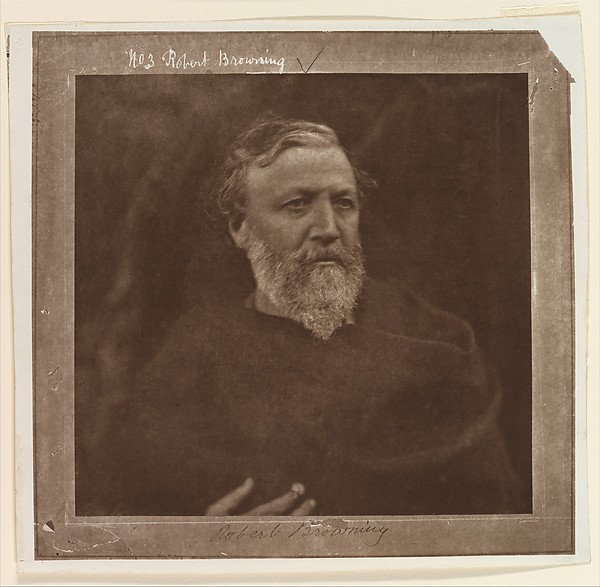
- Metropolitan Museum of Art, Julia Margaret Cameron’s Robert Browning. Collection record and photograph, object 33.43.353.
- George Mason University, annotated text of “Soliloquy of the Spanish Cloister.” Notes on the religious references and the closing prayer.