Mr. Hale points upstairs. He is showing the county attorney how Minnie Wright, sitting in her kitchen the morning before, indicated where her dead husband lay. For a moment the farmer has a part to play. He points where she pointed, walks where he walked. Just as he gets to the sight of the body, the attorney interrupts. Hale can tell that part upstairs, where he can show the men exactly what he means. An excellent suggestion for a murder inquiry. For anybody in the audience who wants to see that bedroom, it is the end of the road. [1]
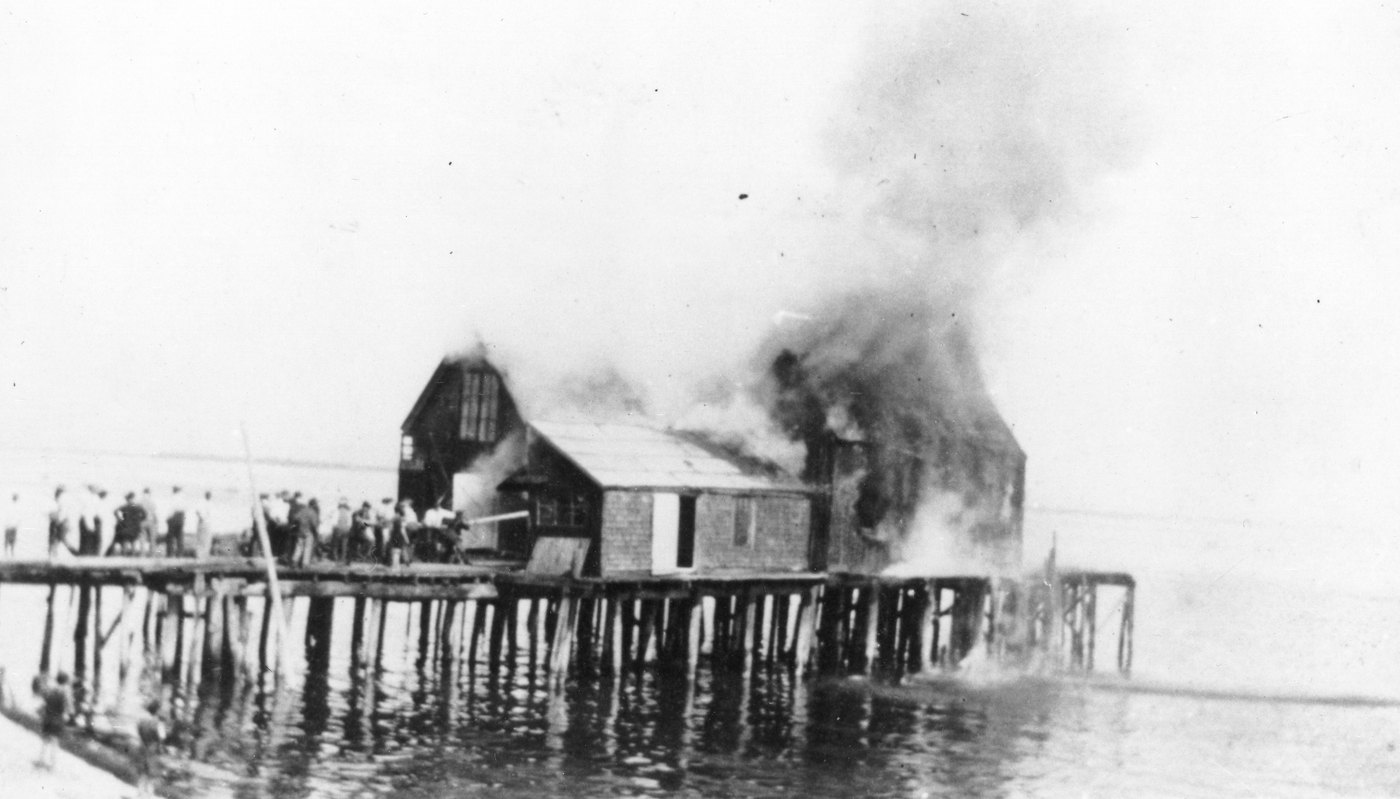
Susan Glaspell keeps the whole of Trifles in the kitchen. The Provincetown Players first put it on at the Wharf Theatre in August 1916, a month after a local photograph caught Lewis Wharf on fire. Glaspell herself played Mrs. Hale, the neighbor who comes along to help gather a few things for Minnie, now in custody. Years earlier, reporting on an Iowa murder case, Glaspell had visited the kitchen of a woman held in jail. The detail she carried away, in her later account, was the experience of walking into that room with its occupant gone. Onstage she gives somebody else that walk. [1][2][3]
Consider what there is to look at while Hale testifies. He indicates the rocker in which he found Minnie. Everybody turns to look at it, a small but rather wonderful demand on the actors. For a beat five people attend to an empty chair. Hale can do Minnie's pointing for her. He has more trouble with her laugh. First he calls her scared, then, as the attorney makes a note, he tries to take the word back. Later Mrs. Peters sits down in the rocker by accident. As soon as she realizes where she is, she gets up. The chair has hardly moved and already two quite different things have happened around it. One witness has tried to say what it was like to see Minnie there. Another has briefly occupied her place. [1]
Once the men go upstairs, listening becomes part of the women's conversation. Mrs. Peters begins to speak, hears steps overhead and lowers her voice. Much later she tells Mrs. Hale about a boy who killed her kitten with a hatchet when she was a girl. Someone had to hold her back. How would she finish the sentence if the two of them were alone? Glaspell writes “I would have—” and gives the actress a glance upstairs. There are those steps again. Only then does Mrs. Peters manage “hurt him.” An actress can put a good deal of time between those three words and the last two. The sheriff, still upstairs, need never know he has taken part in the conversation. [1]
By now the women have found Minnie's dead bird, its neck wrung. They can imagine a reason someone might have put a rope around John Wright's neck. The county attorney comes back into the kitchen still wishing for precisely such a reason. Glaspell gives him a fair chance. He picks up an apron and actually disturbs the quilt pieces covering the box that holds the bird. Then the sheriff wants him to look at some windows in the other room. That mundane request buys the women a few seconds in which they have to decide what to do with what they know. [1]
It is worth following the hands here. Mrs. Hale signals with her eyes. Mrs. Peters makes the first attempt, but the box is too big for her bag. She opens it to take the bird out and finds she cannot touch it. The next cue is the sound of a doorknob turning. Mrs. Hale has a coat pocket big enough for the whole box. If a director rushed this business, the two women might seem to have reached an agreement long ago. Played at the speed of a woman finding out what fits in her bag, it leaves room for the more unsettling possibility that neither knows what she will do until she sees what the other cannot. [1]
Glaspell later made the play into the short story A Jury of Her Peers, and the two works have acquired a place in feminist legal criticism. The story's title gives an inviting name to what the women have done. At the end of the play I find myself thinking about the peculiar position of a spectator. We have seen the evidence leave the table. We could tell the attorney exactly whose pocket to search. And when he comes through that door, the convention that has kept us quietly in our seats all evening allows Mrs. Hale to keep her hand there. [1][2][4]
Sources
- Susan Glaspell, Trifles, complete one-act play and original cast list. Musical Theatre Resource Center.
- History Matters, “Trifles,” production history and Glaspell’s account of the Iowa kitchen.
- Provincetown Advocate, photograph of the Lewis Wharf fire, July 6, 1916. Wikimedia Commons.
- J. Ellen Gainor, ed., Susan Glaspell in Context, introduction and contents. Cambridge University Press.