On the night of 16 October 1834, firefighters took several engines inside Westminster Hall. The rooms at its south end were burning. Outside, soldiers and firemen had falling rafters and molten lead to contend with. Inside, the crews had a stretch of open floor, stone walls and a way up toward the medieval roof. A builder had left them scaffolding. The repairs for which it had been erected suddenly came second to keeping the roof above it.[1][2]
By then the fire had taken the House of Lords and reached the Commons. What gave the crews a chance in the Hall after they had lost so much of the same palace? James Braidwood, who led the London Fire Engine Establishment that night, later wrote to The Times about a skill that had failed him at Westminster. Ordinarily he could stand outside a burning building and form a fair idea of the rooms his men would find inside. Here he could look straight at the building and have no idea where a passage went.[1]
The receipt beneath the floor
That morning the job at Westminster had been to clear away two cartloads of old receipts. The English Exchequer had recorded payments on wood from the middle of the twelfth century until 1826. A surviving London tally dated 1822 gives some idea of what a clerk once handled. Its longer piece, the stock, measures 58 centimetres. The shorter foil fits against it. Notches cut into the wood recorded sums ranging from pennies to thousands of pounds. The pieces could go their separate ways and later be brought together to check the payment. An alteration to one set of marks would show when the pieces met again.[3][4]
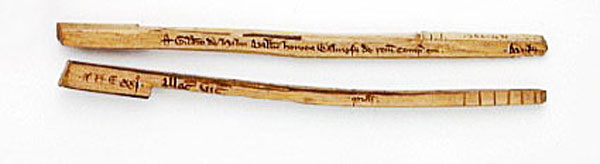
Eight years after the last such accounts were kept, the wood still took up space. The Clerk of Works chose two stoves beneath the House of Lords for its disposal. Two workmen began in the morning. Upstairs that afternoon, the deputy housekeeper, Mrs Wright, took visitors through the chamber. They could feel the heat through the floor and see smoke coming up. Below them, the men still had a job to finish. By five the stoves were out, and Mrs Wright locked up.[4]
That hour matters. Someone checking whether the men had left a stove alight could have come away satisfied. A different fire was already smouldering beneath the floor. Shortly after six, a doorkeeper’s wife returning from an errand saw flames at the scarlet curtains around Black Rod’s box. The historian Caroline Shenton traces what the woman could see in the chamber to the collapse of the flues underneath it. At about half past six the fire broke through the roof, visible across London. The visitors who had felt the hot floor had come closer to its beginnings than any of the people who now had a clear view from the street.[4][6]
What Braidwood could see
Braidwood’s letter reads like a walk around a building he wished he had known earlier. In a house, the positions of windows and doors gave him clues to the divisions behind them. Even a warehouse or factory had a layout his crews could often infer from the street. Westminster had grown by successive alterations. A passage that got a clerk conveniently from one office to the next could carry smoke and flame the same way. Braidwood called attention to the missing party walls, the deep ranges of rooms and the quantity of timber on the outside. His list ends with an unusually personal admission for a superintendent explaining a public disaster. He counted his own unfamiliarity with the place among the reasons for the loss.[1]
People had time to carry bundles of public papers to safety. Saving a chamber required something else. Crews tried to defend the Commons while there was still distance between it and the seat of the fire. Around eight, according to the Worshipful Company of Firefighters’ account, the wind drove flames against the corner nearest the Lords. Men working on the Commons roof had to give it up. The fire passed on through committee rooms toward the south end of Westminster Hall. On a plan those rooms might read as a succession of separate destinations. To the men with the pumps they had become one continuous fire.[1]
At the Hall, some of Braidwood’s difficulties fell away. The thick masonry could hold back fire while crews worked, and the repair scaffold gave them access above the floor. The vulnerable part was overhead. The great span of oak dated from the late fourteenth century. Prime Minister Lord Melbourne called for water to be directed onto the roof. Parish and insurance engines had joined Braidwood’s establishment at the palace, and volunteers helped work the pumps. The engines brought into the Hall could put water where it would help preserve a whole building, even as the rooms beside it burned.[1][2][6]
The men still needed a little luck. Around midnight the wind shifted in their favour. A floating fire engine arrived on the Thames, bringing pumping power to a fire whose demands had exceeded the ordinary water supply. By morning the Hall had its roof. The crews stayed for five days dealing with fresh outbreaks in the ruins. When the Privy Council investigated on 22 October, it traced the origin to the furnace below the Lords. That finding answered the question of how the fire began. Braidwood’s account answered the question a visitor walking through the ruins might have asked next. Why had the destruction run so far in one direction and stopped here?[1][2][6]
What the walls could still do
Within two weeks scaffolding went up again, this time against the surviving walls of the former House of Lords. Robert Smirke, the architect whose repairs had put scaffolding inside Westminster Hall before the fire, now had to find rooms for Parliament to meet in. William IV had offered Buckingham Palace. Occupying it would mean remodelling a newly refurbished royal residence, and even its location struck critics as inconvenient for business. Smirke could do more with the shells still standing at Westminster than the first accounts of devastation might suggest.[7]
On 19 February 1835 MPs assembled inside the repaired walls of the room where the doorkeeper’s wife had seen the curtains catch. The Lords had moved to the Painted Chamber. Above the Speaker’s chair in the temporary Commons was a gallery with its own entrance for reporters, who previously had to compete for places in the back row of the public gallery. A newspaper reader following the first debates could thus benefit from a curious distinction the fire had made. A chamber could be lost in an evening. Enough of its walls could survive for a different House to meet there four months later, with a better seat for the person taking down its words.[7]
Sources
- Worshipful Company of Firefighters, “Houses of Parliament 1834,” including James Braidwood’s letter to The Times.
- UK Parliament, “Reconstruction and the fire of 1834,” on repairs and the defence of Westminster Hall.
- Science Museum Group, “Exchequer split tally, English, 1822,” object 1860-30.
- UK Parliament, “The Great Fire of 1834,” on the stoves, the visitors and Mrs Wright.
- Nick Barratt, photograph of Exchequer tally sticks, 2013, via Wikimedia Commons.
- Caroline Shenton, “The Westminster Fire of 1834,” The History of Parliament, 2025.
- Kathryn Rix, “‘A place of business’: the temporary chamber of the House of Commons, 1835–1851,” The History of Parliament, 2025.