The most telling words in Abraham Lincoln’s patent come before he names a single pulley. He wanted boats to pass through shallow water “without discharging their cargoes.” A captain whose keel caught on a sandbar could already make his boat draw less water. The crew could take freight off, float the boat free, then put the freight back. Lincoln’s promise, in the application he filed on March 10, 1849, was that every barrel a shipper had paid to send downriver could stay where it was.[1][2]
An episode from the previous year helps explain the appeal. On Lincoln’s journey home to Illinois in 1848, according to biographer Sidney Blumenthal’s account as reported in Time, a steamboat grounded in the Great Lakes. The captain had empty barrels lashed alongside. The distinction between the two sets of barrels matters. A barrel of freight weighed the vessel down. An empty barrel held partly underwater could help bear that weight. What would it take for a boat to carry a permanent version of the captain’s improvisation?[2]
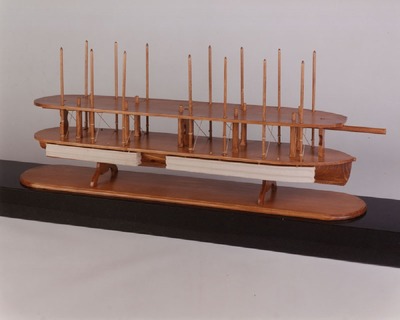
Start with the sides of the boat. Lincoln put a chamber there with a stiff top and bottom and waterproof cloth between them. Packed away, it took up little room. To open it, turn a shaft running lengthwise through the vessel. Ropes carried the motion out to upright spars fastened to the bottom of the chamber. As the spars pushed the bottom down, short restraining ropes caught the top. The two faces drew apart. Air entered through openings above, much as it enters a bellows when someone pulls the handles apart.[1]
Here the direction of travel can trip up a reader. The spars go down because the boat needs to go up. Opening a chamber below the waterline makes room for air where water used to be. The water pushes back, and the fittings transmit that upward force to the hull. Lincoln allowed for a shaft made in sections. A crew could put one pair of chambers to work separately, a useful distinction on a long vessel where one end might still be afloat.[1]
The final sentence of the patent runs the whole operation backward. Once the boat cleared the bar, the crew could reverse the shaft, squeeze out the air and draw the folded chambers up under cover. Imagine leaving a length of wet fabric hanging over the side for the rest of a river passage. Stowing it safely was part of the invention Lincoln claimed. So was the linkage that allowed the same control to do both jobs. The Patent Office granted that claim on May 22, 1849.[1]
The little boat in the photograph belongs to a history of how inventors made themselves understood in Washington. Under section 6 of the Patent Act of 1836, an applicant whose invention could be represented in miniature had to furnish a model sized so that its parts could be seen to advantage. Lincoln brought a wooden model to Washington. An examiner could inspect the relation between a spar and the chamber it opened, the very thing that takes several sentences to follow on paper.[2][4]
There was one question the examiner could scarcely settle by looking at a model on a table. How hard would a crew have to turn that shaft with a loaded hull resting on a bar? In a later interview, a Smithsonian curator drew attention to the force needed to drive the floats underwater. The specification allows the boat’s steam engine to turn the shaft, or people to turn it by hand. It gives no result from a loaded passage. On paper the freight stays aboard from the first sentence to the last. Getting it over an actual sandbar was the part that remained to be demonstrated.[1][2]
Sources
- Abraham Lincoln, “Buoying Vessels over Shoals,” U.S. Patent 6,469, May 22, 1849. Frank and Virginia Williams Collection, Mississippi State University Libraries.
- Time, “How Abraham Lincoln Became the Only U.S. President to Hold a Patent,” 2016. The 1848 voyage, the model and the practical difficulty of deployment.
- “Photograph of Abraham Lincoln Patent Reproduction,” undated. Frank and Virginia Williams Collection, Mississippi State University Libraries.
- United States Congress, Patent Act of July 4, 1836, section 6. Requirements for descriptions, drawings and models.