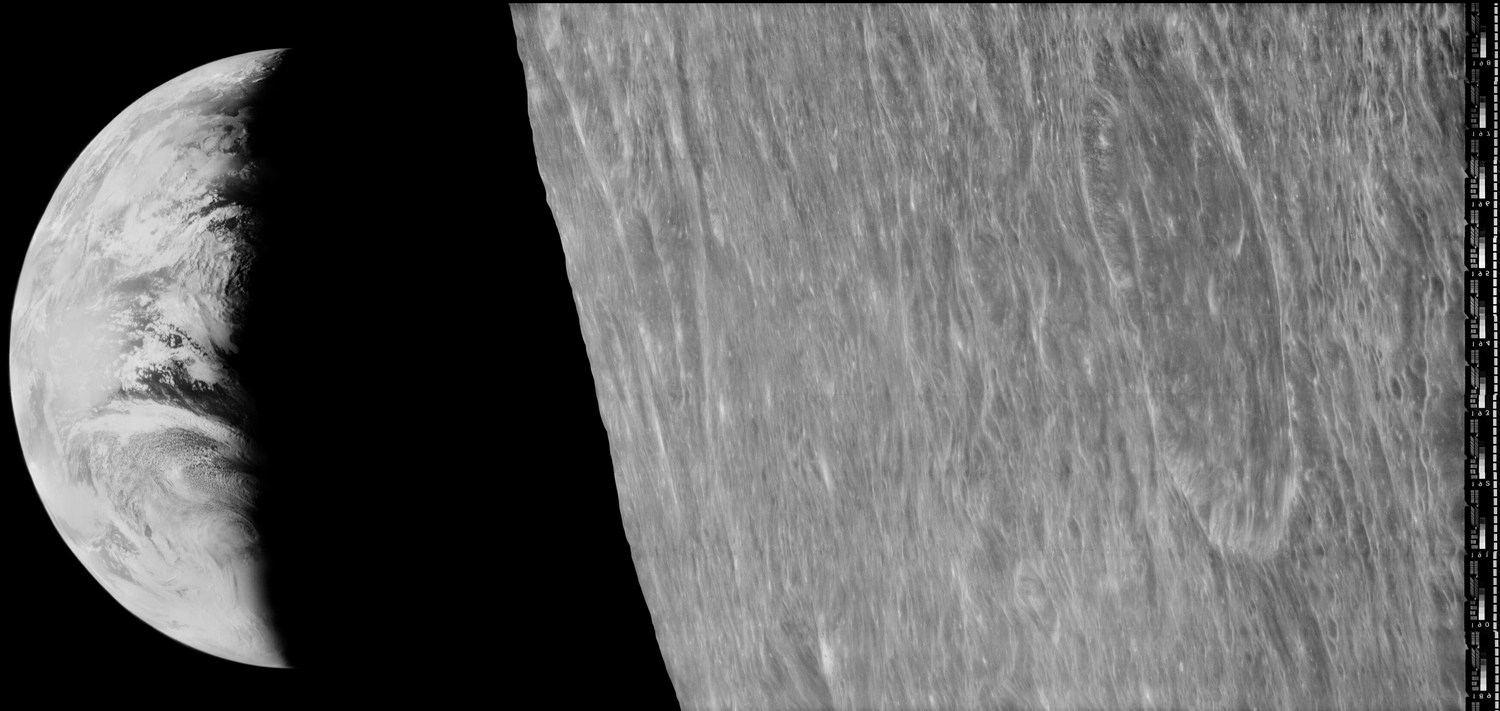
Look at the clouds first. They curl across a bright crescent of Earth, thick enough to hide most of the land. NASA’s caption gives a reader looking for a foothold the western edge of Africa, faintly visible at upper left. Across a narrow band of black, the Moon fills the right side of the frame. Tilt your head toward your left shoulder and the slanting edge of that gray ground becomes a horizon. Now there is somewhere to imagine standing. Nobody stood there. Lunar Orbiter 1 took the photograph on August 23, 1966, and the version in which we can pick out those clouds dates to November 2008. What, exactly, survived between the two dates?[1][2]
An extra exposure
The horizon is the first clue that something unusual happened. The engineers planning the Apollo landings wanted to look straight down. They needed to find level ground with a clear approach, and Lunar Orbiter 1 carried a Kodak camera system with two lenses. A wide view could place a promising patch of terrain in its surroundings. A narrow one could pick out features within it. Earth lay well outside the ordinary business of either lens.[2][3]
One detail in NASA’s mission history explains how the photographers acquired some latitude. A problem with the film developer meant that controllers had to advance the film more often than planned. There was room in the schedule for extra exposures. The team turned the spacecraft to look along its direction of travel. As it came around from the far side of the Moon on August 23, the camera caught Earth beyond the curve of the lunar surface. Two days later the controllers had it take another look.[2]
Consider what that turn did to the foreground. In a downward survey photograph, one might ask how far a patch of smooth ground extends before a crater interrupts it. Here the ground recedes into the distance. It offers the eye a place from which to look out. The crewless machine produced a view that a person could inhabit precisely because, for this exposure, its operators had given it a different job.[1][2]
What came home
There was film aboard the orbiter, and there was film on Earth. They were different strips. In flight, the Kodak system developed the exposed film and passed a scanner over it. The spacecraft transmitted the resulting signal. On the ground, equipment could turn that signal back into a photographic image, and recorders could also preserve it on magnetic tape. On October 29, 1966, controllers deliberately sent the spacecraft into the far side of the Moon. By then its transmissions were safely on Earth.[2][3][4]
For someone who had seen the grainy picture in circulation, a better copy might have seemed to depend on finding a better print. The tapes offered another way back into the exposure. They held the signal from which the ground equipment had made a picture in the first place. A limit on the detail that equipment could reproduce in 1966 need never have been a limit on what the camera had seen.[1][4]
At NASA Ames in California, the Lunar Orbiter Image Recovery Project put period tape drives back into working order. That was the part a newer computer alone could never do. Once the drives could play the old recordings, the team could digitize their output and reconstruct the photograph. NASA released the recovered view on November 13, 2008. The clouds belong to a single August day in 1966. The separation between shades of gray that lets us follow their contours also owes something to the people who read the tape forty-two years later.[1][4]
At the time of the release, the team had some 1,500 tapes to work through. For lunar scientists, the promise lay in the less celebrated frames looking straight down. An older picture of a patch of ground could be set beside a new survey of the same patch to look for evidence of later impacts. The photograph of Earth had served a practical purpose here, too. Before anyone could use the collection to ask what had changed on the Moon, those wisps of cloud had helped show how much of an old exposure the drives could still deliver.[2][4]
Sources
- NASA Earth Observatory, “Earthrise 1966,” November 15, 2008. Recovered photograph and Holli Riebeek’s description of the visible geography.
- NASA History, “55 Years Ago: Lunar Orbiter 1 Launches to Survey the Moon.” Flight chronology, film-advance problem and camera orientation.
- NASA, “Lunar Orbiter 1.” Mission objectives and the Kodak imaging system.
- Kimberly Newton, “NASA restores historic Lunar Orbiter 1 image of Earth,” Ames Astrogram, November 2008.