Ask for the religieuse at a raclette in Valais and you are asking for the bit a tidy cook might trim away. It forms along the rim of the half-wheel, where the cheese browns and goes crisp. Most of what slides from the knife will be soft enough to spread with a potato. The person who gets a piece of that rim has something to crunch.[1]
Cut a wheel across its diameter and the reason for serving it this way becomes plain. The cut exposes a long, flat face that the cook can turn toward the embers. As soon as the surface softens, a broad knife can take off dinner for one person. The solid cheese behind it gives the blade something to press against. Each pass uncovers a fresh face for the fire, while the projecting edges get another chance to toast.[1][2]
A potato can wait
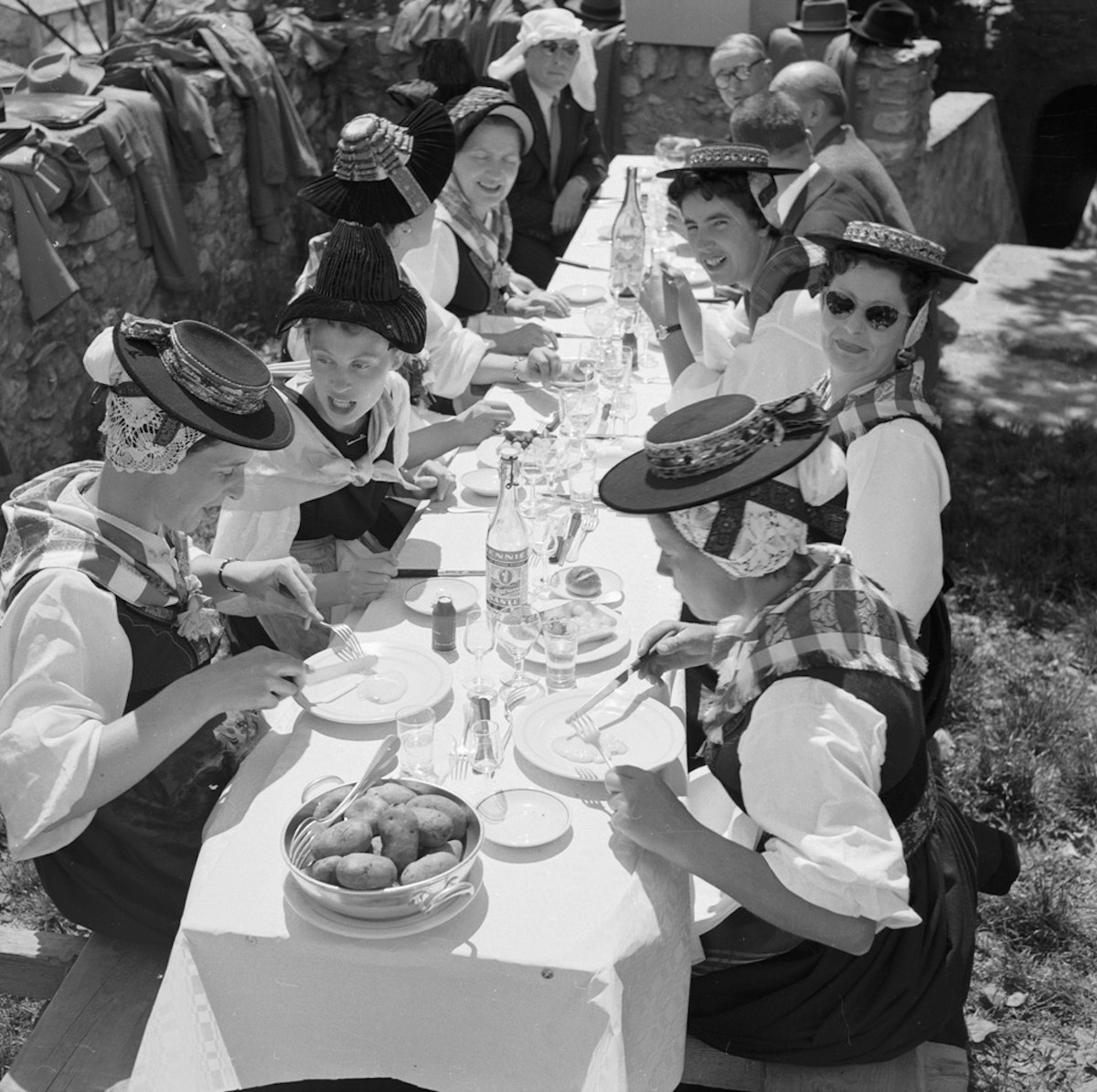
The potato has an enviable job at this table. Boiled in its skin, it can sit through a round of conversation. Split it and the two rough faces give the molten cheese somewhere to settle. A cornichon or a pickled onion supplies a cold, sharp mouthful between bites. The cheese sets the pace. If everyone waits politely for the last plate to arrive, the first guest loses the pleasure of pushing a fork through cheese still loose from the heat.[1][3]
There is plenty to taste even in a forkful that misses the brown edge. Raclette du Valais AOP is a semi-hard cheese made with raw cow’s milk from the canton. Switzerland Cheese Marketing describes a milky flavor with a little acidity and notes of herbs and fruit. Try a piece of the cheese cold if one comes your way. In Valais it also turns up sliced alongside dried meat and rye bread. A cold slice gives you time to taste the milk. On a hot plate, the first thing likely to command your attention is how far the cheese will follow the fork.[1][4]
Another turn at the wheel
A half-wheel no longer requires anyone to tend a wood fire all evening. The Swiss culinary heritage inventory describes an electric element sized for the job, now customary in Valais. The cook swings the cheese under the heater and draws it out to scrape. The little tabletop pans familiar elsewhere in Switzerland redistribute that work. Each diner lays a rectangle of cheese in a pan and decides when to tip it out. A table of six can melt six slices at once.[1][4]
The half-wheel offers a different pleasure precisely because people have to take turns. Swiss archivists have photographs of raclette at a mountain hut inauguration in Chandolin and at a grape harvest meal in Sion. The occasions are quite different, yet the work of feeding the group is easy to picture in either setting. Someone has to mind the cheese. Someone has a moment to peel a potato. And someone who has already had a plate can watch the brown lip growing on the wheel and put in a word for the next one.[1][2]
Sources
- Swiss Culinary Heritage Inventory, “Raclette du Valais (AOP),” on the browned rim, half-wheel ovens and accompaniments.
- Swiss Federal Office of Culture, “Raclette comme pratique sociale,” with historical photographs from Médiathèque Valais.
- Valais/Wallis Promotion, “Raclette du Valais AOP,” on serving raclette in the canton.
- Switzerland Cheese Marketing, “Cheese and preparation,” on the milk, flavor and serving methods.