At the Auberge du Safran in Taliouine, Mahfoud Mohiydine saved a few threads for the tea glasses. The rest he crumbled into cold water and brought to a boil before adding the gunpowder green tea. By the time he stirred in the sugar and poured the liquid back and forth between glass and pot, the tea was the color of caramel. A guest could pick out the whole thread in the glass. The saffron that had scented the pot was much harder to see. Jeff Koehler recorded the preparation during a harvest visit to southern Morocco in 2013. [1]
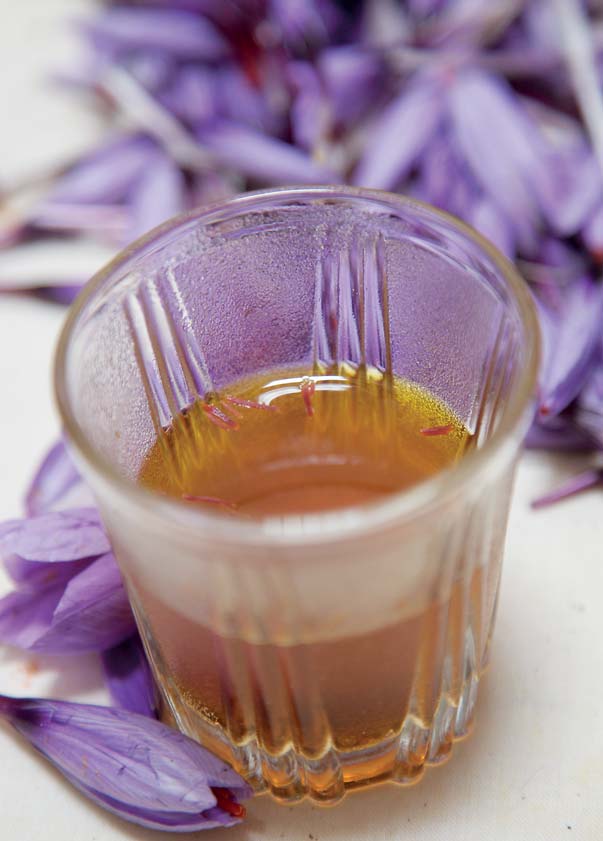
In the nearby village of Ighri, Koehler found a second occasion for the drink. The Ouhsoo family served it with toasted almonds at the table where they pulled the threads from the flowers. An ingredient valuable enough to sell by the gram was also what people drank to get through an afternoon of sorting it. [1]
What comes in from the field
On the Souktana plateau, the growers documented by Slow Food farm plots of a hectare or less, some 1,300 to 1,500 metres above sea level. Through the October and November flowering season, families go out at dawn while the crocuses are still closed. They carry the flowers into a cool room. Each purple bloom holds three red stigmas, and someone has to open it to reach them. Picking a basketful commits the household to another stretch of work indoors. [1][2]
The scale becomes easier to grasp at a kitchen counter. Enabel’s Trade for Development Centre estimates that a kilogram of dried saffron takes roughly 150,000 flowers. At that yield, the gram a cook can balance on a scale represents about 150 blooms, each handled in the field and again at the sorting table. The week in which those flowers open matters as much to a grower as their total number. [3]
In April 2026, Saida Abkhar of the Saktana Saffron Cooperative told Hespress that the harvest she remembered stretching from late October into early December had contracted to about twenty days. She described irregular rain and higher temperatures, with more of the crop ready at once. Rain had given her reason to expect a better yield. For a family doing the picking and sorting, a bigger crop in a shorter window also means more flowers coming through the door on the same morning. [4]
What leaves in the jar
Once dried, the threads can wait. Whether their owners can wait is another question. Slow Food describes its Taliouine producers keeping saffron in glass or terracotta jars, then delivering it to their cooperative or taking it to the souk. In its 2019 account, Enabel explains one attraction of the weekly market. A trader paid cash on the spot. A family with bills due had good reason to accept the offer, even knowing that the spice would fetch more farther along its route. [2][3]
For a restaurant buyer, that makes the name on the jar worth a second question. Knowing which cooperative supplied a batch gives the kitchen someone to ask about the flowering season or the terms of sale. The price of a gram on an invoice, however impressive, reveals little about what the household received that week. [2][3]
Back at the auberge, Mohiydine’s pot held enough for four. He allotted ten threads to the water and another one or two to each glass. It is an unusually legible piece of hospitality. A guest gets to see, against the side of the glass, exactly what the family in Ighri spent the afternoon teasing from the petals. [1]
Sources
- Jeff Koehler, “Morocco’s Threads of Red Gold,” Saudi Aramco World, September/October 2013.
- Slow Food Foundation for Biodiversity, “Taliouine Saffron,” producer and harvest profile.
- Enabel Trade for Development Centre, “Moroccan cooperatives contributing to sustainable future,” 2019.
- Hespress English, “Rain brings relief to Morocco’s saffron growers, but climate and costs still weigh,” April 2026.