Set down your chopsticks at Azumaya in Morioka and you still have some work to do. The person serving your wanko soba has another mouthful of noodles ready, and the sight of the bottom of your bowl is their cue to tip it in. If that last mouthful really was your last, you need to get the lid onto the empty bowl while the server is looking. It takes two people to agree that lunch is over.[1]
Azumaya has served soba in this city in northern Japan since 1907. You can also sit down there to a pork cutlet over rice, a meal whose size you can take in at a glance. The soba arrives in such small installments that, by the house reckoning, it takes about fifteen to make up an ordinary bowl. The arithmetic makes more sense from the other side of the table. Someone has to deliver lunch fifteen times.[1][2]
Iwate’s prefectural travel guide offers one account of how that division of labor came about. When a host had a crowd to feed, a batch of freshly boiled noodles could go round the room in small helpings. Everyone got some while they were fresh. Then the host came round again. In that telling, the immediate refill began as a courtesy. An empty bowl was something a good host looked out for.[3]
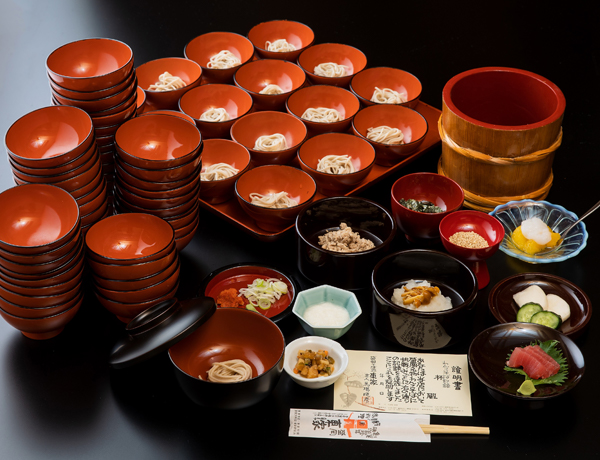
To start, lift the lid and raise your bowl a little to meet the server’s hand. The noodles come dipped in hot broth. Azumaya suggests tasting the first helping plain. After that, the little dishes on the table come into play. A dab of sesame paste can dress one mouthful. Grated daikon with red chili can sharpen the next. There is tuna sashimi to linger over and a tub for tipping out the broth that collects in the eating bowl. The short measure gives even an indecisive eater considerable freedom. A mouthful is about as long as you have to live with any seasoning decision.[1][4]
Meanwhile, the server has a voice in how fast lunch goes. The Morioka calls of “Hai jan jan” and “Hai don don” give each fresh helping a beat. Travel south in Iwate and the same small portion keeps quite different time. Hanamaki traditionally dispenses with the chant. Around Hiraizumi and Ichinoseki, the moridashi style puts a tray of filled bowls in front of the guest, who can pause as long as they like between them. Look at the tray and you can see your next several bites. At Azumaya you have to look up at a person.[1][4]
What you can see at Azumaya is how much you have already eaten. The server stacks the little bowls emptied into yours. At a hundred helpings the house awards a tegata, a commemorative token, but its own instructions also encourage guests to take their time and talk to the person serving. There is room in the ritual for someone who wants a souvenir and someone still considering the sesame paste. Each has a lid within reach.[1]
Sources
- Azumaya Soba Shop, “Wanko-Soba Noodles,” house menu, photograph and serving instructions.
- All Nippon Airways, “Wanko Soba Azumaya,” on the Morioka shop and its menu.
- Iwate Official Travel Guide, “Wanko Soba (Morioka),” on the local custom of feeding guests.
- Travel to Tohoku, “Explore the Diversity of Japan’s Noodle Culture,” on broth and regional serving styles.