“Painted stations whistle by.” Try telling the stationmaster that. He has spent the afternoon in the same building, listening to engines announce themselves. From the seat Robert Louis Stevenson gives us in “From a Railway Carriage,” though, the sentence reports exactly what happens. A patch of colour and a blast of sound arrive together at the window and vanish together. Across the Atlantic, Emily Dickinson gave a railway engine a quite different audience. Her speaker likes to watch it come in. The pleasure of reading these two short poems together is that you can get off Stevenson's train, stand beside Dickinson, and feel the verbs change hands. [1][2]
Dickinson begins with a tongue. The creature can “lap the miles,” and the little flick it takes to say lap seems sufficient to dispose of a considerable stretch of country. Valleys go down just as easily. Then the animal has to stop at a tank. There is something companionable about this first pause. Anyone who has walked a thirsty dog knows how a journey gets divided up on the animal's terms. Only here the drinking bowl belongs to a railway, and somebody has installed it exactly where the beast will need it. An entire system of human arrangements peeps through the animal fancy. [2]
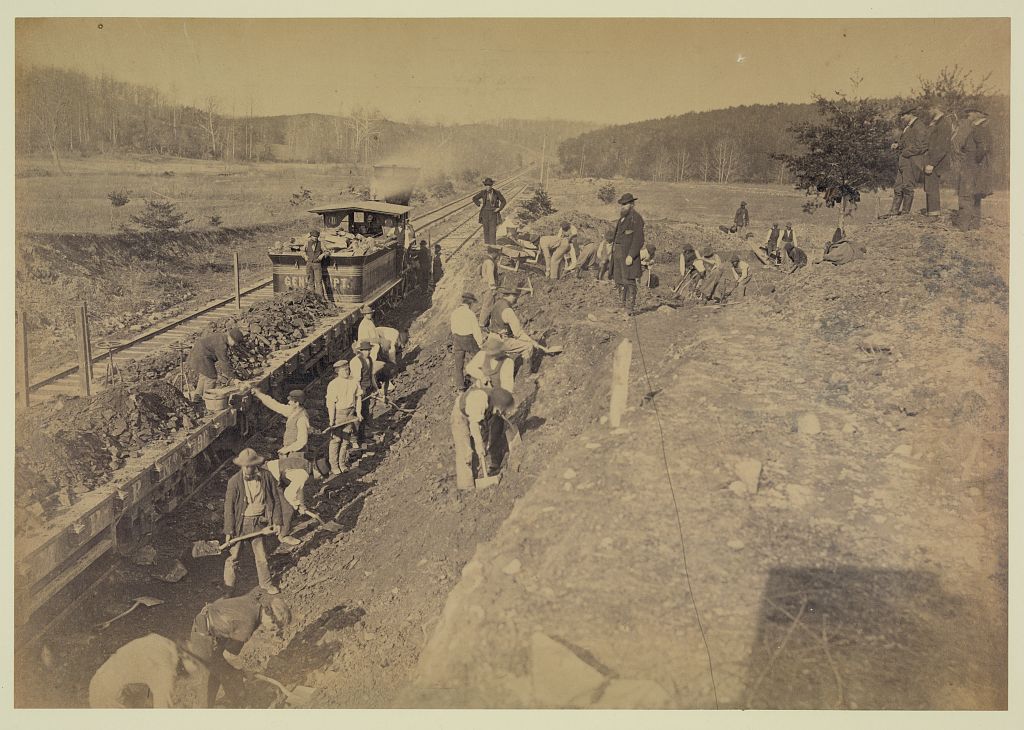
Russell's photograph gives the men who cut a railway through the earth time to stand still and be seen. Dickinson makes the same work go by in a grammatical sleight of hand. In lines eight and nine the engine appears to shave a quarry down to its own dimensions as it passes. The University of Toronto's edition records a small difference between the manuscript and the early printed text. In print the cutting fits the train's “sides.” In manuscript it fits its “ribs.” With that one word restored, you can almost feel the mountain graze a flank. The boast about what the engine can do to rock contains a shiver about what rock might do to the engine. [2][3]
Stevenson's passenger has time for a different kind of mistake. Halfway down the page a child appears gathering brambles. Listen to how long he gets to stay. The first line gives him two ways of getting up a bank, clambering and scrambling. The next discovers what he came for. The rhyme of “scrambles” with “brambles” buys him that extra instant. A man standing and gazing gets one line. By the last couplet a mill and a river have to share one. The beat carries on at much the same cheerful clip while the allowance of time per sight dwindles. You might still be wondering what the man was looking at when the poem runs out of track. [1]
There is a measure of that loss elsewhere in A Child’s Garden of Verses. In the 1885 volume, an earlier poem, “Travel,” lets a child wish a whole itinerary into existence. At the Nile the child can linger through the blink of a crocodile and watch a flamingo fishing. Imagination can hold those two creatures in view for as long as their encounter takes. The passenger on page 45 has made it aboard an actual conveyance in the world of the poem. A boy picking berries within calling distance is already beyond reach by the time the passenger has found the word for what he is picking. [1][4]
Dickinson can afford to wait for her animal at the end of its run. There is even time, after the great emphatic “Stop,” to consider how much strength it takes for something that powerful to arrive so gently at its stable. Stevenson's last line leaves the passenger considering what has gone. I like to think the berry picker has a pocketful by now. To find him again, a passenger has to turn the train around. A reader only has to go back eight lines. [1][2]
Sources
- Robert Louis Stevenson, “From a Railway Carriage,” Scottish Poetry Library.
- Emily Dickinson, “The Railway Train,” Representative Poetry Online, University of Toronto. Text of the 1891 publication and notes on the manuscript.
- Andrew J. Russell, “Excavating for ‘Y’ at Devereux Station, Orange & Alexandria Railroad,” 1863. Library of Congress albumen print, catalogued on Wikimedia Commons.
- Robert Louis Stevenson, A Child’s Garden of Verses, 1885. First-edition scan, including “Travel” on pages 13–14, University of Pennsylvania.