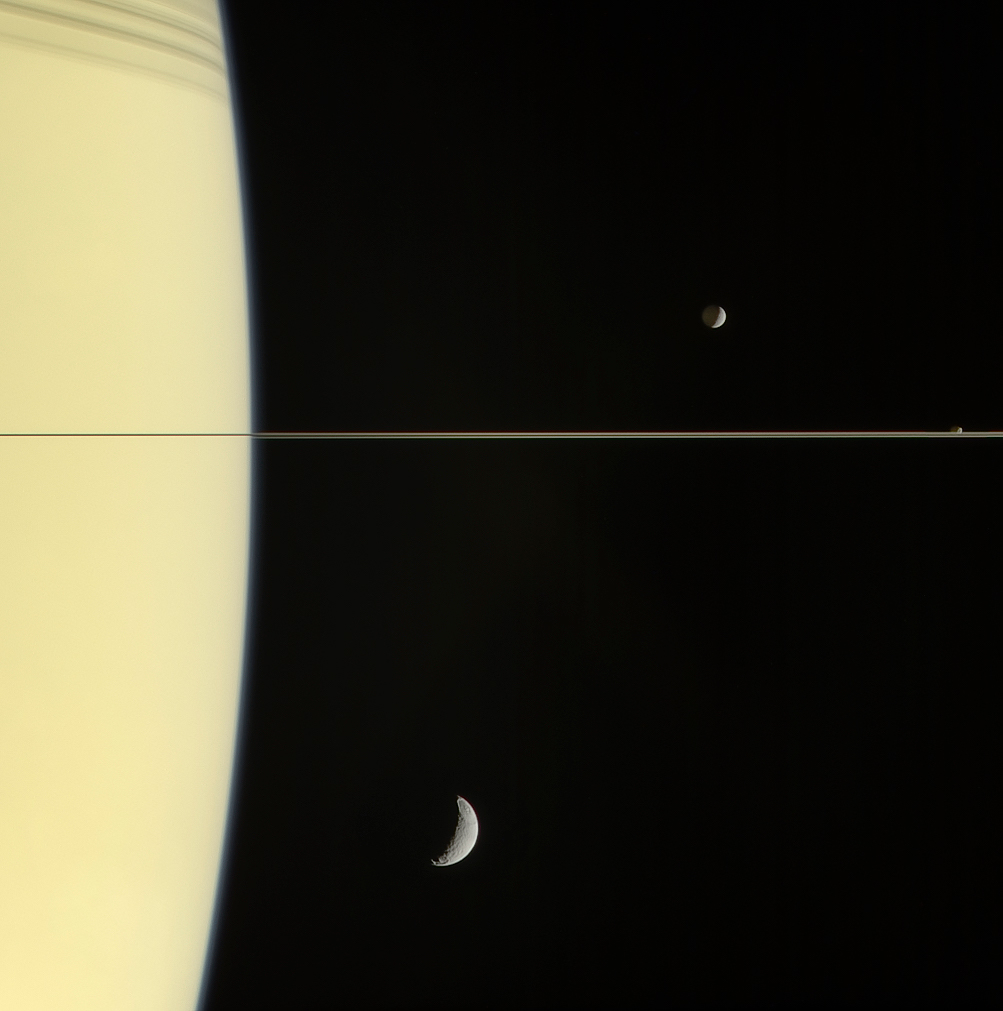
On March 13, 2006, Cassini photographed three moons along the edge of Saturn’s rings. Mimas and little Janus appear above the narrow band of rings, Tethys below. The date is enough to file the photograph. Reconstructing the view takes finer timing. Cassini shot through red, green and blue filters in turn. Each exposure caught the moons at a slightly different instant. Cassini kept time on its own clock. SpiceyPy, an open-source Python interface to NASA’s SPICE toolkit, lets us follow a reading from that clock all the way to a date someone could print under a picture.[1][2]
Half a second written as 128
Take a round count chosen for this example, 1/1500000000:128. The first digit identifies a clock partition. Partitions let a mission distinguish two runs of a counter if a reset makes the same reading occur twice. Cassini’s clock file records a single partition. After the slash come two fields. The coarse counter has advanced 1,500,000,000 whole spacecraft seconds. The fine counter advances through 256 ticks per coarse second, so 128 puts the reading halfway to the next whole count. Someone transcribing the suffix as .128 seconds has already moved the event, before doing any astronomy.[3][4]
The rule about 256 lives in a plain-text data file called a spacecraft clock kernel. Open Cassini’s archived file cas00172.tsc and look for SCLK01_MODULI_82. Its second value is 256. Farther down, under SCLK01_COEFFICIENTS_82, are rows of three numbers each. Those rows answer a harder question. Even after we can read the dial, how much time on a reference clock has elapsed since Cassini showed a particular count?[3][4]
Each row gives SPICE a starting count in encoded ticks, the corresponding instant on a reference time scale, and a rate for advancing from that pair. Think of checking a watch against an observatory clock on Monday. That gives you one pair of readings. If you also know how much the watch gains each day, you can estimate Tuesday’s observatory reading from Tuesday’s watch reading. Cassini’s file has many such starting points and rates. SPICE uses the row for the interval containing the observation. A single offset measured at launch would discard the rate information the mission preserved.[3][4]
Two files and a calendar date
Here is the conversion for our sample count, using the two named kernel files in the working directory. The clock kernel supplies the correlation for Cassini. The leap-seconds kernel supplies the time-scale constants and UTC leap-second history. The number -82 tells SPICE which spacecraft clock to use.[2][3][4][5][6]
import spiceypy as spice

spice.furnsh("cas00172.tsc")
spice.furnsh("naif0012.tls")
et = spice.scs2e(-82, "1/1500000000:128")
print(spice.et2utc(et, "ISOC", 3))
The result is 2005-07-14T02:12:14.078. The intermediate value, et, is elapsed seconds on SPICE’s ephemeris time scale from its standard epoch, J2000. An orbit calculation can use that value directly. The last line serves the person reading the result. It asks for UTC as a calendar date and rounds the displayed seconds to three decimal places. Those three places express a choice of display precision. The clock correlation would need its own accuracy assessment to justify a claim that the exposure time was known to a millisecond.[3][5][7]
There is a practical reason to keep the original clock string alongside a converted date. The header inside the Cassini kernel used here carries a February 2018 timestamp, years after the three-moon photograph. A researcher who retains the spacecraft reading can repeat the calculation with that particular file or measure what changes with a different correlation. A caption that says March 13, 2006 has done its job for the reader looking for Tethys. For the reader trying to put Tethys back in precisely that spot, the more valuable inscription is the one the spacecraft could write for itself.[1][4]
Sources
- NASA, “Postcard from the Ring Plane,” Cassini image PIA18323 and observing notes.
- Andrew Annex and contributors, SpiceyPy project and interface documentation.
- NASA Navigation and Ancillary Information Facility, Spacecraft Clock Required Reading.
- NASA Navigation and Ancillary Information Facility, Cassini spacecraft clock kernel cas00172.tsc.
- NASA Navigation and Ancillary Information Facility, scs2e_c spacecraft-clock conversion routine.
- NASA Navigation and Ancillary Information Facility, leap-seconds kernel naif0012.tls.
- NASA Navigation and Ancillary Information Facility, et2utc_c output formats and precision.