
A shipment of fish arrives at Uzuki while Shuichi Kotani is rolling soba. He would like to inspect the fish. His hands keep moving. There is time for a tuna delivery on the restaurant’s schedule, but the sheet of buckwheat dough spread out in front of him has begun to dry. The fish will get its inspection once the noodles are safely tucked away. [1]
In the opening seconds of Bon Appétit’s visit to the Brooklyn restaurant, Kotani explains the choice behind this small scheduling conflict. All the flour in his noodles comes from buckwheat, which has no gluten. The restaurant has taken on the job of turning that flour into strands long enough for a diner to lift with chopsticks. Watch what happens to the shape of the dough as it passes from bowl to rolling pin to knife. By the time Kotani makes the first cut, he has already settled one of the noodle’s two dimensions. [1]
An earlobe in the recipe
The noodle-making sequence begins at 4:05. Kotani makes tea before turning to his mixing bowl. Later he closes his eyes while working water through the flour. Follow his fingers through this passage. A wet lump can travel around a bowl all afternoon picking up a coat of dry flour. What he needs to know is whether the water has reached the flour throughout. He adds more, gathers the damp crumbs and tests their give. For anyone trying to imagine the texture through a screen, he supplies a reference within easy reach of the cook’s free hand. The dough should feel like an earlobe. [1]
The same comparison turns up in a written soba lesson from Shimogo, in Japan. Its formula contains four parts buckwheat flour to one part wheat flour by weight, a blend called nihachi. Here are two cooks who could agree on how a dough ought to feel between finger and thumb and still have quite different doughs in their hands. The wheat in the Shimogo version supplies gluten to help the sheet hold together. Even for that blend, the lesson asks cooks to pay attention to the humidity of the room. Think how much surface Kotani exposes to the air as a lump small enough to knead becomes a sheet wide enough to wrap around a pole. [1][3]
Where the corners go
Kotani starts with a disc and works toward a square. There is a practical pleasure in seeing those corners emerge. Imagine folding a round tablecloth in half and cutting parallel strips from the folded edge toward the rim. The middle strips would be long and the outer ones decidedly short. A squared sheet lets the maker fold straight edge against straight edge and put more of the dough into strands of comparable length. Winding the dough onto a long pin also gives him somewhere to put the finished portion while he rolls the rest. [1][2]
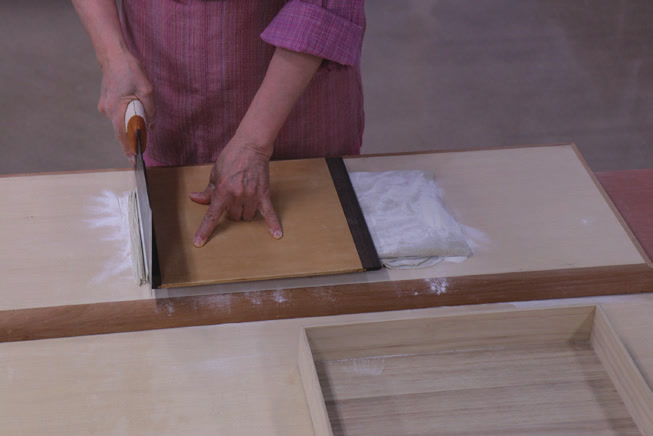
That leaves a thick-looking parcel on the bench. Its bulk is deceptive. Each layer is already as thin as the eventual noodle ought to be. Dusting flour between the folds keeps the layers apart, so that a single stroke through the parcel can release several lengths of noodle. When the cutting begins, look just beside the blade. The little board resting on top of the dough is the komaita. [2][3]
The sideways part of a downward cut
The Edo Sobalier Association gives a wonderfully economical instruction for using the guide. After a cut, the cook tips the blade against the board. That slight tilt nudges the board sideways and exposes a narrow margin of dough for the next stroke. Repeat the angle and the margin stays the same. Listen to Kotani cutting and it is easy to hear only the downward beat. Each beat has this quiet sideways movement for a partner. The usual target in the association’s lesson is a strand about as wide as the rolled sheet is thick. One side of that little square was made at the rolling bench. Its neighbor is being measured out here. [1][2]
It matters at the stove because the cook has to lift a whole batch from the water at once. A fat strand among thin ones would need extra time just as its neighbors were ready to come out. The buckwheat miller Masudaya describes the last part of cutting as a steady, relaxed rhythm. Seen from the dining room, that rhythm buys a small courtesy for the guest. Whichever few strands the chopsticks happen to pick up, they should offer much the same bite. [2][4]
At 15:09 the fish finally gets its turn. By then Kotani has separated the cut noodles and laid them in a wooden box that keeps them from drying out. He says he likes to leave them there for a few hours before cooking. It gives the delivery scene a lovely ending. The cook who could barely spare a moment while the dough lay open on the bench can now afford to let the noodles rest until service. All it took to change the pace of the kitchen was the lid of a box. [1]
Sources
- Bon Appétit, “A Day Making Some of the World’s Most Difficult Soba Noodles,” On the Line, filmed at Uzuki.
- Edo Sobalier Association, “How to make SOBA,” illustrated guide to rolling, cutting and boiling, with the cutting photograph.
- Shimogo, “How to make Soba noodles,” a local nihachi recipe and illustrated method.
- Masudaya, “Regarding Soba,” a buckwheat miller’s account of making traditional soba.