A baker in Recco can spend several minutes coaxing a piece of dough thin enough to see through, then take a perfectly good stretch of it between finger and thumb and tear a hole. A few inches along, another pinch. The distinction that matters is which sheet of dough gets the holes. Underneath the cheese, a tear can spill dinner into the pan. Above it, those little openings give steam a way out. [1]
Manuelina, on the Ligurian coast east of Genoa, dates its cheese focaccia to the family tavern in 1885. In the family's telling, people who had eaten the dish at home on feast days began coming out for it as a late-night snack. It is easy to see the appeal of an order just out of the oven. A portion has a brittle, oil-brushed surface that gives way almost immediately to warm cheese. Measured along the rim, the whole thing should stand less than a centimetre high. [1][2]
Under the sheet
In the recipe Manuelina shared with ItalianGourmet, the cook divides the dough in two and gives it about half an hour to rest. Flour, water, olive oil and salt are the entire dough. There is no yeast. The change the baker wants during that quiet half-hour becomes apparent on picking it up again. A piece that yields to a gentle pull can be worked out toward the diameter of a large round copper pan. Keep having to wrestle it back to size and the finest stretches will tear. [3]
Closed fists go under the sheet. Working from below lets the baker support a broad patch of dough while rotating it, easing the thickness out a section at a time. The first sheet goes into an oiled pan intact. Only when it is down does its full burden become obvious. Manuelina's formula calls for 800 grams of fresh crescenza to 400 grams of flour. The cook has made something thin enough to read through in order to carry twice the flour's weight in cheese. [1][3]
Down at the marina, La Baracchetta di Biagio gave Gambero Rosso a different set of quantities. Its recipe pairs a kilo of crescenza with a kilo of flour and reserves a little more than half the dough for the base. The two kitchens agree on a more consequential detail for the person doing the stretching. The top sheet has to reach across little mounds of soft cheese. The bottom one has had the advantage of landing on a flat pan. Leave some slack for those hills. [3][4]
Where the heat goes
The cook presses the two edges together, then opens the vents with fingertips. At Manuelina, a palm spreads the finishing oil over the top and gently flattens the mounds. About six minutes at 300°C is the restaurant's guide. At La Baracchetta the instructions specify stronger heat underneath. The upper sheet is so thin and exposed that its first brown blisters tell the cook little about the dough beneath all that damp crescenza. Lift an edge. The underside should already be amber. [1][3][4]
There is a small pleasure in reading the official specification alongside those two recipes. It describes a cheese that can take the heat and stay creamy, without shedding whey or drawing out into strings. Either failure would be conspicuous here. There is scarcely any bread to soak up a puddle, and a long strand pulled across the cut would drag the fragile lid with it. [1]
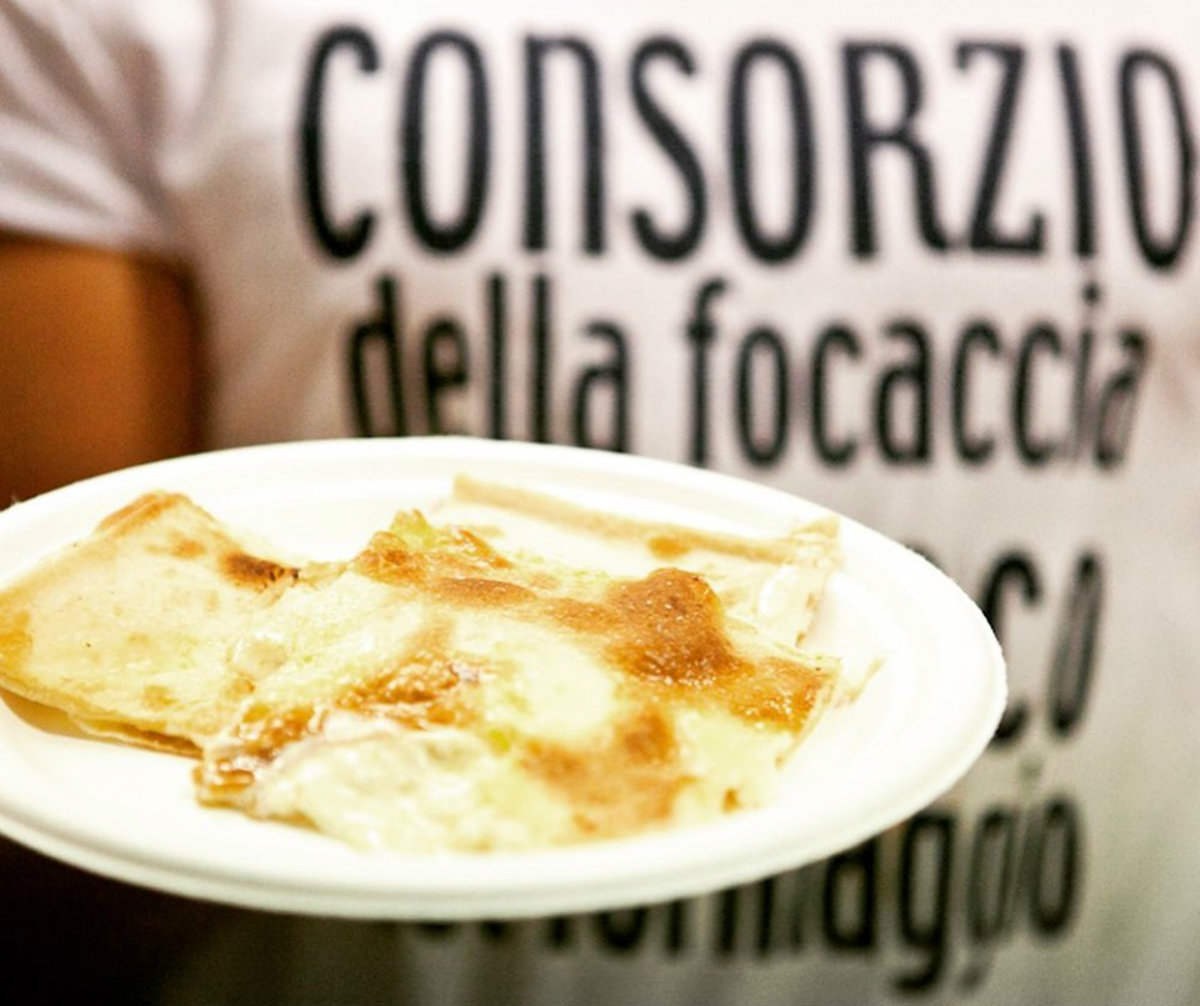
The first cut through the middle gives a diner much the same view the baker had while assembling it. There are still low places between pockets of cheese, a browned patch beside a pale one, a seam at the edge where a thumb pressed two sheets into one. Take a piece that includes the rim. In the space of a few bites you get the crisp join, the soft middle and one of those little windows where the cheese has been in the open air all along.
Sources
- Genoa Chamber of Commerce, production specification for Focaccia di Recco col formaggio, articles 2 and 5 (PDF, Italian)
- Manuelina Focacceria, the family’s account of its focaccia
- ItalianGourmet, Manuelina’s recipe for Focaccia di Recco col formaggio IGP
- Michela Becchi, the history of Recco’s focaccia and La Baracchetta di Biagio’s recipe, Gambero Rosso