There are two ways up through Charles Sheeler’s photograph of the Ford plant. The broad, enclosed passage rising from lower left to upper right could carry a load of coal. The staircase down in the left corner could carry you. It takes a moment to find the steps. By then your eye has probably traveled the length of the conveyor twice. [1][2]
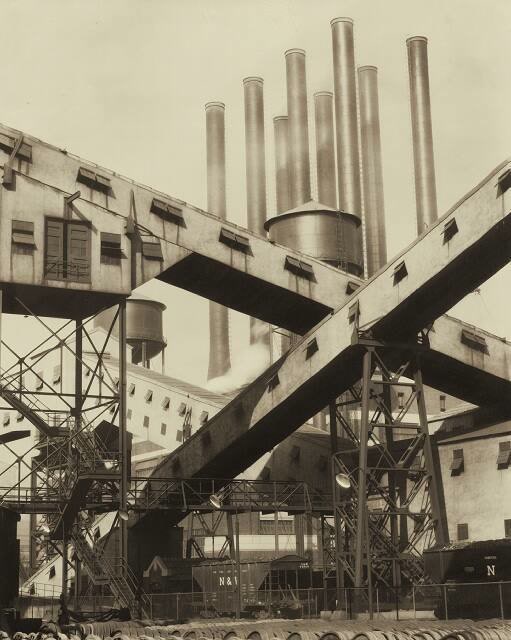
Start where the two great diagonals meet. The nearer conveyor cuts clear across the farther one. A dark band of shadow along its underside makes it easy to keep your place as you follow it to the right edge. Now try to follow the other conveyor from left to right. For a short stretch you have to supply it from memory, until its pale siding comes out the other side. The crossing looks simple enough to draw with two strokes of a pencil. Looking carefully means taking those strokes apart again. They occupy different depths, with enough air between them for each to go about its business. [1]
What business? The Henry Ford identifies these as the routes for coal and coke going to the buildings where material was pulverized and screened. Coke fed the blast furnaces used in making steel. You could study the print for a long time without learning any of this. The housings hide their loads. Little rectangular openings recur along their sides, giving the eye a way to measure distance even as the material traveling that distance stays out of sight. Behind them stand the water tanks and the stacks of Power House No. 1. Only the upper reaches of the stacks have an uninterrupted patch of sky to themselves. [1][2]
Ford commissioned the photographs in 1927 for the introduction of the Model A. Other pictures in the series took viewers to the pulverizer building and inside a blast furnace. Here was a way to advertise a car before a single recognizable piece of one came into view. Of the 32 prints Sheeler made, this was the first to appear in print, alongside a Vanity Fair article about Henry Ford. A magazine reader could take in that bold crossing at a glance. The achievement it implied had a ready name in the accompanying story. [3][4]
The stairs offer a slower way through the same picture. Pick out the handrail first, then the little succession of treads beneath it. Where the big conveyor has a broad strip of daylight on its flank, the stairs are threaded among braces and posts of much the same gray. To trace a possible climb you have to look for gaps in the steelwork. Each tread gives the foot a place to land. Suddenly there is a unit of measure down here that you can carry back up to the conveyors. Imagine climbing one step at a time along the whole length of one of those housings. [1]
The Nelson-Atkins print is barely ten inches tall. Held at reading distance, it could fit between your hands. Within that span the conveyors can look almost effortless, two clean sweeps across a small sheet of paper. The staircase rewards a second look because it puts an ordinary stride inside that sweep. Even after your eye returns to the crossing, some sense of the walk goes with it. [1]
Sources
- Nelson-Atkins Museum of Art, “Criss-Crossed Conveyors--Ford Plant,” collection photograph, print dimensions, and gallery label.
- The Henry Ford, “Criss-crossed Conveyors at Ford Rouge Plant, 1927,” on the materials carried and their destinations.
- The Metropolitan Museum of Art, “The Photography of Charles Sheeler,” on the Model A commission and the companion factory views.
- Art Institute of Chicago, “Charles Sheeler: Across Media,” commercial photography section on the series and its publication in Vanity Fair.