A man has shut his eyes and let his head fall to one side. A hat hangs within reach. If you came across him without the title, you might lower your voice to let him sleep. Hippolyte Bayard gave the scene a more definite reading when he called it Le Noyé, or The Drowned Man. Even with the title in mind, it takes a moment to register what is missing. There is no water in the picture. [1]
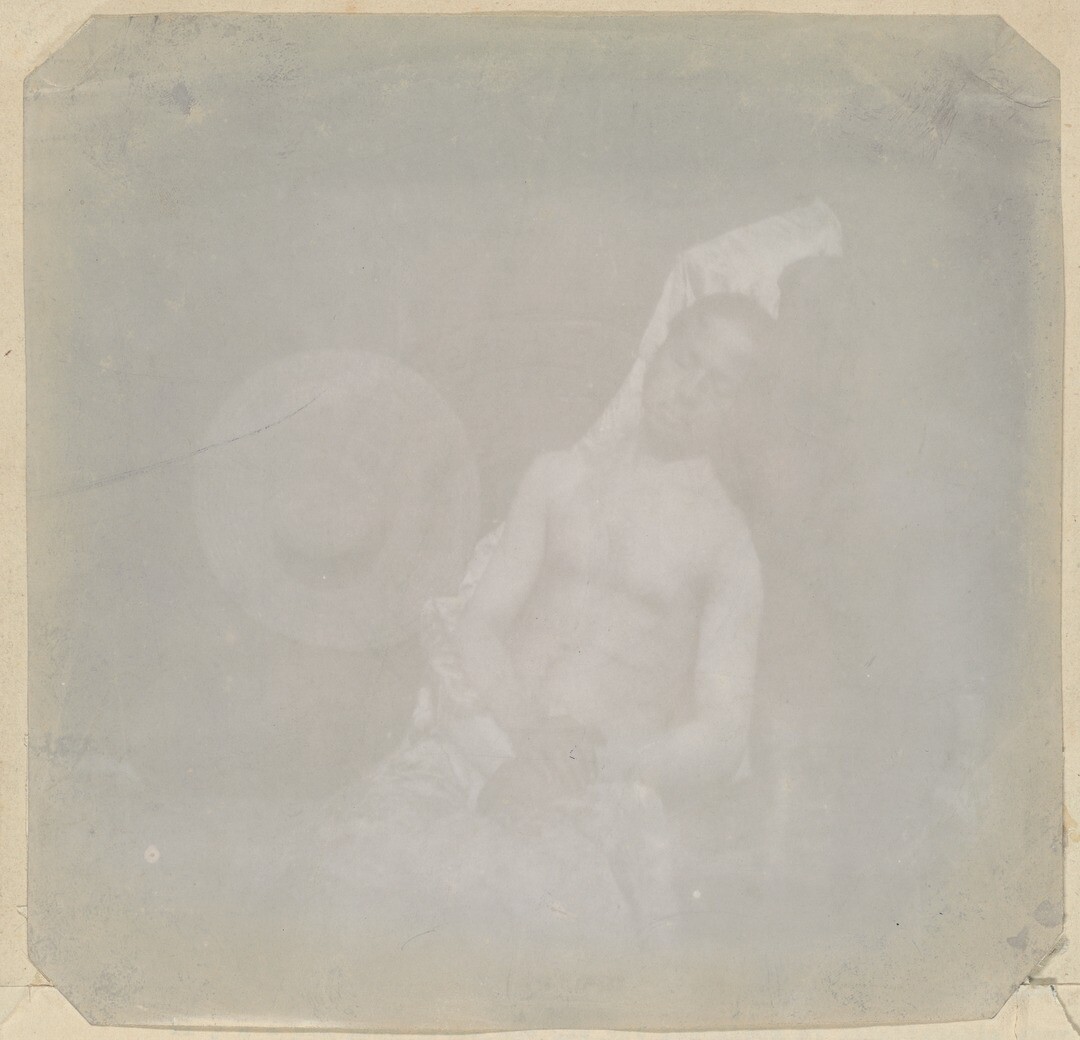
Bayard found a role in which the chief demand photography made of a sitter could pass for good acting. A corpse could keep perfectly still. He made three versions, varying the pose and the props. Each required him to play dead all over again. His process made a positive image directly on the sheet of paper in the camera. There was no negative from which he could run off another impression. The surviving variations record separate performances. [1][2]
On the back of the final version, Bayard introduced a new character. An apparently well-informed stranger identifies the deceased as a certain Monsieur Bayard, praises his long labors on behalf of photography and explains that the French government had given so much to Louis Daguerre that it could spare nothing for his rival. Hence the drowning. One pleasure of the inscription is hearing how handsomely a man can compliment his own ingenuity once he has arranged to be absent from the conversation. [1]
The grievance had a history. In Paris in 1839, Daguerre’s process was on its way to securing him a state pension. Bayard, a Ministry of Finance employee who had worked out how to make pictures on paper, showed his results to François Arago at the Academy of Sciences in May. Arago asked him to hold off announcing the process while the arrangements for Daguerre went through. An appeal for recognition addressed to Arago would have had one reader. The inscription on the photograph recruits anyone who picks it up to hear the case. [3][4]
Try to retrace what that reader has to do. Turn the sheet to read the account and the body disappears. Turn it back to examine the evidence and the witness falls silent. The tilt of the head is persuasive on either viewing. What has changed is the extraordinary amount you now seem to know about a seated man from looking at his closed eyes. A name, a profession, a rival and a government decision have all entered the room by way of the handwriting. [1]
Bayard even tells his reader that the dead man invented the process responsible for the picture in hand. His narrator can deplore the waste of a fine photographer, but the reader gets to handle a piece of his work while hearing the lament. That may be the shrewdest part of the performance. Long after the joke about the drowning has given itself away, the sheet still does precisely what Bayard wanted recognition for teaching it to do. [1][2]
Sources
- Getty Museum, “The 19th-Century Selfie Pioneer,” with the photograph, collection credit and a translation of Bayard’s inscription.
- Getty Museum, “The Mysteries of Early Photography,” on the structure of Bayard’s direct positive prints.
- Getty Museum, “Politics and Competition,” gallery text for the exhibition Hippolyte Bayard: A Persistent Pioneer.
- Swiss Camera Museum, “Hyppolyte Bayard, the Forgotten Inventor,” on Bayard’s employment and the politics of announcing his process.