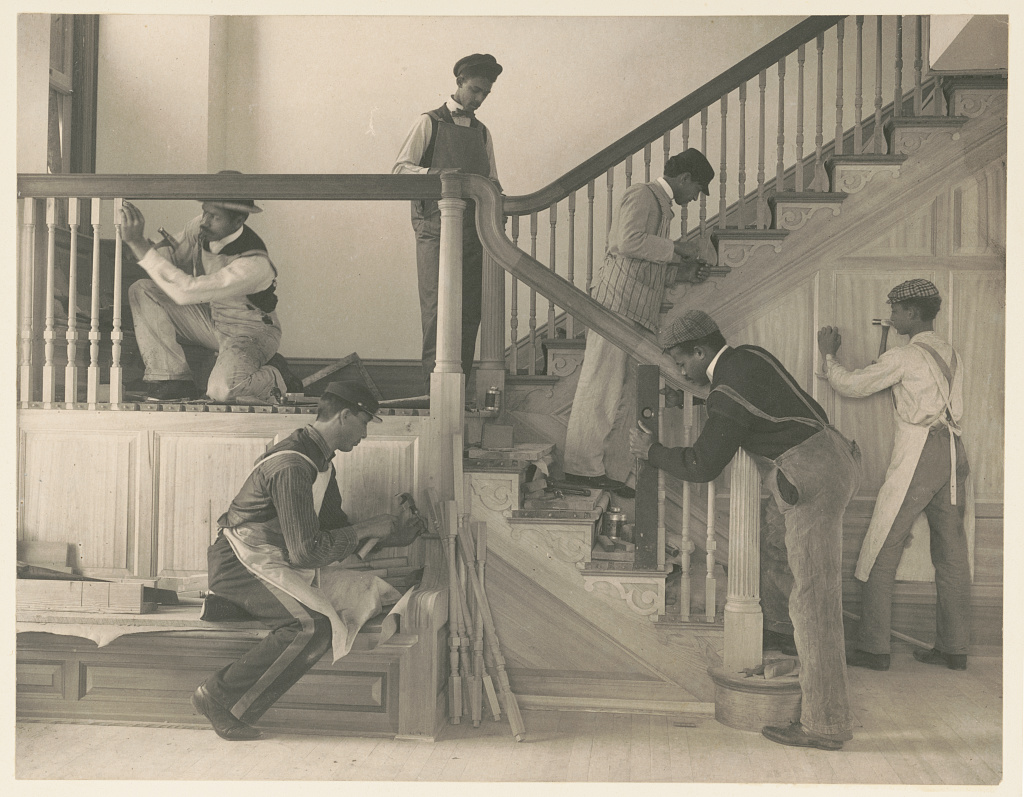
At the foot of the staircase, a handful of turned wooden spindles lean together like walking sticks. Look up a few inches and you can see where they belong. On the landing to the left, a row of their fellows already stands upright beneath the handrail. A kneeling man has his fingers around one of them. Frances Benjamin Johnston managed to get three stages of a carpenter’s job into one photograph, and she did it in a room where six men had to hold still. [1][4]
There are two good places to begin reading this picture, depending on whose print you have in hand. The Museum of Modern Art calls its print Stairway of the Treasurer’s Residence: Students at Work. The Library of Congress gives its version the title Students at work on a house built largely by them. The first tells us who gets to come down these stairs for breakfast. The second gives the young men credit for much of the house, including parts of it that disappear beyond the edges of the photograph. [2][3]
Johnston took the picture during a commission from the Hampton Normal and Agricultural Institute in Virginia in the winter of 1899–1900. The school taught African American and Native American students. It wanted photographs of its teaching to send to the Paris world’s fair. There was a practical difficulty in photographing a woodworking lesson indoors. Johnston’s glass plates needed several seconds of exposure. A man swinging a hammer would have had trouble keeping his hand legible. At the far right, one student holds his hammer head level with his face, his other hand against the panel. A viewer can supply the next stroke. [1][3][4]
What takes longer to see is the care the men have already put into the wood. Each stair has a little scroll tucked under the lip of its tread. The handrail makes a particularly tricky turn at the landing, where the long horizontal stretch gives way to a curve and then a straight descent. Try tracing it with a finger. For a moment the student leaning over the lower flight interrupts the sweep. His bent back brings the eye down to the upright piece he is steadying. Under the treasurer’s caption, that curve looks like a handsome feature of a residence. Under the builders’ caption, it prompts a question about joinery. How many pieces had to meet before a hand could slide over them without catching? [1][2][3]
In Paris the photograph had another job. Researcher Jane Pierce describes cabinets with hinged leaves that held the Hampton photographs and W. E. B. Du Bois’s charts of African American life in Georgia. A visitor could turn from a picture to a statistical argument with a movement of the arm. Hampton had commissioned evidence for its vocational curriculum. The Black organizers of the larger exhibition had room for a wider argument about life since emancipation. Du Bois himself praised Johnston’s pictures while disputing the narrow educational opportunities offered to Black students. Admiring the young carpenters’ accomplishment left the question of what else they ought to have been free to study wide open. [2][3][4]
One word in the Library’s caption keeps drawing me back to the pile of spindles. “Largely” is an unusually careful way to assign credit. It leaves room for other hands and gives the students a substantial share in the finished house. Neither caption names the kneeling carpenter. But once you have read that second title, the little rail under his fingers belongs in a different kind of picture. You can look at a treasurer’s home and see somebody else’s work. [1][2][3]
Sources
- Library of Congress, digital reproduction of Johnston’s platinum print, from the Frances Benjamin Johnston Collection
- Museum of Modern Art, collection record for the stairway photograph in the Hampton Album
- Library of Congress, Micah Messenheimer interviews Jane Pierce about the Hampton prints, their captions, and their display in Paris
- MoMA Learning, the stairway photograph’s exposure, staging, and reception