Try a leaf from the edge of a salade lyonnaise before you touch the poached egg. There's a little vinegar in the frills, a little pork fat on the stem, and the bitter taste of frisée comes through as you chew. Now put the side of your fork through the egg and draw a second leaf through the yolk. The vinegar seems gentler. In the space of two mouthfuls you've tasted the cook's dressing twice, once as it left the kitchen and once as you finished it at the table. [1][2]
The salad belongs to the repertoire of Lyon's bouchons, the city's traditional restaurants. It makes a generous opening course. There's cured pork to get your teeth into and, in some versions, bread browned in butter. Yet a fork can still come up from the bottom of the plate carrying nothing heavier than a tangle of leaves. How much pleasure there is in that forkful depends on what the cook did with the bacon pan. [1][3]
What stays in the pan
In Sara Kate Gillingham's recipe, the browned bacon spends a short spell on a paper towel. Its fat stays in the skillet. In goes minced shallot, then red wine vinegar and Dijon mustard. The bacon comes back just before the hot dressing goes over the greens. Even a leaf that escaped every piece of meat tastes faintly of bacon. The little burst of shallot caught in its curls is half the fun. [2]
Steve Dunn, writing for Cook's Illustrated, starts with a thick slice of pancetta. He boils the cut pieces briefly, drains them, then browns them gently in oil so they keep some chew. He also dresses his two greens in sequence. Frisée gets the warm contents of the skillet first. The second handful, chicory or escarole, goes in after a thorough toss. You can picture the difference on the fork. The fine branches of frisée have had time to bend, while a broader leaf added at the end still has a little spring. [4]
Bread introduces another small decision. In the Rouxbe cooking school's version, half the buttered croutons go into the mixing bowl with the greens. The cook scatters the rest over each portion. One batch of bread yields two textures. A cube from underneath has a corner softened with vinaigrette. One perched beside the egg can still crackle when you bite it. [1]
A different egg in Lyon
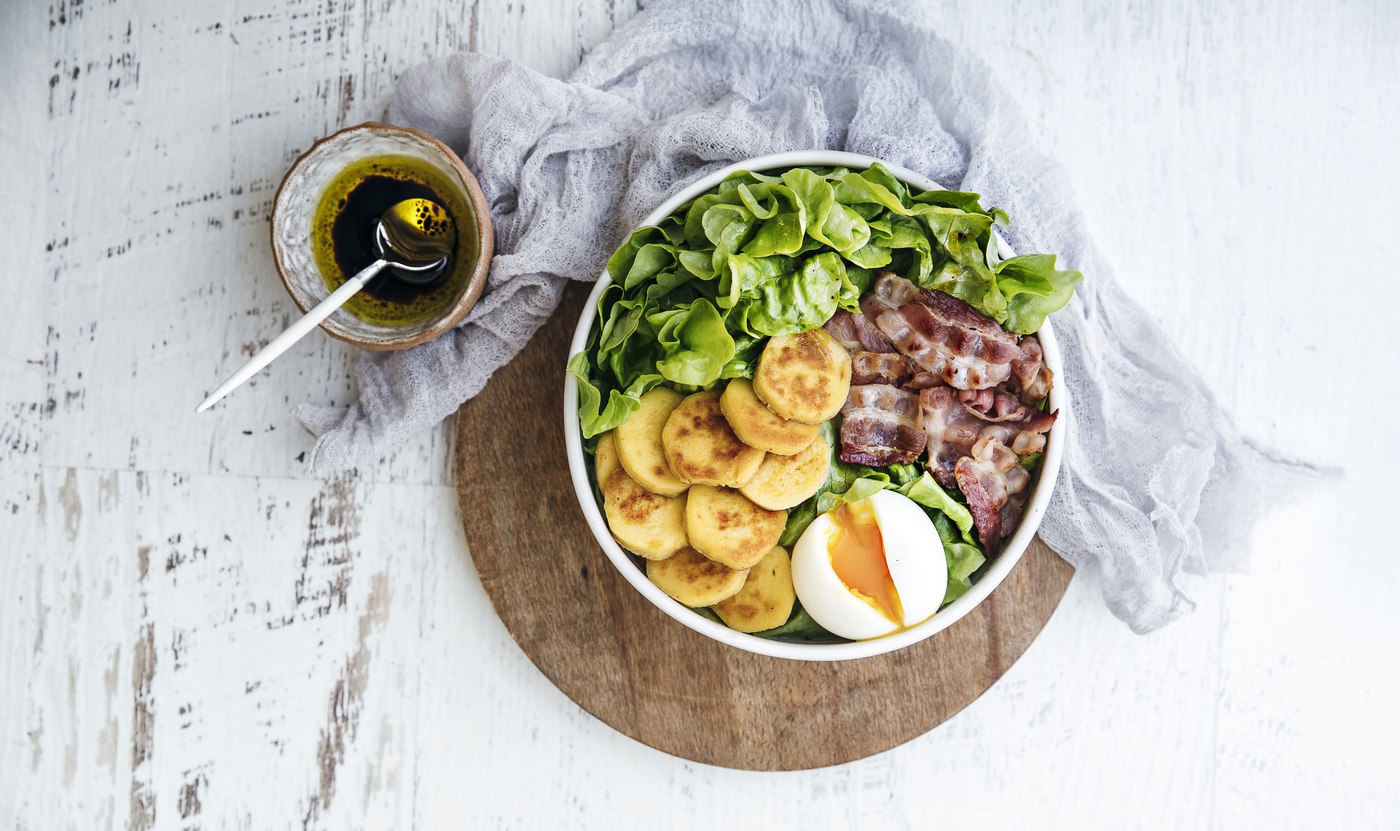
Stéphanie Iguna took a few liberties when she made the dish for the Lyon Tourist Office. She suggests oak-leaf lettuce, mixes her balsamic dressing in a bowl and cuts quenelles, the plump dumplings, into rounds for the frying pan. A quenelle laid on its side acquires two broad golden faces. It takes up considerably more room on a fork than a crouton. [3]
Iguna also boils the eggs in their shells for seven minutes, then cools them. That choice changes what the diner does. A piece of soft egg can ride on a browned round of quenelle, with a fold of lettuce underneath. With a warm poached egg, I would save a crouton for the end. Down at the bottom, where the last streak of yellow meets the sharp juices from the leaves, there's still something worth picking up. [1][3]
Sources
- Rouxbe, “Salade Lyonnaise” — bacon-fat vinaigrette, buttered croutons and assembly.
- Sara Kate Gillingham, “Lyonnaise Salad,” The Kitchn — warm shallot dressing and poached eggs.
- Lyon Tourist Office and Stéphanie Iguna, “Salade Lyonnaise” — bouchon context, quenelle variation and photograph.
- Steve Dunn, “Salade Lyonnaise,” Cook’s Illustrated — pancetta and the order of dressing the greens.