Two pieces of Roquefort on a cheese board can give quite different answers to the question “Where is this from?” Take a wedge from Papillon and one from Gabriel Coulet. The sheep that supplied the first grazed in the country around the Lévézou plateau. The milk for the second could have come from the red earth around Marcillac or from up near Aubrac. Yet at one point the two cheeses would have been close enough for somebody to walk from one cellar door to the other. [1][2]
Roquefort takes its name from that point of convergence. The territory for its raw, whole Lacaune sheep’s milk spreads across the southern Massif Central. The territory for ripening the cheese narrows to a stretch of broken limestone in the village of Roquefort-sur-Soulzon. A cheesemonger who gives you the producer’s name along with the village has handed you both ends of a journey. [1][2]
Two routes to the village
Papillon’s milk goes to Villefranche-de-Panat, on the southern side of the plateau. Gabriel Coulet’s goes to Sébazac-Concourès, north of Rodez. Each dairy can send a young cheese to Roquefort already carrying something particular to the house. The blue comes from a culture of Penicillium roqueforti, and producers choose their own strains. Papillon even keeps a bakery for the rye loaves on which it grows its culture. Bread belongs in this cheese’s story well before anybody brings a basket to the table. [2][3]
By the time the wheels reach the village they have been drained, salted and pierced. The needles leave passages through which air can reach openings in the curd. Makers have some latitude here too, down to the size and number of needles they use. Cut a finished wedge across its broad face and the blue-green patches give you a view into those little spaces. The ivory between them is part of the pleasure of a slice. You can take a mostly pale piece on the tip of a knife, then another across a pocket of blue. [1][3][4]
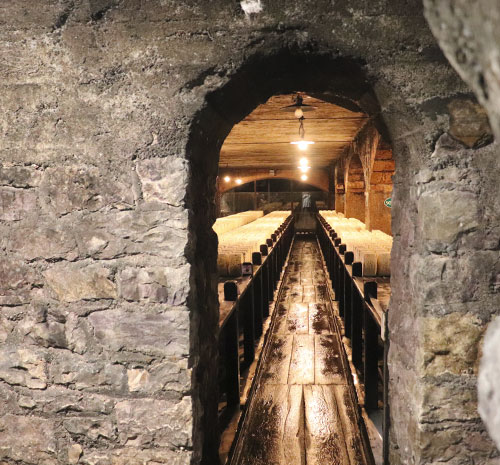
The cellar door has a job
Under the Combalou mountain, fissures called fleurines carry air through the fallen rock. Warm weather above ground can send a stronger current of cool, damp air into a cellar below. A ripener has doors and hatches to catch or temper that draft. It is an unusually literal connection between the weather outside and the cheese on a shelf. The mould inside a wheel needs oxygen. How much air moves past the wheels is one of the things a person on the cellar floor can influence. [1][2]
That person also decides when the cheese has had enough. A stainless-steel probe takes a sample from inside a wheel. The ripener can inspect the reach of the blue and feel how readily the paste yields. After at least fourteen days in the cellar, a wheel judged ready gets a close wrapping, traditionally in tin foil. The wrapper slows the mould’s growth while the cheese continues to mature in the cold. The minimum age for Roquefort is ninety days from manufacture. Those two clocks explain how a cheese can be old enough to serve and still have spent only a fraction of its life exposed to the draft. [1][2][4]
Back at the cheese board, keep the labels beside the wedges for the first bite. See which piece breaks cleanly under the knife and which leaves a creamy smear. Taste a little of each before adding bread. If you have a favorite, the house name is the part worth remembering for your next order. The village on both labels tells you where their paths crossed.
Sources
- Institut national de l’origine et de la qualité, “Roquefort” — production area, milk and ripening requirements.
- Confédération Générale de Roquefort, “Natural ripening” — cellar work, photography and the milk routes of individual houses.
- Confédération Générale de Roquefort, frequently asked questions — producers’ choices of cultures and piercing needles.
- French Ministry of Agriculture, “Le Roquefort AOP, le fromage emblématique de l’Aveyron” — piercing, wrapping and maturation.