There was mutton enough for two in one version of the picnic. In another, half a loaf would do. Both Persian quatrains reckon the pleasure of sitting outdoors with someone dear against the resources of a sultan. Edward FitzGerald’s English reader arrives under the tree to find bread, wine, a book and somebody singing. The mutton has gone. So, apparently, has the sultan. To find him, go back four lines. [1][2]
FitzGerald came to the quatrains attributed to Omar Khayyám through his Persian teacher and friend Edward Byles Cowell, who made him a copy of a manuscript in Oxford’s Bodleian Library. When FitzGerald published his English poem anonymously in 1859, he had done something a reader of a bilingual edition might find inconvenient. A stanza in English could draw on several quatrains, and a thought that occupied one Persian line could turn up a stanza away from its companions. The picnic gives us a way to hear what he gained by taking that liberty. [2][3][4]
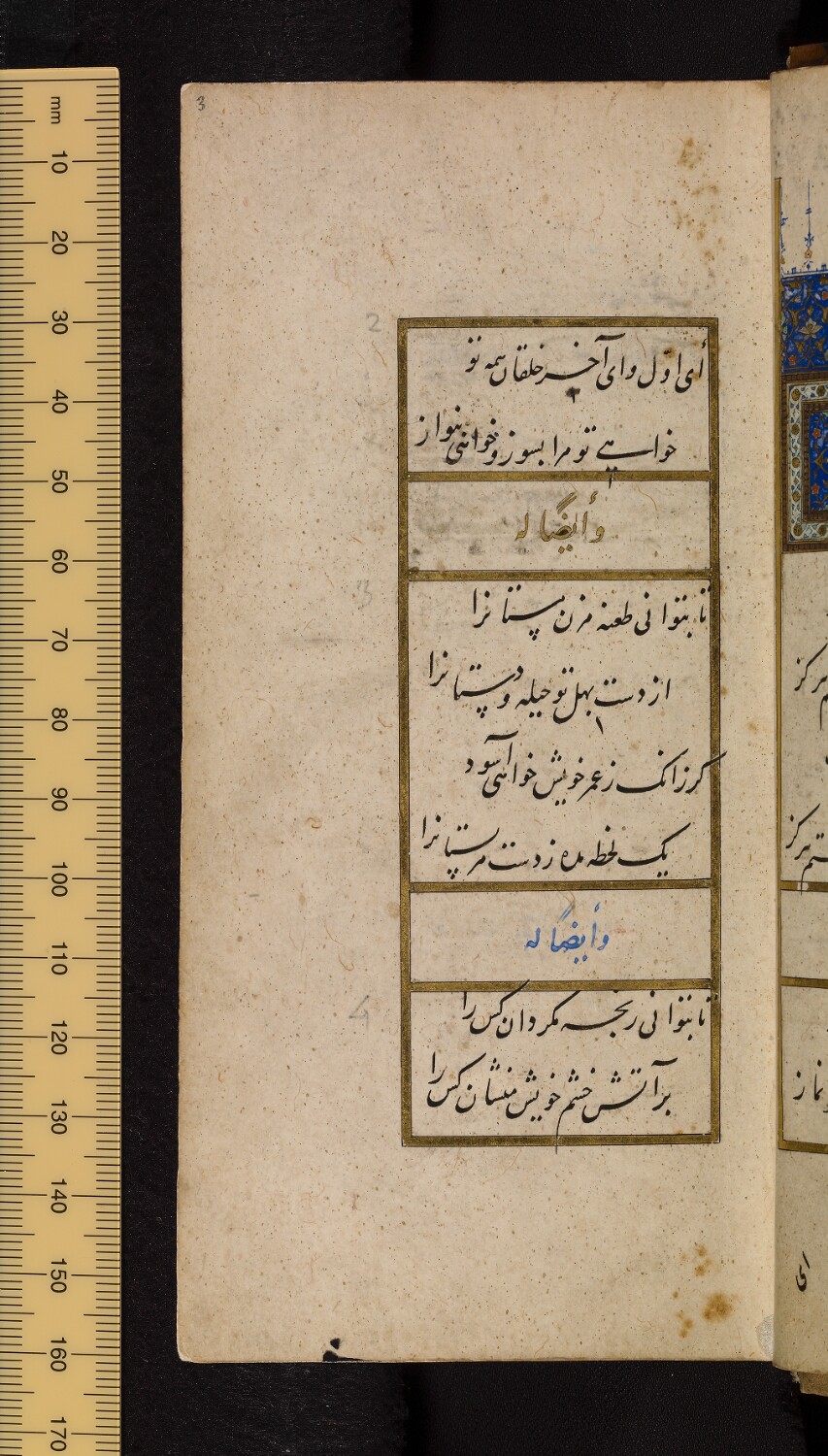
Edward Heron-Allen, who later traced FitzGerald’s verses to their Persian sources, asks readers to take the picnic and the stanza before it as a pair. His renderings of Bodleian quatrains 149 and 155 give us two slightly different hosts. The speaker of 149 wants wine, a book and enough bread to stay alive. The speaker of 155 would welcome wheat bread, wine and a cut of mutton with the bone in. The meals cost different amounts, but both speakers can afford the same magnificent closing gesture. Give either one the right company and he can turn down a kingdom. The sultan earns his place at the end of the sentence by having the most to offer. [2]
In stanza X of FitzGerald’s first edition, the couple approach along a strip of grass between cultivated ground and desert. Out here, the speaker says, one might even “pity Sultán Mahmúd on his Throne.” The last two words leave Mahmúd seated while the couple can walk. Then comes the little word that opens stanza XI, “Here.” It works almost as a tap on the arm. They have found a spot. By giving the sultan his own stanza, FitzGerald lets the couple enjoy a moment beyond comparison. Neither has to spend a second of lunch explaining to the other how much worse a king must have it. [1]
The guest gets a part in the translation too. In Heron-Allen’s renderings the pleasure consists in sitting together. FitzGerald brings his second line to rest on “Thou,” the last item in a list of desirable things. Read on across the line break and the guest begins to sing. The speaker who could supply the loaf, the flask and even a book of verse has to listen for this particular pleasure. Try stopping at the rhyme and the companion sounds like a possession. Give the sentence one more line and you can hear another voice. [1][2]
FitzGerald kept tinkering. In the first edition the loaf comes first, as it might to anyone hungry after a walk. In the version printed in Boston in 1878, following the third London edition, the book takes its place at the head of the stanza. The wine now comes in a jug. Most delicately of all, the first edition’s “is” becomes “were.” What began as a declaration that this patch of wilderness is paradise can now be heard as an invitation still waiting for an answer. The speaker can set the book down, pour the wine and picture the two of them under the bough. Whether the guest will come and sing is still deliciously up to the guest. [1][5]
Sources
- Edward FitzGerald, Rubáiyát of Omar Khayyám, first edition (1859), stanzas X–XI. Representative Poetry Online, University of Toronto.
- Edward Heron-Allen, analysis of stanzas XI–XII and translations of Bodleian quatrains 155 and 149, in The Sufistic Quatrains of Omar Khayyam, p. 53.
- Bodleian Libraries, University of Oxford, MS. Ouseley 140, digital facsimile.
- Dick Davis, “FitzGerald, Edward,” Encyclopaedia Iranica.
- Edward FitzGerald, Rubáiyát of Omar Khayyám, first American edition from the third London edition (Boston, 1878), stanza XII, p. 35. Harvard copy digitized by Google, via Historical Poetics.