The first tool we hear about in Robert Frost’s “The Tuft of Flowers” is a scythe. The first tool anyone tries to hear is a whetstone. A man has come to turn the cut grass so it can dry. The mower has finished ahead of him, but he might still be taking an edge to his blade somewhere beyond the trees. The newcomer looks, then listens. This is a peculiarly companionable way to look for somebody. He knows the little sound the other man’s work would make. [1]
Having failed to hear it, he comes to a large conclusion very quickly. Everybody works alone, he tells himself, even people working side by side. The rhyming couplet gives that thought a satisfying click of finality. Yet the opening sentence has already lodged a small objection. Try saying “once after one” aloud. The words almost run together as the speaker fits his own arrival to the movements of a stranger. The grass has reached him in exactly the condition his job requires. What more would it take for him to feel he had company? [1]
A butterfly takes a surprisingly long time to cross the field. It circles a spot where a cut flower may be lying, flies almost out of sight, then comes back. A reader in possession of the title can guess where this is going. The man with the hay to turn has every reason to give up watching. Frost brings him to the instant of getting back to work, then lets one verb pass between man and insect. He would have turned. The butterfly “turned first.” For a beat they seem almost to have collided over who gets to move the sentence along. [1]
The flowers it finds grow beside a brook. Here the rhyme does the work of a second look. Frost ends successive lines with “spared” and “bared.” The same sweep of the blade has exposed the brook and left a tuft standing beside it. To see the flowers as the mower saw them, the speaker has to reconstruct the stroke that might so easily have taken them down. He also has to walk over and see what they are. There is something funny and exact about the name he comes back with after following a butterfly all that way. Butterfly weed. [1]
Frost included the poem in A Boy’s Will, published in London in 1913. The early book offered its readers an unusual aid. Short remarks in the table of contents traced a young man’s movement through the poems, out of solitude toward fellowship. Elinor Frost helped her husband select and arrange the collection. A reader who came to the hayfield by way of that contents page had some reason to expect a meeting. Frost keeps the mower offstage clear through lunch. [3][4]
What the speaker allows the mower to keep is his morning to himself. He imagines a man so pleased by those flowers that he let them grow, without a thought for whoever might come along later. That seems to me the most generous guess in the poem. If the mower had left a posy for the next fellow, the next fellow could have picked it up and counted himself the intended recipient. The standing flowers ask him to imagine what somebody else enjoyed before he got there. He can join in that pleasure while leaving the flowers where the butterfly found them. [1]
Listen again at the end. Now the speaker hears the blade going through grass. We know what kind of hearing this must be, because the grass lies cut at his feet. By noon he has even held a conversation with the mower, in the tentative fashion Frost calls “dreaming, as it were.” The last couplet brings back the rhyme of heart and apart and the whole last line of the speaker’s earlier pronouncement. One small grammatical change carries the weight of the morning. The first time he spoke within his heart. This time there is a him to tell. [1]
Sources
- Robert Frost, “The Tuft of Flowers,” full poem. Academy of American Poets.
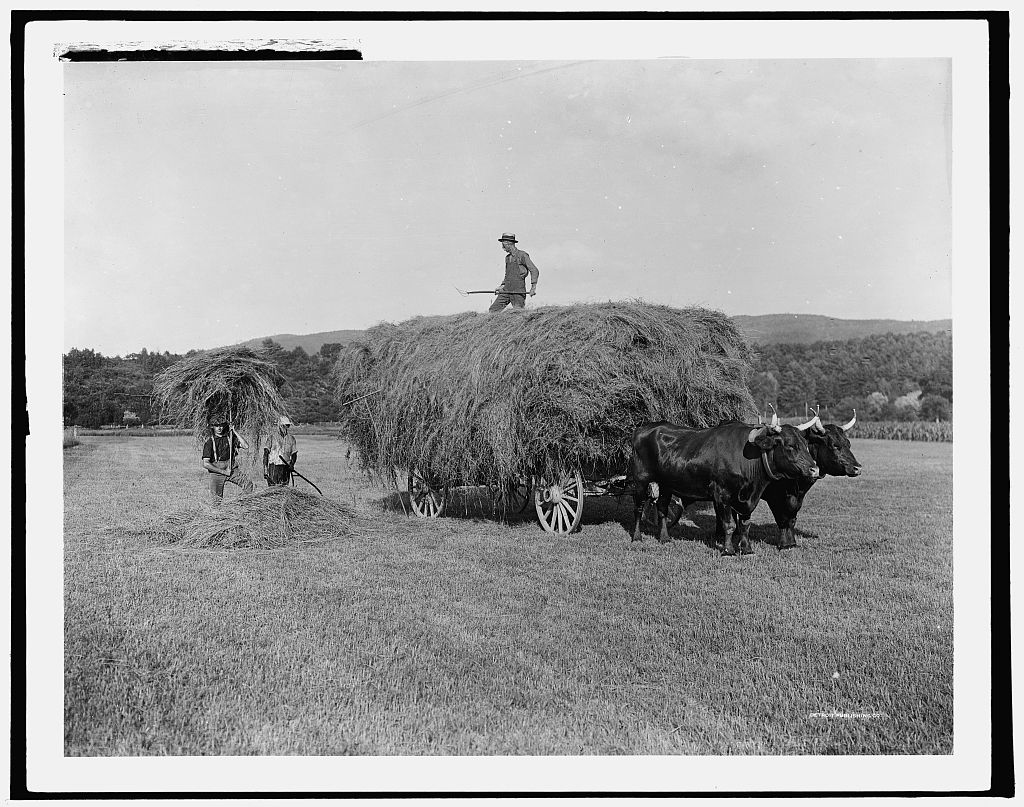
- Detroit Publishing Company collection, “Haying on the meadows, Northfield, Mass.” Library of Congress, archival photograph.
- University of Virginia Library, “A Frost Bouquet,” editions in English and the London publication of A Boy’s Will.
- Moffett Library Special Collections, “Five by Frost,” on the arrangement of A Boy’s Will and its early contents-page glosses.