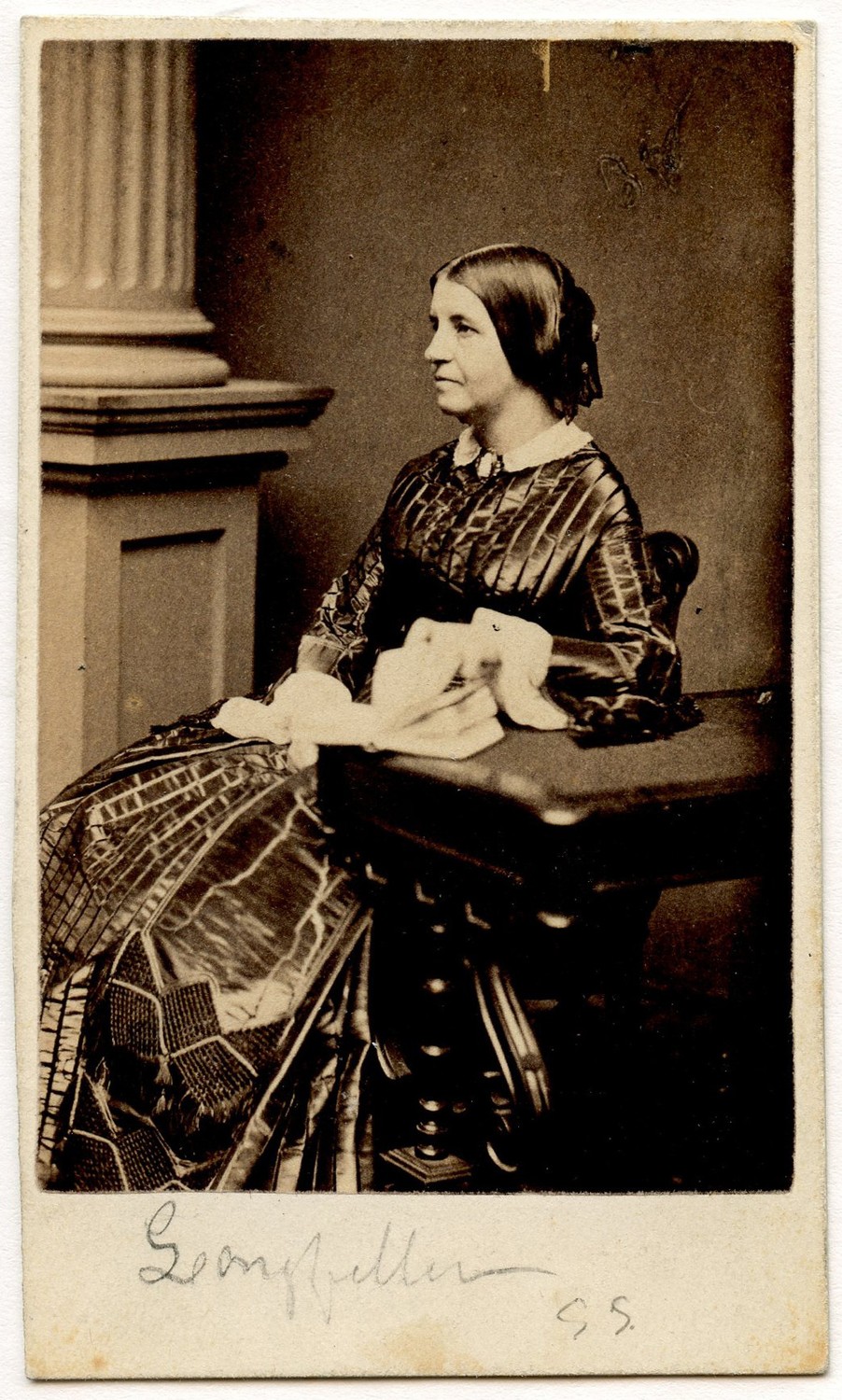
Somebody is awake in the first line of Henry Wadsworth Longfellow’s “The Cross of Snow.” We have the length of his night before we have any idea who he is. By line three we can just make him out, in the little word “me.” A face on the wall is looking at him. Try reversing the arrangement in ordinary speech: I lie awake looking at her picture. That would give the grieving husband something to do, even if all he could do was look. Longfellow gives that privilege to his dead wife. [1]
The night-lamp helps her hold it. Its light puts a halo around her head, and the poem lets us see the bit of household equipment responsible for the miracle. For a moment we can see by the lamp as he does. Then comes “Here in this room she died.” You could say those six words to somebody standing beside you. They are startlingly easy to say aloud next to the ceremonial language that follows, in which a soul passes through martyrdom and a life becomes a legend fit for a book. For half a line the widower has shown us where to stand. [1]
At the ninth line, where a sonnet reader might expect the man to tell us how he feels, he gives directions to a mountain. Even those are vague. Somewhere out west there is a peak with snow caught in its ravines in the shape of a cross. A contemporary reader might have supplied the name. William Henry Jackson photographed Colorado’s Mountain of the Holy Cross in 1873, and the sight of his photograph sent the painter Thomas Moran west to see the peak himself. Longfellow’s brother Samuel recalled a different sort of journey. Henry had been looking through an illustrated book of western scenery. The distance from the picture in the book to the picture on the wall could have been covered in a few steps. [1][3][4]
Read the six mountain lines aloud and something happens that the eye can easily miss. “West” comes back as “breast.” It takes exactly three lines to bring that faraway place home to the body of the man in the bedroom. And there, at last, in line twelve, he says “I.” The verb he gets is wear. It suggests a cross on a chain, the sort of thing a hand might go to under a shirt. Yet the cross we have just seen takes up the side of a mountain. For the comparison to work we have to imagine what could weigh on one person that heavily and still go about the world with him. [1]
Longfellow dated the poem July 10, 1879, eighteen years to the day after Fanny died. He put it away. Samuel brought it into print in his biography of his brother, giving readers the story of the illustrated book along with the sonnet. A reader who meets the poem there knows whose death to expect before the night-lamp is lit. [4]
The poem itself saves a small surprise even for that reader. The last line ends in “died,” the word we heard in the middle of line five. The first time, we were being shown a room. The second time, we have been through eighteen years and come back to the same syllable. Say the two passages aloud and listen to where the voice stops. In the bedroom sentence, the speaker takes a breath and goes on to praise her. At the end he can let the word stand. [1]
Sources
- Henry Wadsworth Longfellow, “The Cross of Snow,” reproduced in chapter XVII of Thomas Wentworth Higginson’s biography. Project Gutenberg.
- National Park Service, “Frances Elizabeth Appleton Longfellow (1817–1861) portrait, 1860.”
- National Gallery of Art, “Mountain of the Holy Cross,” on Jackson’s photograph and Moran’s field studies.
- James M. Cox, “Longfellow and His Cross of Snow,” PMLA, 1960. Includes Samuel Longfellow’s account of the poem.