Fanny W. Hall enters Rachel Gardner’s emancipation papers six pages into the file, in a few handwritten lines. Nothing on that page suggests that the two women had ever met. Yet when the federal government settled the claim arising from Gardner’s emancipation in Washington, D.C., Hall was the person entitled to collect. To see how her name got there, it helps to follow the verbs in the file. First someone was freed. Then someone assigned a claim. The two acts concerned different people and took place weeks apart.[1][2][3]
On April 16, 1862, Congress ended slavery in the District. The first section of the act did the work of freeing Gardner. The second gave former slaveholders loyal to the Union ninety days to apply for compensation. A board of commissioners would examine what each applicant said he or she had lost. Gardner’s freedom took effect while the government still had all of those judgments ahead of it.[2]
The space left for a cook
Perry E. Brocchus filed petition 78 on May 7. A printed form supplied much of his account. It even supplied the sentence in which he acknowledged that the law had freed the person he once held in slavery. The blanks required a name, an age and details by which someone could recognize her. Brocchus identified Gardner as about twenty-eight. Farther down, another blank asked how he had acquired his claim. He wrote that twelve years earlier he had paid Aurelia T. Young $360 for her in Washington. By his own reckoning, Gardner would have been about sixteen then.[1]
It is the next blank that preserves something of Gardner’s working life. She cooked exceptionally well, Brocchus told the commissioners, and was skilled at laundry. He described her intelligence and dependability and took care to mention that she had lost a few teeth. Those details sit oddly together until one reads the instructions printed for the applicant. He was to give facts that could increase the valuation and disclose anything that might diminish it. Brocchus wanted the board to accept a figure of $1,000. A reader looking for Gardner can learn two of her trades here. A reader looking for a meal she made, or the name of someone she taught, reaches the limits of a form designed to price a loss to Brocchus.[1]
What changed hands on May 7
In a separate document dated the very day he filed, Brocchus acknowledged receiving $669 from Rittenhouse, Hart & Co. In exchange, he signed over “whatever award may be made to me.” The tense matters. The $669 was money the firm had already paid him, according to his signed statement. The award was an amount the commissioners still had to determine. He authorized the government to send the eventual payment to the firm or to anyone to whom it passed the claim.[1]
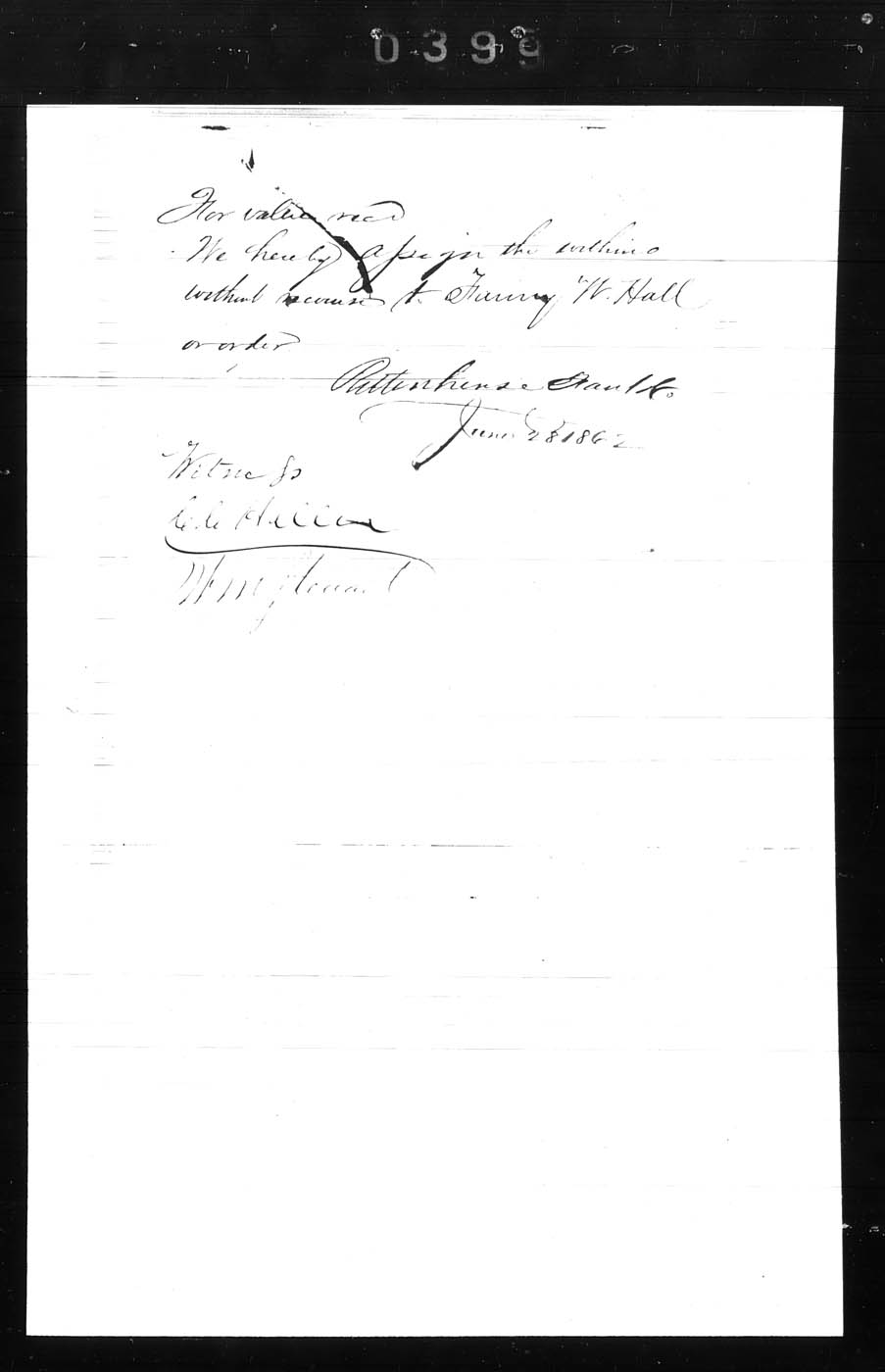
On June 28 the firm used that power. Its endorsement names Hall and gives no dollar amount. On November 12, a filing notation records that Hall submitted the assignment. By then Gardner had been free for nearly seven months. What Hall held was the right to receive money from the Treasury. Each transfer could take place without Gardner’s signature.[1][2]
The records offer an unusually good way to check the outcome. The National Archives preserves the board’s compensation records on microfilm M520.[4] In Table B, the spelling of Gardner’s name changes, but case number 78, Brocchus and Hall all appear together. The sum entered is $306.60. The payment column names Hall through her attorney, D. A. Hall. That amount could exceed $300 under the wording of section three of the act. Congress applied the $300 limit as an average across all the people covered by valid claims. Individual awards could vary.[2][3]
There are four sums in this short paper trail. The $360 recalls a purchase made when Gardner was a teenager. The $1,000 records what Brocchus asked the government to recognize. The $669 records what he said he took to part with the claim, and $306.60 is what the government allowed. We can follow the money as far as Hall’s attorney because the Treasury needed to know whom to pay. For Gardner, whose years of cooking and washing made the claim valuable in the first place, petition 78 preserves no comparable account of her first earnings in freedom.[1][3]
Sources
- Civil War Washington, University of Nebraska–Lincoln, “Petition of Perry E. Brocchus, 7 May 1862,” with the assignments, filing notations and seven microfilm images.
- U.S. Capitol Visitor Center, transcript of the District of Columbia Compensated Emancipation Act, April 16, 1862, sections 1–3.
- Commissioners’ compensation table, Table B, case 78 and note iv, transcription.
- National Archives, “Slavery and Emancipation in the Nation’s Capital,” on the board’s compensation records.