One afternoon in the first months of 1855, a ball that should have fallen at one o’clock stayed caught in its clips on the Kent coast. Someone had skimped on the oil. For a sailor watching from the anchorage off Deal, the failure was plain enough. The more curious thing is that an assistant at the Royal Observatory in Greenwich could also tell that something had gone wrong, though the clips were far out of sight. [1]
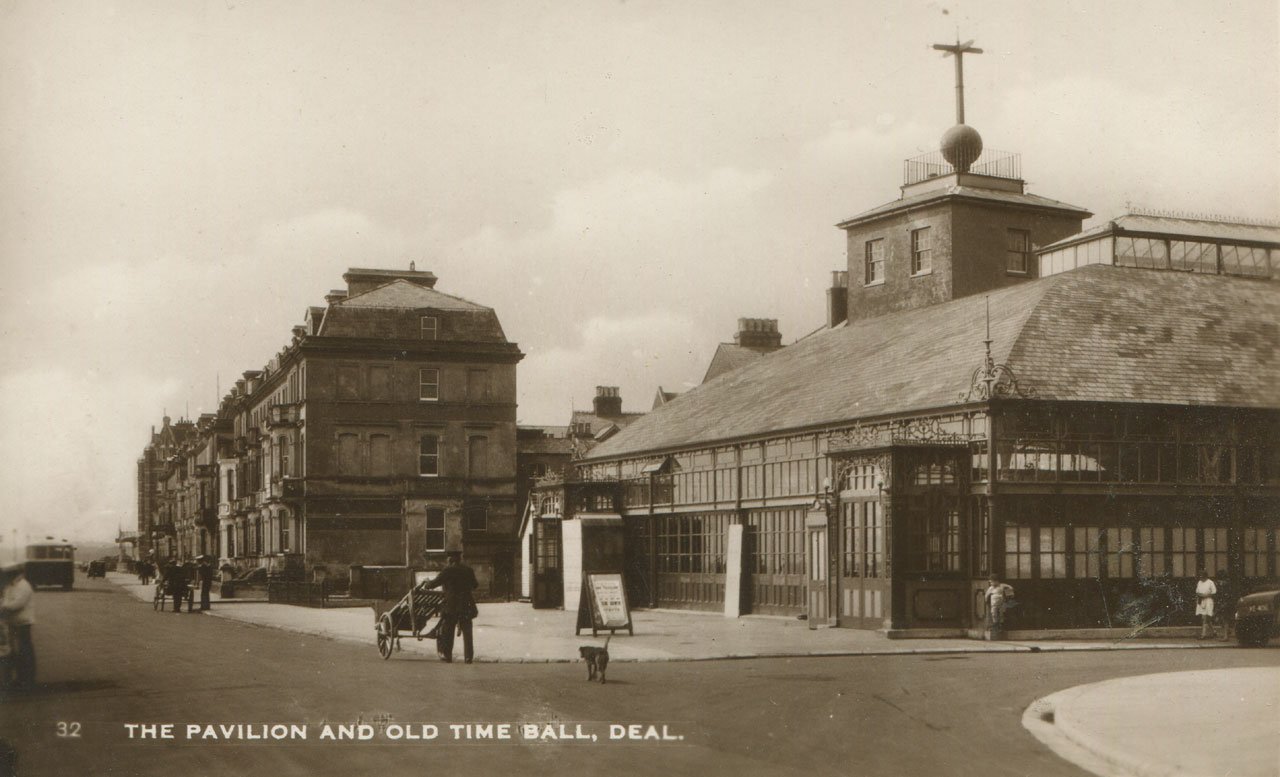
Ships waited off Deal in the Downs before heading out to sea. From the deck, a navigator could watch the ball on a former semaphore tower and read the ship’s chronometer at the instant the ball began to move. Suppose the instrument showed eight seconds past one. The navigator now had a correction to carry aboard. If the ship stayed another day and the reading at the next drop was ten seconds past, there was a second piece of information worth taking to sea. The instrument had gained two seconds in a day. Knowing its rate helped a navigator recover Greenwich time well into a voyage, when the difference between Greenwich time and local time observed by sextant could give the ship’s longitude. [2][3]
What the falling ball sent back
At one o’clock the apparatus that released Greenwich’s own time ball also sent a current down the wire to release Deal’s. The Greenwich equipment then switched the connection so that an assistant could watch a needle for a reply. At Deal, the ball itself worked the other end of the circuit. When it reached the bottom of its fall, its movement changed the electrical connections and sent a current back. A few seconds after the navigator had taken a reading, the assistant had evidence that the ball had travelled all the way down. [1][2]
The sticking clips explain why it mattered where that second signal came from. A contact on the release mechanism could have acknowledged the order while the ball was still hanging in full view of the ships. By making the reply depend on the end of the fall, the designers gave the assistant a way to check what had happened outside the tower. Silence still left a question. The Astronomer Royal recorded three failures after March 2 in his first report on the working service. The sticking clips explained one. On another occasion the railway line’s current had been switched off. The cause of the third remained uncertain. The attendant at Deal kept a register and sent each completed sheet to Greenwich. The electrical reply could travel in seconds. An explanation might take a visit from a workman, or elude the staff altogether. [1]
When Deal flew the black flag
A ball that stayed up cost a sailor a reading. A ball that fell early could give the sailor a reason to mistrust a perfectly good chronometer. In the year covered by the Astronomer Royal’s June 1879 report, stray telegraph signals twice released the Deal ball about two seconds early. On seven other days the telegraph connection failed and there was no one o’clock drop. Deal hoisted a black flag on all nine occasions and gave ships another drop at two. An observer who had already written down a comparison could look back at the tower, see the flag and know to take a fresh reading. [4]
The same report credits the attendant with seventeen drops when the current was weak. He released the trigger himself, apparently as close to the hour as anyone could measure. From a deck in the Downs, one of those hand-released drops would have looked much like a good electrical one. The records kept ashore let us see the difference. For the navigator about to sail, the distinction that mattered was whether to keep the figure just entered beside the chronometer or wait another hour and cross it out. [4]
Sources
- Reports of the Astronomer Royal, 1855 and 1856, on the Deal circuit, early failures and the attendant’s register.
- Edwin Dunkin, “A Day at the Royal Observatory,” The Leisure Hour, January 1862, on chronometer comparisons and the return current.
- Graham Dolan, “The Deal Time Ball,” a history of the tower with photographs of the seafront.
- Report of the Astronomer Royal, June 7, 1879, on early drops, hand releases and the black flag.