
Zuul crurivastator is easy to remember for the wrong reason. The name, borrowed from the horned creature in Ghostbusters, is wonderfully sticky, and the species name translates into the bruising phrase "destroyer of shins." That public hook helped the Royal Ontario Museum introduce a new armoured dinosaur to a wide audience. But the fossil's scientific value is not that it looks like a movie monster or that its tail club sounds like a weapon from a fantasy game. Zuul matters because the specimen keeps several normally separated lines of evidence attached: skull, tail club, osteoderms, skin impressions, keratin-covered spikes, quarry context, and later injury analysis.[2][3][4]
That is why ROM's short video on Zuul's soft tissues is worth watching as more than a museum teaser.[1] The video directs attention to the part of ankylosaur anatomy that often gets simplified in public display: armor was not just decorative plating over a skeleton. Osteoderms were embedded in skin. Horny sheaths changed the living shape of spikes and armor. Dark preserved films and impressions can carry information about epidermal structures that bare bone alone cannot supply.[2][3]
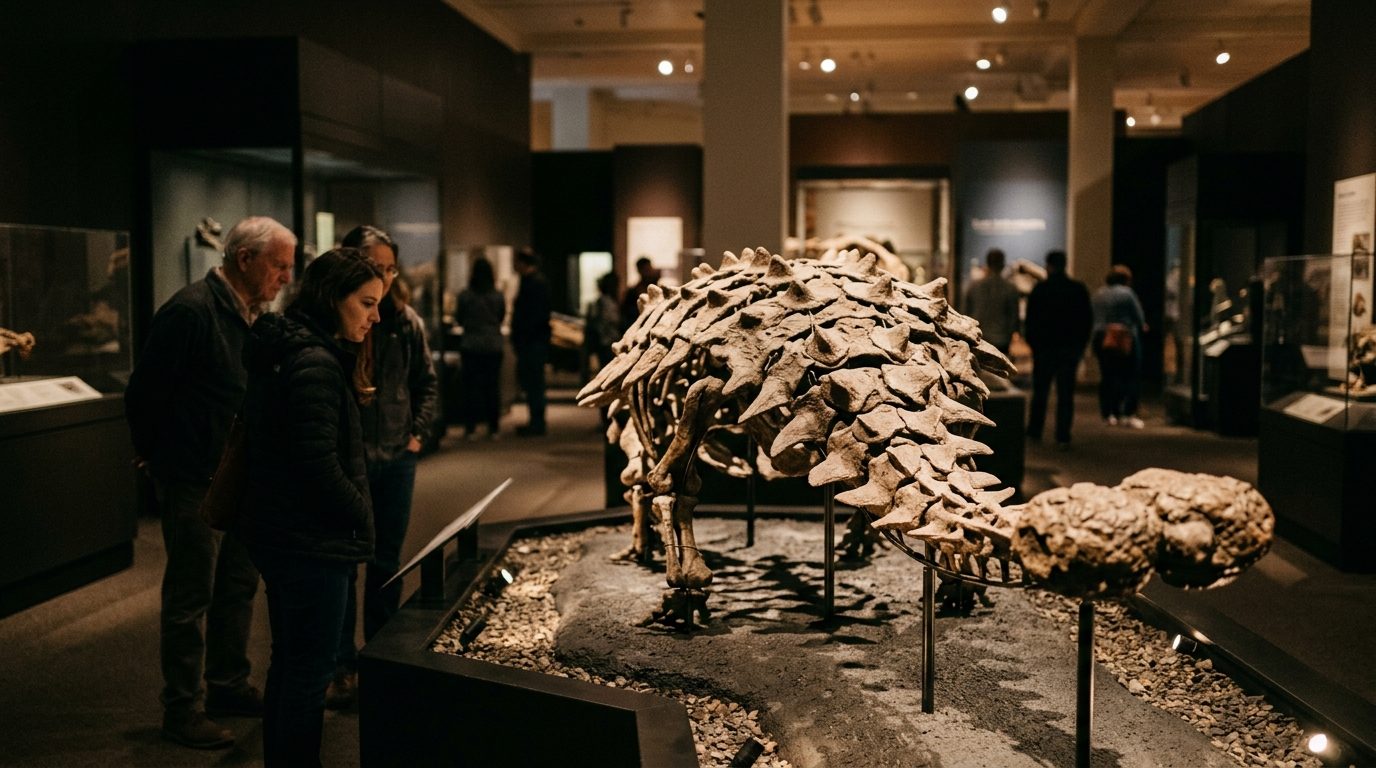
Before the embed, keep the basic provenance in view. Zuul was found in Hill County, Montana, in rocks of the Judith River Formation and later acquired by ROM. The museum presents it as one of the most complete ankylosaurids ever discovered, rare especially because the skull and tail club are preserved together and because the armor and soft-tissue traces remain unusually informative.[2] Arbour and Evans's 2017 description made the formal case: ROM 75860 is an exceptional ankylosaurine skeleton from the Coal Ridge Member, with abundant soft-tissue preservation, in-situ osteoderms, skin impressions, and dark films interpreted as probable keratin.[3]
The first useful thing to notice in the video is the shift from silhouette to tissue. A normal ankylosaur summary starts with "armored dinosaur" and then moves quickly to defense. ROM's soft-tissue framing slows that sequence down. Armor has to be understood as a living body surface before it becomes a behavioral argument.[1][2] Osteoderms can remain in original position or drift after decay; keratin sheaths can enlarge or sharpen the profile beyond the bony core; skin impressions can show how closely the animal's living outline maps to the fossilized skeleton.[2][3]
Around the video's core explanation, the value of the specimen becomes methodological. A skeleton with a skull but no tail club can tell one kind of taxonomic story. A tail club without the skull can tell another. A more complete body with soft tissues changes the question again. Zuul lets researchers connect identity, weapon anatomy, armor placement, and external tissues in the same individual.[2][3] That individual scale matters because ankylosaurs are often reconstructed from composite evidence across specimens. Here, the public is not only seeing a member of a clade. It is seeing one animal whose surfaces and appendages can be compared against each other.
The second thing to notice is how careful the soft-tissue claim has to be. The preserved material does not mean Zuul arrives as a perfect living animal with color, muscles, and behavior ready to read. The ROM page itself treats color cautiously, noting that pigment interpretation is difficult and that no preserved pigment evidence has been found so far for Zuul.[2] That boundary is important. Soft tissue in paleontology is not permission to imagine freely. It is a constraint on imagination. The fossil tells us that some skin-related and keratin-related structures survived; it does not hand over every missing biological property.
The later tail-club injury paper shows why that constraint pays off. Arbour, Zanno, and Evans argued in 2022 that pathological osteoderms in Zuul cluster around the flanks near the hip region. They interpreted that distribution as consistent with impacts from lateral tail-swinging by another ankylosaur, rather than random damage or a straightforward predator attack.[4] The argument works because the specimen preserves the armor field well enough for injury position to matter. Without the body surface, the tail club remains a plausible weapon. With the body surface, the weapon can be discussed in relation to wounds on the same animal.
That does not mean defense disappears. A club that could injure a rival could also have been dangerous to a predator. The stronger point is that Zuul moves the conversation away from one simple cartoon: tyrannosaur attacks, ankylosaur swings, story finished. The preserved armor makes a more complex behavioral space visible. Tail clubs may have served defense, display, and intraspecific combat, and the specimen's flank injuries make rival-to-rival blows a serious hypothesis rather than an afterthought.[2][4]
The video is also a useful reminder that museum preparation is part of the evidence chain. Zuul's belly and hips were held in a massive block, while the skull and tail were prepared earlier for research and display.[2] That sequencing shapes what scientists can ask at any given moment. A fossil is not fully available the instant it is found. It becomes available through stabilization, preparation, scanning, comparison, and sometimes years of waiting for a block to reveal enough of its surface.
Read this way, Zuul is not a monster-shaped novelty. It is a lesson in how spectacular fossils become disciplined. The name brings readers to the case. The skull holds the face in memory. The tail club gives the animal drama. But the soft tissues do the deeper work. They keep armor attached to skin, weaponry attached to injury, and public spectacle attached to evidence. That is why this short ROM video earns an annotated viewing: it teaches the viewer to look past the shin-destroyer joke and toward the rare fossil condition that made the joke scientifically useful.
Sources
- Royal Ontario Museum, "Zuul's soft tissues," YouTube video.
- Royal Ontario Museum, "Zuul, Destroyer of Shins" - specimen overview, discovery context, soft-tissue notes, and public research summary.
- Victoria M. Arbour and David C. Evans, "A new ankylosaurine dinosaur from the Judith River Formation of Montana, USA, based on an exceptional skeleton with soft tissue preservation," Royal Society Open Science 4 (2017), via PubMed Central.
- Victoria M. Arbour, Lindsay E. Zanno, and David C. Evans, "Palaeopathological evidence for intraspecific combat in ankylosaurid dinosaurs," Biology Letters 18 (2022), via PubMed Central.
- Royal Ontario Museum, "Introducing Zuul, Destroyer of Shins, Generator of Science" - ROM blog page and source context for the skull photograph.