Tuzoia used to be the kind of Cambrian animal that looked overknown and underknown at the same time. Its shell-like valves were common enough to name, compare, and map across continents. The rest of the animal stayed frustratingly vague. A domed, reticulate carapace with spines can tell paleontologists that a body was protected, streamlined, or strengthened. It cannot, by itself, tell them where the eyes sat, how the legs worked, whether the animal swam in open water, or whether it could handle prey near the seafloor.[1][2]
That is why Tuzoia deserves an anatomy-and-method deep dive rather than another "weird Cambrian shell" profile. The important change came when rare Burgess Shale specimens preserved more than the carapace. The 2022 redescription by Alejandro Izquierdo-Lopez and Jean-Bernard Caron used soft tissues from ROM material to reconstruct a head with eyes and antennae, a trunk with roughly ten pairs of legs, spinose limb elements, and a tail fan with paired caudal rami.[2] Once those parts entered the same body, the old shell stopped being a silhouette and became an evidence problem.
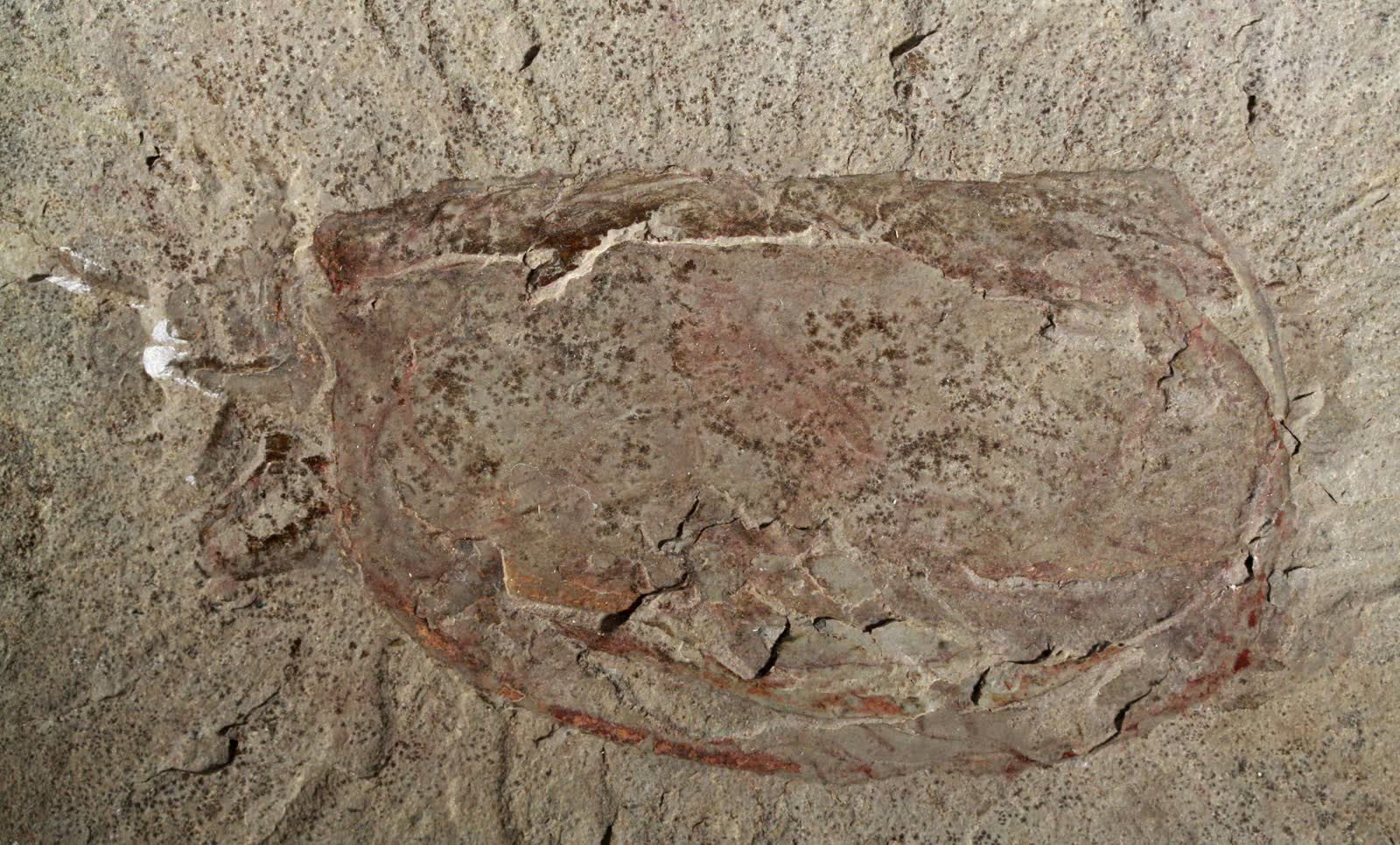
The carapace was useful, but it was also a trap
The Royal Ontario Museum summarizes Tuzoia burgessensis as a large bivalved arthropod with a reticulate carapace, known from Burgess Shale localities including Walcott Quarry, Raymond Quarry, Mount Field, Stanley Glacier, and related sites.[1] The genus name reaches back to Charles Walcott's 1912 Burgess Shale work, while Resser later established Burgess Shale species including T. burgessensis, T. canadensis, and related forms.[1][4]
That history matters because many Tuzoia species were diagnosed mainly from carapace features: valve shape, reticulate pattern, lateral ridges, anterior and posterior spines, and the position of marginal projections.[1][2][3] Vannier and colleagues' 2007 study made the shell story much more disciplined, describing Tuzoia as a large Cambrian bivalved arthropod whose non-mineralized domed carapace could reach substantial size and whose spines, ridge, and reticulation probably carried hydrodynamic and strengthening functions.[3]
But carapace-first paleontology has a built-in danger. A valve is not the animal. It can preserve often, travel after molting or death, split along a hinge, and dominate collections because it is the most durable visible part. The 2022 ROM-based work makes that sampling problem explicit: close to 400 Tuzoia specimens were in the ROM collections, yet only a small subset preserved soft tissues beyond the carapace.[2] That imbalance explains why Tuzoia stayed a classification problem for so long. The obvious part was abundant; the decisive parts were rare.
Soft tissues moved the question from outline to machinery
The 2022 reconstruction changes the center of gravity. Instead of asking only what shape the valve had, it asks what kind of body had to sit under it. The new material shows a head extending beyond the front of the carapace, large front-facing eyes, possible antennae, differentiated cephalic appendages, a trunk divided into repeated leg-bearing units, and a tail fan.[2]
Those details are methodologically important because each one filters a different interpretation. Large eyes alone might suggest a swimming animal, but eye direction and head placement matter. A tail fan suggests active control in water, but it does not prove a purely open-water life. Claw-like leg endings and spinose front limbs suggest contact with surfaces, prey, or carcasses, but they do not turn Tuzoia into a bottom-crawling crab. The useful reconstruction is a mixed one: an active swimmer that probably worked close enough to the seafloor to use its legs for predation, scavenging, anchoring, or manipulation.[1][2]
The ROM public page lands in the same zone. It notes that the midposterior and posteroventral spines may have acted like stabilizing keels while swimming, that the lateral ridge may have helped directional control and streamlining, and that the reticulate pattern could have strengthened the carapace without adding excessive weight.[1] At the same time, ROM points to claw-like leg tips and large front-directed eyes as evidence for a predator or scavenger able to interact with the benthos.[1]
That is the key anatomical balance. Tuzoia was not simply a floating shield. It was also not a familiar benthic arthropod wearing a shell. Its body plan sits between those lazy categories: a lightly armored, bivalved Cambrian arthropod with enough swimming hardware to move through the water and enough limb information to make the seafloor part of the story.[1][2]
The reticulate shell starts to read differently
The famous polygonal pattern on Tuzoia valves is easy to treat as decoration. It is better read as engineering evidence with limits. Vannier and colleagues argued that the carapace was non-mineralized, domed, and reinforced by prominent features, with the reticulate pattern helping stiffen a large but lightweight covering.[3] ROM's summary echoes the same functional logic: strength without so much mass that swimming became impossible.[1]
That does not mean every ridge, spine, or polygon has one solved purpose. Structures can do more than one job. A spine can affect water flow and deter predators. A ridge can strengthen a valve and influence stability. A broad carapace can protect soft tissues and also hide them from paleontologists. The point is not to assign a neat label to each feature. The point is to read the carapace as part of a whole-body compromise.
That compromise becomes clearer once the legs are included. The 2022 study describes leg endopods with multiple podomeres, claw-shaped distal elements, enlarged basipods, and strong spines on anterior legs.[2] If the animal used these structures near the substrate or against food, the carapace had to allow contact. The authors note that the valves may have opened enough for the legs to reach below the body.[2] In that reading, the carapace is not a closed display object. It is a flexible boundary around a working animal.
Tuzoia was widespread, but that does not settle its lifestyle
The wide geographic record of Tuzoia once encouraged a simple pelagic reading: if a genus appears across many Cambrian marine deposits, perhaps it drifted or swam broadly in open water. The newer picture is more careful. The Frontiers study of the Guanshan Biota in Yunnan emphasizes that Tuzoia ranged from Cambrian Series 2 into the Miaolingian and occurred in North America, Europe, Asia, Australia, and elsewhere.[4] It also notes that earlier authors considered swimming, benthic, or nektobenthic possibilities.[4]
That distribution is real, but it is not a shortcut. Larval stages, repeated environmental windows, broad ecological tolerance, and preservation bias can all widen a fossil's map without requiring an exclusively pelagic adult lifestyle.[2][4] This is especially important for bivalved arthropods, because their carapaces can be abundant even when soft tissues are rare. A map of valves is not automatically a map of living behavior.
The wider comparative record adds another reason for caution. The 2022 redescription reviews Tuzoia as a globally distributed Cambrian bivalved arthropod whose older interpretation leaned heavily on valves, while the Frontiers study shows how Chinese material extends the same distribution and ontogeny problem beyond Laurentia.[2][4] In other words, Tuzoia is not solved by one locality alone. Its best reading comes from holding Burgess Shale soft tissues, Chinese occurrence data, and older carapace studies in the same frame.[2][3][4]
The mandibulate question remains useful because it is bounded
The 2022 paper retrieves Tuzoia as an early mandibulate hymenocarine lineage in its Bayesian analysis, which would place the genus near one of arthropod evolution's major living success stories: the group that includes crustaceans, insects, myriapods, and their relatives.[2] That is a strong claim, but the paper itself keeps an important boundary. Hymenocarine relationships remain debated, and the position of Tuzoia depends on rare soft-tissue characters that are still incompletely known across the group.[2]
That is not a weakness to hide. It is exactly what makes Tuzoia scientifically useful. The fossil does not become important because it hands over a finished textbook answer. It becomes important because it shows what kind of evidence is needed to move from a shell-based Cambrian fossil to a whole-body evolutionary argument. Eyes, antennae, leg segmentation, basipods, spines, tail fans, and carapace mechanics all have to be read together.[1][2]
The safest conclusion is therefore narrow and strong. Tuzoia was a large, globally distributed Cambrian bivalved arthropod whose carapace once dominated interpretation. Rare soft tissues now make it legible as an active swimming animal with nektobenthic predatory or scavenging possibilities, and probably as part of the early hymenocarine-mandibulate debate. The animal is no longer only a shell. It is a case study in how paleontology escapes the shell when the rest of the body finally appears.
Sources
- Royal Ontario Museum, "Tuzoia burgessensis," Burgess Shale fossil page with specimen photographs, taxonomy, locality, morphology, and ecology notes.
- Alejandro Izquierdo-Lopez and Jean-Bernard Caron, "The problematic Cambrian arthropod Tuzoia and the origin of mandibulates revisited," Royal Society Open Science 9 (2022), PMC full text.
- Jean Vannier et al., "Tuzoia: Morphology and lifestyle of a large bivalved arthropod of the Cambrian seas," Journal of Paleontology 81 (2007), Cambridge Core record.
- Jian Ma et al., "New Data on the Bivalved Arthropod Tuzoia From the Cambrian (Series 2, Stage 4) Guanshan Biota in Kunming, Yunnan, Southwest China," Frontiers in Earth Science 10 (2022).