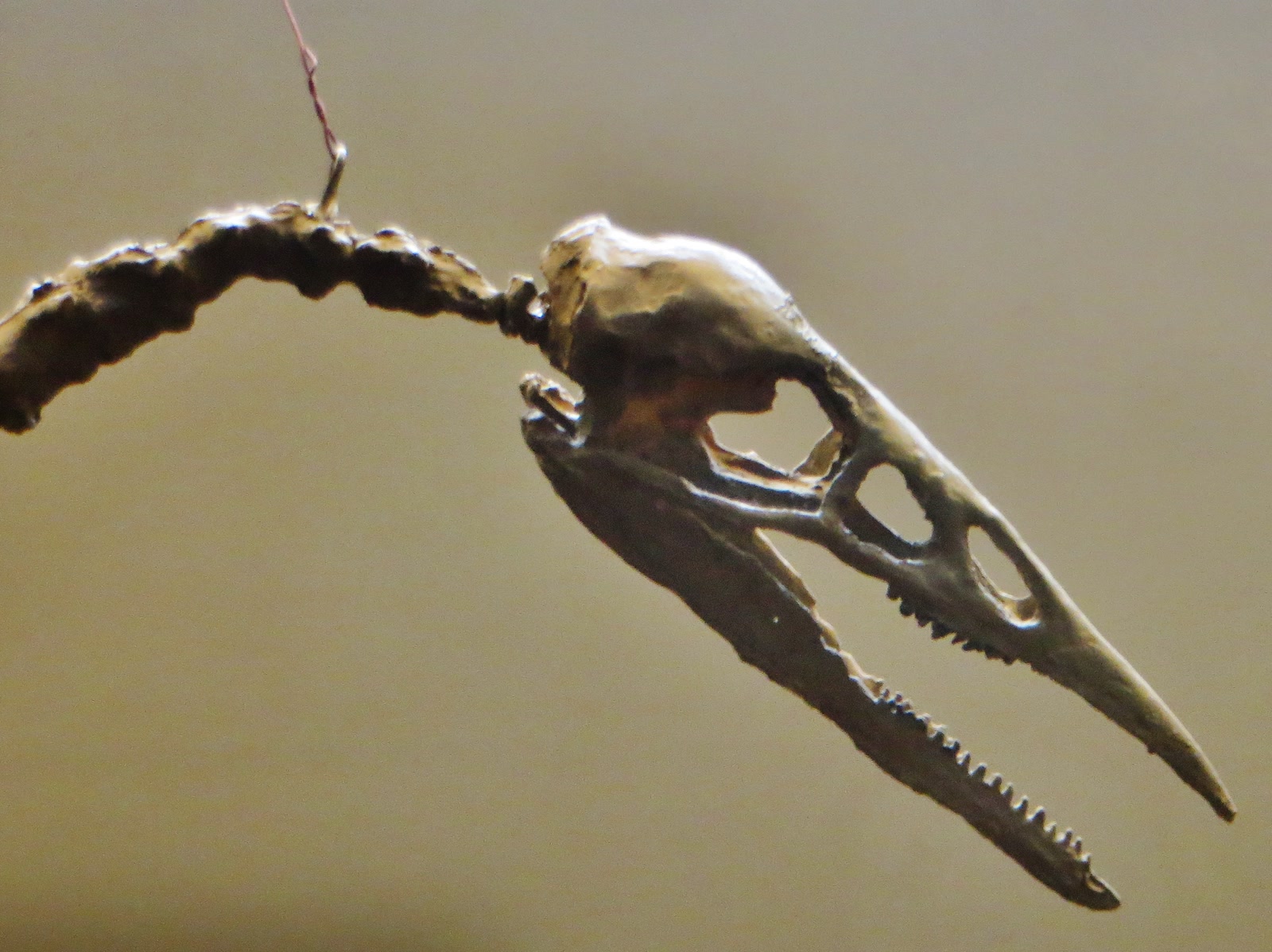
Ichthyornis dispar is most useful when it is not treated as a missing-link slogan. It was a Late Cretaceous bird close to the living-bird radiation, but it kept teeth. That combination sounds simple until the skull is read carefully. The animal does not merely say, "birds once had teeth." It says that several pieces of the modern bird head arrived at different speeds: a small beak at the jaw tips, teeth along much of the jaw, a surprisingly bird-like palate, a relatively modern braincase, and a temporal region that still made room for dinosaurian jaw musculature.[1]
That is why the lead image starts with a real fossil photograph rather than a restoration. The skull and neck do not look like a finished gull with accidental teeth added. They look like a Cretaceous bird whose head is still negotiating two construction systems at once. The fossil's force is not nostalgia for a stranger bird. It is the way one specimen complex lets paleontologists separate beak origin, feeding mechanics, brain evolution, and tooth loss instead of collapsing them into one neat transformation.
The old headline was teeth
The historical reason Ichthyornis mattered was unavoidable: Marsh's nineteenth-century work on North American toothed birds made the animal one of the classic fossils used to argue that birds had a deeper reptilian past than living species alone could show.[3] In the old frame, teeth did most of the attention work. A flying bird with teeth felt like a direct challenge to the tidy boundary between modern birds and other reptiles.
That historical shock was real, but it also flattened the animal. Marsh's Odontornithes grouped Cretaceous toothed birds into a broad interpretive moment, and the title itself shows the emphasis: extinct birds of North America with teeth.[3] Teeth were the visible contradiction. They were also easy to overuse. Once a fossil becomes famous for one surprising trait, every other part of the body starts to serve that trait rather than being read on its own terms.
Julia Clarke's 2004 systematic revision is useful because it made Ichthyornis less theatrical and more precise. Working through the Yale Peabody material and related specimens, Clarke reduced a historically crowded taxonomic picture, showing that much of the material belonged to one species, Ichthyornis dispar, while some named forms did not belong there.[2] That is not a glamorous correction, but it is exactly the kind of cleaning a close reading needs. Before the skull can tell an evolutionary story, the name has to stop absorbing every similar scrap.
The beak was small, not absent
The 2018 Nature skull study changed the center of gravity. Field and colleagues reported four three-dimensionally preserved specimens, including an unusually complete skull, and used high-resolution CT to build a near-complete reconstruction.[1] That matters because many Mesozoic bird skulls are crushed, distorted, or incomplete. A flattened skull can preserve outline and teeth, but it can make the palate, braincase, jaw suspension, and muscle chambers much harder to compare.
The reconstruction showed that Ichthyornis had a transitional beak: small, limited to the jaw tips, and lacking the broad palatal shelf typical of modern birds.[1] That is a sharper result than either "beaked bird" or "toothed bird." The fossil shows that beak origin did not require the immediate disappearance of teeth from the rest of the jaws. The premaxillary tip could become beak-like while much of the feeding margin still retained dental hardware.
That detail changes the evolutionary sequence. If the beak is imagined as a single all-or-nothing replacement for teeth, Ichthyornis becomes awkward. If it is read as a modular transformation, the fossil becomes clarifying. The beak begins at the front of the mouth; tooth-bearing regions persist behind it; other cranial systems continue changing on their own clocks. A small beak is still a beak, but it is not yet the modern bird face.
The palate moved ahead of the jaw muscles
The most interesting part of the 2018 paper is not simply that Ichthyornis had a beak and teeth together. It is that the skull combined a bird-like kinetic system with a much more primitive temporal region.[1] In living birds, cranial kinesis lets parts of the upper jaw and palate move in coordinated ways during feeding. Field and colleagues argued that a kinetic system similar to that of living birds was already present in Ichthyornis, meaning important feeding-apparatus features evolved earlier than the complete modern beak-and-jaw package.[1]
The temporal region tells a different story. The same skull retained a large adductor chamber and substantial remnants of the ancestral upper temporal fenestra, leaving more room for jaw-closing musculature than modern birds normally show.[1] This is the mismatch that makes the fossil so valuable. A bird-like palate did not wait for a fully modern beak. A relatively modern brain shape did not wait for complete reduction of the old jaw-muscle architecture.[1]
That is why Ichthyornis is better than a transitional mascot. It lets the transition be uneven. Paleontology often becomes strongest when it refuses the smooth version of a story. Here the head does not move from dinosaur to bird as one synchronized block. It changes by parts: beak tip, teeth, palate, braincase, temporal fenestra, muscles. Each part carries its own timing and constraint.
The body keeps the skull honest
The skull is the star, but the rest of the fossil record keeps the animal from becoming only a cranial argument. Benito and colleagues' work on forty additional specimens gave Ichthyornis an unusually detailed postcranial frame for a Mesozoic avialan, including new information on the pectoral girdle, forelimbs, hindlimbs, vertebrae, and partial skeletons.[4] That matters because a head alone can tempt readers into treating the animal as an abstract evolutionary diagram.
The postcranial material says otherwise. Ichthyornis was a real flying bird, not a skull experiment floating in Cretaceous space. The body record strengthens its position as a crownward stem bird, close enough to living birds to make modern traits relevant, but outside the living radiation and still carrying ancestral anatomy in visible places.[1][4] The animal therefore sits at a particularly useful distance: near enough to modern birds to illuminate their origin, far enough away to show that the final package had not yet locked into place.
This body context also keeps the teeth from becoming too much of the story. Teeth were part of the animal's feeding apparatus, but not the whole animal's identity. Wings, shoulder anatomy, vertebrae, hindlimbs, and skull all belong in the same reading. The fossil is important because it preserves a late stage in avian assembly, not because one feature makes it look half-modern in a cartoon sense.
What Ichthyornis does and does not settle
The secure claim is strong: Ichthyornis dispar shows that a small avian beak, bird-like cranial kinesis, and a relatively modern brain shape could coexist with teeth and a more dinosaurian jaw-muscle region near the origin of living birds.[1] That is enough to change the sequence. It means that tooth loss, beak expansion, palate function, braincase modernization, and temporal-region reduction were not one indivisible event.
The boundary is just as important. Ichthyornis does not tell us that modern bird beaks evolved for one single ecological reason. It does not show the exact moment all teeth disappeared from the bird line. It does not turn every Cretaceous toothed bird into a direct ancestor of living birds. What it does is narrower and better: it makes the assembly of the bird head visible as a mosaic rather than a switch.[1][2][4]
That is why the fossil remains fresh even after a century and a half of attention. The old headline was that birds once had teeth. The better close reading is that a bird could already be deeply bird-like in its skull mechanics while still biting with a mouth that modern birds no longer possess. Ichthyornis makes the beak stranger by keeping the teeth in frame.
Sources
- Daniel J. Field et al., "Complete Ichthyornis skull illuminates mosaic assembly of the avian head," Nature 557 (2018) - CT-based skull reconstruction, transitional beak, kinetic palate, braincase, and temporal-region findings.
- Julia A. Clarke, Morphology, phylogenetic taxonomy, and systematics of Ichthyornis and Apatornis (Avialae, Ornithurae), Bulletin of the AMNH 286 (2004), DOI record.
- Othniel Charles Marsh, Odontornithes: a monograph on the extinct toothed birds of North America (1880), USGS publication record.
- Juan Benito et al., "Forty new specimens of Ichthyornis provide unprecedented insight into the postcranial morphology of crownward stem group birds," Journal of Vertebrate Paleontology 41 (2022), via PubMed Central.
- Wikimedia Commons, "File:Ichthyornis dispar skull and neck.jpg" - source page for the real fossil photograph used as the article image.