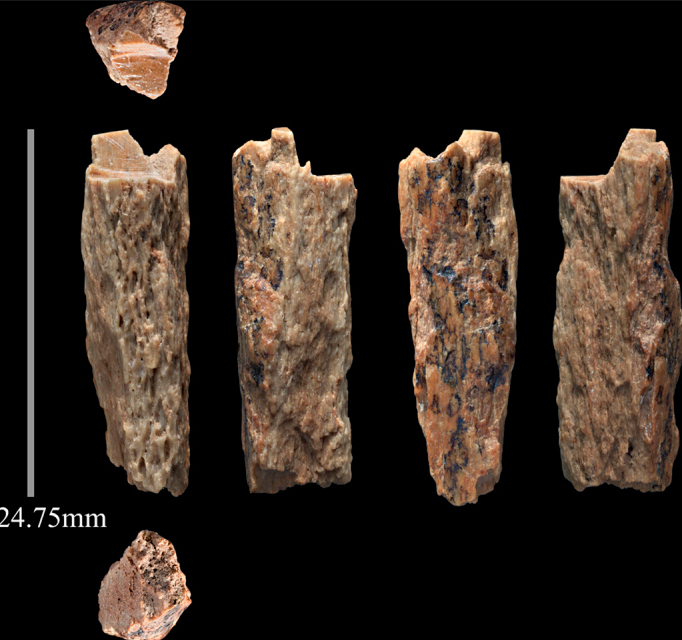
Denisova 11 does not look like a discovery. In photographs, it is a narrow splinter of brown cortical bone shown from several angles beside a scale bar. There is no tooth, joint or sculpted surface to announce what part of the skeleton it came from, much less whose skeleton it was. Its visible anatomy had fallen below the threshold of recognition.[3][6]
In 2016, that fragment emerged from a screen of 2,315 similarly unpromising bones from Denisova Cave in Siberia. A collagen test flagged it as hominin. Mitochondrial DNA then showed a Neanderthal maternal line, and later nuclear DNA revealed something the collagen alone never could: the bone belonged to a girl whose mother was Neanderthal and whose father was Denisovan.[3][4]
The sequence matters more than the celebrity result. Zooarchaeology by mass spectrometry, or ZooMS, did not identify a hybrid. It made the hybrid findable. The method turns one of palaeontology’s most common losses—bone broken beyond morphological identification—into a chemical sorting problem. Its power lies in that change of scale. So do its limits.
A fossil can lose its name before it loses its protein
Traditional identification begins with form. A ridge on a tooth, the end of a limb bone or the geometry of a joint can be compared with reference skeletons. Break away those landmarks and an expert may be left with “large mammal,” “long-bone shaft” or simply “unidentified.” That is an honest answer, but it creates a filter: robust and distinctive parts enter faunal lists more readily than fragments made by butchery, carnivore digestion, trampling and excavation.
ZooMS looks for a different kind of difference. Type I collagen is the dominant structural protein in bone. Its long chains are built from amino acids, and those sequences vary slightly among animal lineages. When one lineage carries a substitution at a particular position, a resulting collagen fragment may have a different mass. A set of those mass differences can work as a taxonomic fingerprint even when the bone’s external shape says almost nothing.[1]
The foundational 2009 study compared collagen from 32 mammal species, found 92 potentially useful peptide markers and demonstrated that ancient bone could retain a readable signal. The central proposition was modest but transformative: do not try to recover the whole organism from one molecule. Compare a reproducible pattern of genus- or group-informative collagen peptides with authenticated references.[2]
Collagen is unusually useful because it is abundant and often outlasts more information-rich molecules such as DNA. “Often” is essential. Protein survival still depends on age, temperature, burial chemistry and treatment after excavation. ZooMS is a route around missing morphology, not around preservation itself.[1]
The spectrum is made, not discovered
A ZooMS fingerprint begins with sampling. Protocols differ with the material and conservation needs, but a conventional bone workflow removes a small amount, extracts collagen from the mineral matrix and heats it into solution. The enzyme trypsin then cuts the protein at predictable amino-acid sites, producing a mixture of shorter peptides.[1]
Those peptides are mixed with a light-absorbing matrix and placed in a MALDI-TOF mass spectrometer. A laser releases and ionizes them. An electric field accelerates the charged peptides through a flight tube; lighter ions reach the detector before heavier ones. Calibration converts arrival time into a mass-to-charge value, and the instrument returns a spectrum of peaks. Researchers compare selected peaks with collagen markers from known animals.[1][5]
This is why “protein barcode” is a useful metaphor only up to a point. A supermarket barcode has a fixed registry and one exact product. A ZooMS spectrum reflects sample preparation, molecular modification, preservation and the reference data available to interpret it. Closely related animals may share the same informative peptide masses. A weak spectrum may preserve only some markers. A peak can also have more than one plausible molecular explanation until higher-resolution tandem mass spectrometry checks its peptide sequence.[1]
The spectrum is therefore not a tiny skeleton hiding inside the machine. It is a measured pattern produced by a chain of choices: which fragment to sample, how to extract it, where trypsin cuts, which peaks count and which living or fossil references are available for comparison. Reproducibility comes from making that chain explicit.
Denisova 11 shows the handoff between methods
The first Denisova 11 study removed 20–50 milligrams from each candidate bone, demineralized the samples and screened the resulting collagen digests. One fragment, laboratory code DC1227, matched the expected hominin markers. Because several initially proposed “human” peaks were also known in other mammal groups, the team did not stop at a pattern match. It used higher-resolution peptide sequencing to support the hominin call, then moved to radiocarbon and mitochondrial-DNA analysis.[3]
That ladder of evidence is the method at its best. ZooMS is relatively rapid and suited to screening large assemblages; it can direct scarce time and more intensive analyses toward the rare fragments most likely to answer a question. DNA offers far greater resolution when it survives. Dating places the fragment in time. Morphology, microscopic damage and stratigraphy still supply anatomical and archaeological context.
Two years later, genome-wide work showed that Denisova 11 inherited one set of chromosomes from a Neanderthal mother and the other from a Denisovan father.[4] Nothing in the collagen fingerprint encoded that family history at readable resolution. Calling ZooMS the tool that “found a hybrid” is defensible shorthand only if the handoff remains visible: the protein screen found a hominin candidate; ancient DNA established her ancestry.
Eight thousand fragments reveal the resolution ceiling
Denisova Cave also shows what happens when the method is used as more than a rare-fossil detector. A later project analysed 8,253 bones that could not be identified morphologically. Seventy-four percent reached their most specific ZooMS taxon, and another five percent could be placed only at family or order level because their spectra were weak. Fewer than five percent of excavated bones at the site had been identifiable by eye.[5]
Those percentages do not mean that ZooMS named nearly four out of five bones to species. The study’s “ZooMS taxon” was often a genus or family-sized bucket. Wolf, corsac fox, dhole and Arctic fox shared fingerprints that collapsed into Canidae; red fox carried a distinguishing collagen difference. The correct resolution came from the chemistry, not from the desire for a longer species list.[5]
Nor did the screen create a neutral census. Researchers preferentially selected fragments around two centimetres or larger, partly because previously known hominin pieces at Denisova were only a few centimetres long. Small vertebrates and birds consequently formed less than one percent of the identified material. The method recovered identities hidden by fragmentation while the sampling design imposed a different visibility filter.[5]
Preservation varied inside the same cave as well. Twenty-eight percent of sampled bones from the South Chamber failed to yield enough collagen for identification, compared with 16 and 17 percent in the other chambers. A blank spectrum is not evidence that a taxon was absent. It may be a history of heat, water, soil chemistry, digestion or protein decay written as analytical silence.[5]
What ZooMS cannot put back
Four boundaries keep a fingerprint honest. First, the test needs surviving collagen; mineralized shape can persist after usable protein has vanished. Second, taxonomic precision cannot exceed sequence differences and the reference library. Identical markers justify a shared group, not an invented species. Third, standard sampling is minimally destructive, not magically free: even a small drilled or cut portion matters when a specimen is unique. Nondestructive and eraser- or bag-based approaches are expanding, but they can trade signal strength for conservation.[1]
The fourth boundary is contextual. ZooMS may identify the animal that supplied a shaft fragment, yet it does not by itself identify the skeletal element, date the layer, distinguish hunting from scavenging or prove that two taxa occupied a cave at the same moment. Those are questions for morphology, taphonomy, stratigraphy, dating and other molecular methods. Collagen adds a line of evidence; it does not dissolve the excavation record.
That is also why the method changes museum drawers as much as fieldwork. A tray labelled “unidentified bone” is no longer necessarily an evidentiary dead end. It can become a searchable population of candidates—provided sampling permission, preservation, reference coverage and the scientific question justify the cost to the material.
Denisova 11 remains the sharpest demonstration because the object and the outcome seem so mismatched. A featureless splinter ultimately carried an extraordinary genome. But the durable lesson is less spectacular: when anatomy goes silent, collagen may still speak at the level it can support. ZooMS is valuable not because it makes every fragment confess a species, but because it tells researchers which fragments deserve the next question.
Sources
- Kristine K. Richter et al., “A primer for ZooMS applications in archaeology,” Proceedings of the National Academy of Sciences 119 (2022)—collagen chemistry, MALDI-TOF workflow, interpretation, sampling approaches and reference-library limits.
- Michael Buckley et al., “Species identification by analysis of bone collagen using matrix-assisted laser desorption/ionisation time-of-flight mass spectrometry,” Rapid Communications in Mass Spectrometry 23 (2009)—foundational comparative marker study and ancient-bone application.
- Samantha Brown et al., “Identification of a new hominin bone from Denisova Cave, Siberia using collagen fingerprinting and mitochondrial DNA analysis,” Scientific Reports 6 (2016)—the 2,315-fragment screen, DC1227 workflow and initial identification of Denisova 11.
- Viviane Slon et al., “The genome of the offspring of a Neandertal mother and a Denisovan father,” Nature 561 (2018)—genome-wide identification of Denisova 11’s first-generation ancestry.
- Samantha Brown et al., “Zooarchaeology through the lens of collagen fingerprinting at Denisova Cave,” Scientific Reports 11 (2021)—8,253-fragment survey, taxonomic resolution, preservation failures and sampling bias.
- Wikimedia Commons, “Denisova-11.jpg”—source, dimensions, authorship and licensing record for the real specimen photographs used as the cover.