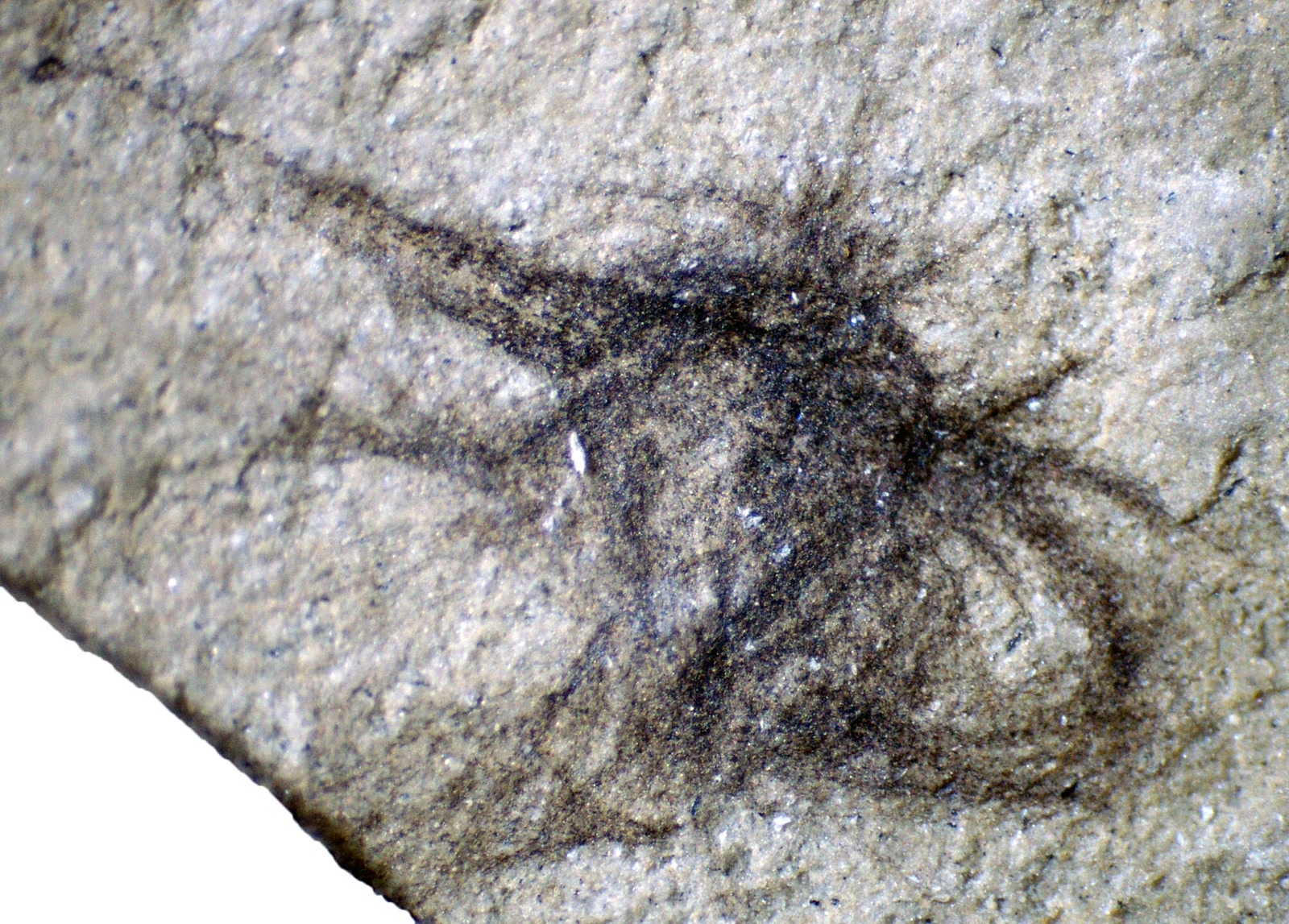
The feather is scarcely more than a dark smudge until its barbs come into focus. On Museums Victoria specimen P 250594, fine strands gather into a short, downy form against pale mudstone. It is one of ten isolated feathers recovered from the Koonwarra Fossil Bed in southeastern Australia: exquisite evidence that a feathered animal lived near an Early Cretaceous lake, but not a body fossil that can name its owner.[5][6]
Koonwarra is famous for things a slab can display—fish, insects, leaves and feathers—yet its latest major revision began with a cylinder only five centimetres across. A 21-metre drill core taken beside the old road exposure passed through the fossil-bearing succession. Researchers sampled the core for microscopic pollen and spores, then paired those biological clocks with uranium–lead dates from zircon grains.[1]
The result is not a single sensational creature. It is a better address for the entire assemblage. The 2025 study places Koonwarra near the late Aptian–early Albian transition, probably somewhat younger than the middle-to-late Aptian framing long used for the site. It also reconstructs a cool-temperate lake margin dominated by gymnosperms, with ferns and lycophytes below and flowering plants present but still scarce.[1][2]
One part of the old picture remains deliberately unresolved. The core sharpens the freshwater and vegetation record, while the study’s environmental synthesis retains the established interpretation of low-oxygen bottom conditions and exceptional preservation. Its new pollen and zircon data do not make annual lake ice the only explanation for those conditions. Koonwarra has acquired a younger clock, not a frozen verdict.
The highway opened the lake twice
Road workers exposed the deposit in 1961 while straightening and widening the South Gippsland Highway east of the town of Koonwarra. Excavations soon revealed thinly laminated claystones and siltstones crowded with freshwater fish, plants and delicate invertebrates. Later reviews expanded the census to crustaceans, spiders, insects, unionoid mussels, a freshwater horseshoe-crab relative and the isolated feathers—the site’s only direct tetrapod remains.[2][3]
That first encounter was horizontal and selective. A road cutting shows accessible beds; excavation follows layers likely to split and reward the collector. The new borehole, B18–68600, supplied a different view. Drilled directly south of the exposure and along the strike of the dipping beds, it recovered 21 metres of rock. The authors treat roughly the basal 10 metres as the Koonwarra Fossil Bed proper. Instead of choosing spectacular slabs, researchers could follow the succession continuously and sample unshowy intervals as well as fossil-rich ones.[1]
Twenty-four samples yielded well-preserved palynomorphs: the acid-resistant microscopic bodies and fragments that include pollen, spores and algal remains. Roughly 30,000 specimens were assigned to about 138 taxa. Sparse insect fragments also appeared. Fresh- to brackish-water algae occurred, while marine palynomorphs did not—an independent microscopic check on the freshwater reading already suggested by the larger fossils and sediment.[1]
The core is not a perfect tape recorder. It is five centimetres wide, and it did not reach the coarse unit expected below the fossil bed, so the true base may lie deeper than the recovered section. A narrow borehole cannot sample every lateral pocket in an ancient lake, while pollen abundance also reflects how much different plants produced, how far grains travelled and where currents deposited them. Its advantage is continuity: the same small window runs through a sequence rather than skipping from one beautiful fossil to the next.[1]
The date needs two kinds of clock
Zircon and pollen answer the age question differently. Zircon crystals incorporate uranium when they form and retain lead produced by radioactive decay. Dating grains carried into sediment can therefore set a maximum depositional age: the enclosing mud must be younger than its youngest reliable inherited grain. It is a ceiling, not the exact afternoon when silt settled on a fish.[1]
The dominant young zircon signal bracketing Koonwarra produced an age of no older than about 114.1 million years, in the latest Aptian. A few grains returned ages near 110 million years, but the study does not promote those outliers into a precise date for the bed. Detrital populations can mix grains from different eruptions and source rocks, and individual analyses can be disturbed. The careful claim is late Aptian or younger, not “Koonwarra formed at 110 million years exactly.”[1]
Palynology supplies the second hand. The combined occurrence of the index spores Coptospora paradoxa and Stoverisporites lunaris, together with shifts in the wider assemblage, fits the base of the Coptospora paradoxa Zone and points tentatively to the early Albian. The qualification matters because southeastern Australia’s Early Cretaceous pollen zones have been revised, and the ranges assigned to some key taxa are not perfectly consistent among schemes.[1]
Together, the clocks narrow the placement to the late Aptian–early Albian boundary interval and make an early Albian age plausible. Earlier fission-track results, with uncertainties of several million years, had encouraged the familiar roughly 118–115-million-year and broadly Aptian descriptions of Koonwarra.[2][5] The new work does not expose those estimates as foolish; it adds a denser biological sequence and a different radiometric method. Geologic age control improves by overlapping constraints whose weaknesses are not identical.
The forest appears as fallout
Across the core, gymnosperm pollen dominates. Alisporites, associated with seed-ferns, is prominent alongside Araucariacites from araucarian conifers, Podocarpidites from podocarp relatives and single-grooved grains probably produced by groups including ginkgophytes and pentoxylaleans. Fern spores form the next major component, followed by lycophyte spores. The study reads this as stable, gymnosperm-rich vegetation with a diverse low-growing flora around a cool-temperate lake margin.[1]
This is a landscape reconstructed from dispersal, not a literal forest inventory. Wind-pollinated trees can flood a basin with grains; a plant growing at the water’s edge may be overrepresented relative to one farther upslope. “Dominant in the slide” and “dominant in standing biomass” are related propositions, not synonyms. The named pollen groups support the broad architecture—gymnosperm canopy and seed-ferns, ferns and lycophytes around it—more securely than they support a stem-by-stem map.
Flowering-plant pollen accounts for only about 1–6 percent of the assemblages. Its rarity is precisely what makes it useful. Angiosperms are present throughout, and their representation rises gradually up-section, but they have not displaced the older gymnosperm and spore-producing vegetation in this local record.[1] Koonwarra therefore catches an evolutionary transition at landscape scale: flowering plants have entered the high-latitude flora without yet owning the pollen rain.
The new age changes the comparison set. An Aptian assemblage and an early Albian assemblage occupy different positions in the rapid Cretaceous expansion of flowering plants and in attempts to compare southern biotas separated by the rifting of Australia and Antarctica. Moving a site by a few million years can change whether a taxon looks early, persistent or contemporary with a record elsewhere. That is why the calendar matters even when every visible feather and fish remains the same.[1][2]
Low oxygen does not name its cause
Koonwarra’s laminated rock lacks the churned texture that bottom-dwelling animals leave when they burrow through sediment. Authigenic carbonate formed within the deposit, fossils retained delicate detail, and bioturbation is absent. In their synthesis, the 2025 authors take those signals together as evidence for anoxic lake-bottom conditions that helped suppress scavenging and decay; the new palynological sampling itself does not measure ancient oxygen.[1]
This conclusion revives an old causal question without closing it. In his 1971 study of the fish beds, Michael Waldman proposed that a cool lake froze seasonally. Ice cut oxygen exchange; fish died in winterkill events; fine sediment settled over their bodies; and cold, oxygen-poor water slowed destruction. Repeated fish-rich laminae gave the scenario an appealing rhythm.[3]
Other researchers have argued for a non-freezing water body episodically connected to a larger lake during high-rainfall floods. A stratified lake can also maintain oxygen-poor deep water, while blooms, runoff or water-column turnover can produce mortality without requiring a lid of ice. The new pollen study supports cool, humid, high-latitude vegetation; the paper’s broader synthesis accepts an anoxic preservational setting. Neither observation uniquely diagnoses surface freezing.[1][3]
That distinction is easy to lose because “polar” sounds like “ice-covered.” Koonwarra lay at roughly 70° south during a greenhouse interval, where long winter darkness and strong seasonality mattered even if the lake did not freeze every year.[5] Cool-temperate plants constrain the regional climate; undisturbed laminae constrain the lake floor. The missing link is a proxy that makes ice, rather than another path to anoxia, the necessary mechanism.
Organic chemistry adds atmosphere without supplying that link. A preliminary study of one Koonwarra sediment sample found long-chain compounds consistent with substantial land-plant input, abundant bacterial biomarkers and aromatic compounds that may record wildfire in the surrounding watershed. Its authors explicitly presented the work as a first test and called for a stratigraphic series.[4] The sample suggests a lake fed by forest debris and microbial recycling. It cannot turn one chemical snapshot into a seasonal history of freezing.
What the core actually changes
The strongest new picture has three levels. Direct observations come first: the core’s sequence, its pollen and spores, zircon measurements, freshwater algae, absent marine palynomorphs, laminated sediment and unburrowed fabric. Reconstructions come next: a cool-temperate gymnosperm-rich lake margin, a late Aptian–early Albian age and oxygen-poor bottom water. The annual-freezing story remains one causal model among alternatives.
That hierarchy does not make Koonwarra less vivid. It makes the site more legible. A road cut supplied the spectacular bodies; a narrow core recovered the background population of microscopic fossils; two imperfect clocks gave the deposit a firmer place in time. Together they turn a cabinet of extraordinary objects into a changing lakeside community.
Return to P 250594 and its limits now become part of its value. The feather does not identify its maker, and the mud around it does not name the season of death. Yet the specimen belongs to a real freshwater basin near the ancient polar circle, bordered by conifers, seed-ferns and a small but rising share of flowering plants. Koonwarra’s winter is still an argument. Its lake has become a landscape.
Sources
- Vivi Vajda et al., “Early Cretaceous vegetation in a polar ecosystem—Palynology and zircon dating of the Koonwarra Fossil Bed, Victoria, Australia,” Review of Palaeobotany and Palynology 338 (2025)—drill-core design, palynomorph census, U–Pb zircon constraints, vegetation reconstruction and anoxia evidence.
- Stephen F. Poropat et al., “Early Cretaceous polar biotas of Victoria, southeastern Australia—an overview of research to date,” Alcheringa 42 (2018)—site history, fossil assemblage, regional geology and pre-2025 age framework.
- Michael Waldman, Fish from the Freshwater Lower Cretaceous of Victoria, Australia, with Comments on the Palaeo-environment, Special Papers in Palaeontology 9 (1971)—original fish-bed study and seasonal-freezing model.
- Michael L. Tuite, David T. Flannery and Kenneth H. Williford, “Organic geochemistry of a high-latitude Lower Cretaceous lacustrine sediment sample from the Koonwarra Fossil Beds,” Memoirs of Museum Victoria 74 (2016)—preliminary biomarker evidence for terrestrial input, bacterial processing and possible wildfire.
- Martin Kundrát et al., “A polar dinosaur feather assemblage from Australia,” Gondwana Research 80 (2020)—analysis of ten isolated Koonwarra feathers, palaeolatitude and the evidentiary boundary between bird-like and non-avian dinosaur feathers.
- Museums Victoria, “Specimen P 250594 Vertebrata”—collection record, locality, photographer, rights and provenance for the real Koonwarra feather photograph used as the cover.