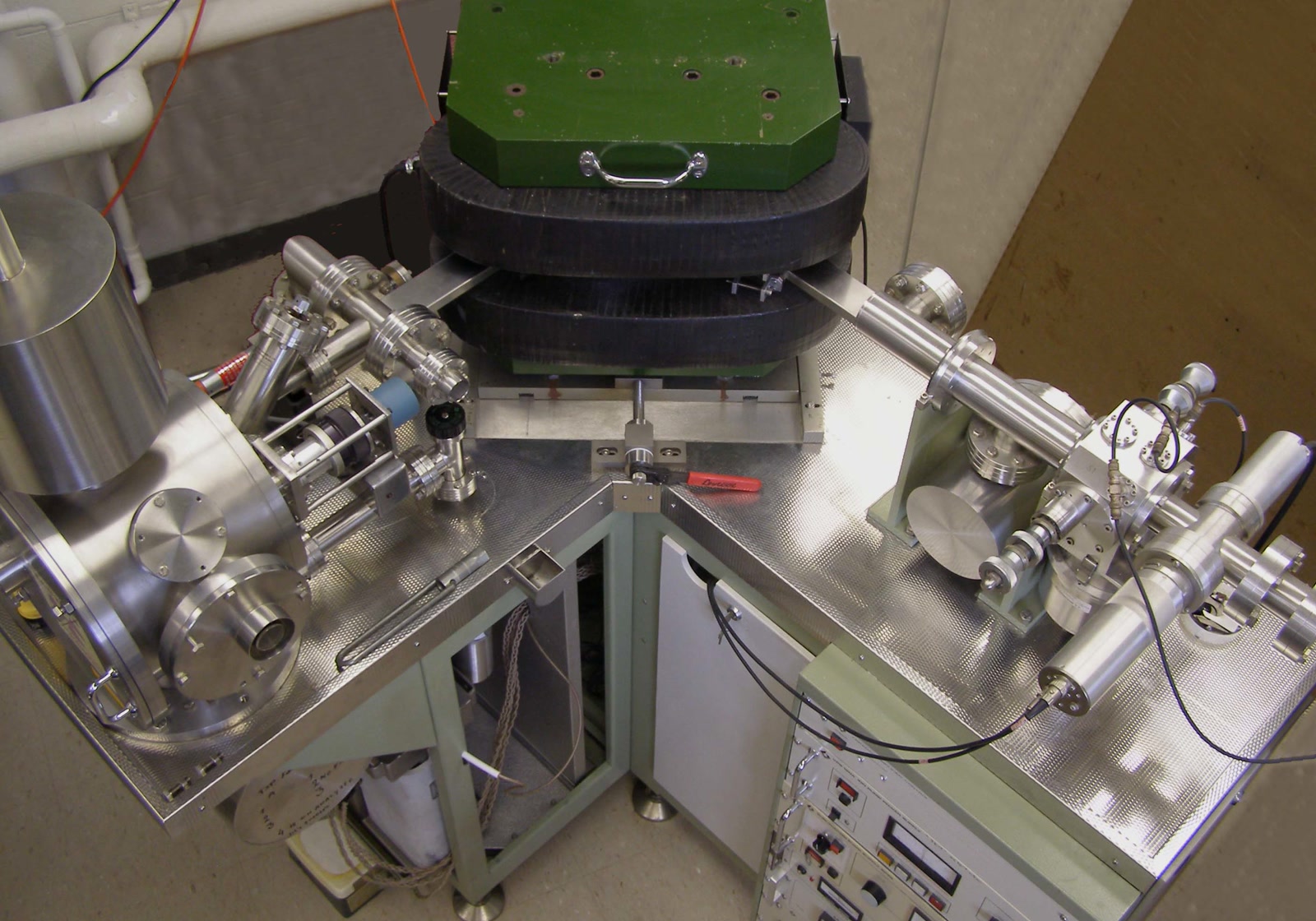
A fossil bone and a zircon crystal can leave the same outcrop and carry different kinds of time. The bone records an organism. The zircon records a mineral crystallizing in magma, often before an eruption scattered it as ash. When a paper gives a fossil an age with several decimal places, the instrument may have measured the zircon beautifully. It has not measured the animal's death.
That distinction is the working core of deep-time geochronology. Most fossils occur in sedimentary rocks, while the most precise radioisotopic clocks commonly date minerals formed in igneous processes. Paleontologists therefore build the fossil's age from relationships: where the fossil sits, where a datable ash bed sits, whether the ash fell there directly or arrived later, and which zircon grains belong to the eruption under study.[1][2]
This is why “How old is the fossil?” is rarely a one-machine question. It is a chain of custody for time.
The clock belongs to the crystal
Radiocarbon is the familiar exception that causes much of the confusion. Carbon-14 enters living tissue and begins to decline after death, so sufficiently young organic remains can sometimes be dated directly. Its 5,730-year half-life also sets a practical ceiling around 50,000 years, beyond which too little carbon-14 generally remains for reliable measurement. A non-avian dinosaur from the Mesozoic is tens of millions of years outside that window.[2][3]
Zircon offers a clock scaled to deep time. Its crystal structure accepts trace uranium while strongly excluding lead when it forms. Uranium-238 subsequently decays to lead-206, and uranium-235 to lead-207. Those two decay chains provide related checks on the crystal's history. Zircon is also physically and chemically durable, which lets tiny grains survive eruption, burial, uplift and erosion that destroy less resistant minerals.[3][4]
But durability creates the first interpretive trap. A zircon's U-Pb date records crystallization of that part of the grain. It does not automatically record eruption, sediment deposition, burial of a carcass or evolution of a species. A crystal may have grown in a magma chamber before the magma erupted. An older crystal may be inherited from rock melted into that magma. A river may erode an ancient zircon from one formation and redeposit it beside a much younger fossil. The date remains real; its relationship to the fossil has changed.[1][5]
What CA-ID-TIMS actually improves
High-precision studies often use an acronym that compresses a long laboratory sequence: CA-ID-TIMS, or chemical abrasion–isotope dilution–thermal ionization mass spectrometry. Each part attacks a different source of uncertainty.
Radiation damage can create zones in zircon from which radiogenic lead has partly escaped. Chemical abrasion anneals a grain and then partially dissolves damaged domains, reducing the risk that lead loss will make a crystal appear too young. The surviving material is dissolved, mixed with a precisely calibrated isotopic tracer, and chemically purified. In the mass spectrometer, uranium and lead are ionized from a heated filament and their isotope ratios measured. The procedure sacrifices the analysed fragment, but it can deliver exceptional precision.[5][6]
The precision is not merely promotional. In a 2025 interlaboratory test, 11 institutions analysed portions of the same pre-spiked zircon solution. Their weighted mean uranium-238–lead-206 ages agreed within 0.05 percent at two standard deviations. The experiment also found remaining laboratory-scale biases, which is exactly why shared tracers, standards, protocols and explicit uncertainty propagation matter.[6]
Chemical abrasion does not make interpretation automatic. Residual lead loss can survive treatment. Different grains may record prolonged crystal growth, inherited material or distinct magmatic pulses. The youngest-looking analysis is not always the eruption age, because lead loss can also drive a date younger. A 2025 method review recommends reading populations of single-grain dates alongside superposition and other geological constraints, not choosing one attractive number in isolation.[5]
An ash bed is a relationship, not a stopwatch
The clean textbook case places a fossil horizon between two primary volcanic ash beds. If the lower ash fell and was buried before the fossil, its eruption age supplies an older boundary: the fossil must be younger. If another ash fell above the fossil-bearing layer, that date supplies a younger boundary: the fossil must be older. The two beds form a bracket.[1][2]
Even here, four events have to stay separate:
- zircon crystallization in magma;
- volcanic eruption and ash transport;
- death of the organism; and
- burial and deposition of the fossil-bearing sediment.
In a rapidly accumulating sequence, these events may sit close enough together for a tight age estimate. In a floodplain crossed by migrating channels, erosion can remove time, sediment can pause, and ash can be reworked long after eruption. A zircon population then establishes that the sediment cannot be older than its youngest reliable source grains—a maximum depositional age—but it does not prove that deposition happened immediately afterward.[5][7]
“Maximum” can sound backward because geological ages count away from the present. If zircon crystallized 220 million years ago, a bed containing that reworked grain may have formed at 220 million years ago or later—say, 218 million years ago—but not earlier solely on that evidence. The zircon provides the oldest permissible numerical limit for deposition, not a guaranteed timestamp.
The same logic disciplines biostratigraphy. An index fossil can correlate separated rock bodies, and magnetic reversals can locate a section within a polarity sequence, but neither becomes an absolute age without calibration elsewhere. High-quality fossil dating is therefore usually a network: radioisotopic dates pin selected points, while stratigraphy, fossils, magnetic polarity and sedimentology carry time between them.[1][2]
The Chinle Formation shows why context wins
The Upper Triassic Chinle Formation in Petrified Forest National Park offers a useful field-scale test. Its river-laid rocks preserve a major record of vertebrate change, including early dinosaurs and their contemporaries, but fluvial strata are difficult clocks. Similar-looking channels can recur, beds can pinch out, and erosion can erase intervals that a continuous-looking cliff seems to contain.
In 2011, Jahandar Ramezani and colleagues tied U-Pb ID-TIMS analyses to 31 measured sections across the park. They dated zircon from nine tuffaceous beds—not nine pristine eruption blankets, but volcanic-rich sediments whose grains constrained maximum depositional ages. Their published model placed the base of the Blue Mesa Member at about 225 million years ago and the top of the Petrified Forest Member at 208 million years ago or younger, across roughly 280 metres of strata.[7]
The important result was not a tidier row of dates. Estimated accumulation rates exposed extensive hiatuses or channel erosion. The authors warned against correlating these fluvial units by rock appearance alone, and their age control allowed the lower Chinle record to overlap in time with the dinosaur-rich Ischigualasto Formation of Argentina. A claim about the tempo and geographic spread of early dinosaur evolution changed because crystals were connected to measured sections, sedimentary breaks and fossil distributions—not because zircon directly dated a dinosaur.[7]
That example also shows why a precise analysis can support a deliberately qualified sentence. “This grain crystallized at X” is one claim. “This tuffaceous bed was deposited no earlier than X” is another. “This fossil is approximately X years old” requires still more evidence about the fossil's exact horizon and the age model around it.
Read the geological verbs before the decimals
The most revealing word in an age statement is often not the number but the verb. Was the dated crystal crystallized, the ash erupted, the sediment deposited, or the fossil buried? Treating those as synonyms manufactures certainty that the laboratory never claimed.
A strong fossil age should therefore make five things visible in prose or methods: the material analysed; the isotope system and preparation method; the event the date is interpreted to record; the dated material's stratigraphic position relative to the fossil; and the geological uncertainties that survive the analytical error bar. Replicate grains and independent constraints matter most when they test that chain rather than merely add decimal places.[1][5][6]
The machine in the photograph is essential, but it is not the final authority. It measures ratios. A fossil age emerges only after field notes, mineral histories and rock relationships tell those ratios what they mean. Zircon can make deep time astonishingly precise. Stratigraphy keeps that precision honest.
Sources
- Charles R. Marshall, “Using the Fossil Record to Evaluate Timetree Timescales,” Frontiers in Genetics 10 (2019)—direct versus indirect fossil dating, ash-bed brackets and uncertainty in fossil ages.
- Smithsonian Human Origins Program, “Dating”—relative stratigraphy, tephrostratigraphy, radiocarbon limits and the construction of age brackets around fossil horizons.
- U.S. National Park Service, “Radiometric Age Dating”—radioactive half-lives, datable materials and uranium-lead geochronology.
- University of Kansas Isotope Geochemistry Laboratory, “What We Do”—zircon chemistry, uranium incorporation, lead exclusion and mineral durability.
- Chuan Yang, Fred Bowyer and Daniel Condon, “High-precision CA-ID-TIMS zircon U-Pb geochronology: a review of the Neoproterozoic time scale,” National Science Review 12 (2025)—chemical abrasion, tracer calibration, lead loss and geological age interpretation.
- Dawid Szymanowski et al., “Interlaboratory reproducibility of ID-TIMS U-Pb geochronology evaluated with a pre-spiked natural zircon solution,” Geochronology 7 (2025)—ID-TIMS workflow, precision and results from 11 participating laboratories.
- Jahandar Ramezani et al., “High-precision U-Pb zircon geochronology of the Late Triassic Chinle Formation, Petrified Forest National Park (Arizona, USA),” Geological Society of America Bulletin 123 (2011)—nine tuffaceous beds, 31 measured sections and maximum depositional ages in a fossil-bearing fluvial sequence.
- Radiogenic, “Thermal ionization mass spectrometer,” Wikimedia Commons (2013)—source page for the real laboratory photograph used as the article image.