Put a finger beside your nose, another below your eye, and a thumb along the lower edge of your jaw. Beneath those three points sit versions of the premaxilla, maxilla, and dentary: old dermal bones that form much of the tooth-bearing margin of a bony vertebrate's face. A cod, a crocodile, and a human remodel them almost beyond recognition, but the bones keep enough relationships to their neighbors that anatomists can follow them across the family tree.
For much of the twentieth century, that trail appeared to stop at the boundary of the bony fishes. Placoderms—the armored jawed fishes that flourished in Silurian and Devonian waters—seemed to bite with a fundamentally different set of plates. Sharks and their relatives, meanwhile, seemed to preserve a simpler condition: jaws supported largely by cartilage, with no great suit of dermal facial bones. It was tempting to picture the familiar vertebrate face as a bony-fish invention laid over a more primitive shark-like plan.[3]
Then a late Silurian fish from Yunnan arrived wearing the categories in the wrong combination. Entelognathus primordialis had a placoderm-like skull roof and trunk shield, yet the rim of its mouth was assembled from bones recognizable as a premaxilla, maxilla, and dentary. A second fish, Qilinyu rostrata, repeated the combination in a different head. Together they did more than fill a gap. They made the history of the jaw depend on whether a bone can change shape and position while remaining the same inherited structure.[1][2]
The strongest lesson is not that either animal was “our ancestor.” It is that a face once treated as the exclusive badge of bony fishes may have been assembled deeper on the jawed-vertebrate stem, before the living shark and bony-fish branches acquired their sharply contrasting bodies. The fossils preserve the mosaic. Phylogenetic models still argue over exactly where to hang it.[4][5][6]
The old tree made bone disappear and return
Living jawed vertebrates divide into two great branches. Chondrichthyans—sharks, rays, and chimaeras—support much of the skull and jaws with cartilage mineralized in distinctive ways, and they do not build the mouth margin from the same suite of large dermal facial bones. Osteichthyans include ray-finned fishes, lobe-finned fishes, and every tetrapod; their history is conspicuously written in internal bone and in large dermal bones around the skull. The split between those branches had already happened by the late Silurian, so neither living anatomy is a clean portrait of their last common ancestor.[3]
Placoderms sit near that split but outside the crown group formed by the common ancestor of living chondrichthyans and osteichthyans and all its descendants. Their name, “plate skin,” advertises the broad dermal armor over the head and front of the trunk. In familiar arthrodires, the biting apparatus includes upper gnathal plates called supragnathals and a lower gnathal element. Those plates do not look like a row of marginal facial bones in a modern bony fish. Under the traditional interpretation, the placoderm plates and the osteichthyan maxilla-premaxilla series followed separate anatomical histories.[3][5]
That interpretation created an awkward sequence. Large dermal plates were present among placoderms, absent from the streamlined facial construction of early shark-line animals, then prominent again in bony fishes. The arrangement could be explained by independent origins, but it also leaned heavily on an assumption: that the cartilage-rich condition of living sharks was close to the ancestral condition for all modern jawed vertebrates. Fossils increasingly made that assumption expensive. Early members of both sides combine armor, fin spines, scales, cartilage, and bone in ways no living fish does.[3]
This is why Entelognathus matters at the level of a lineage rather than as an isolated oddity. Its armor and face join two structures that the old narrative had placed on opposite sides of an evolutionary break.
One skull carried the facial pattern across the boundary
Min Zhu and colleagues named Entelognathus primordialis in 2013 from the Kuanti Formation near Xiaoxiang Reservoir at Qujing, Yunnan. The holotype, IVPP V18620, preserves an articulated head shield and trunk armor from the late Ludlow interval of the Silurian. Referred skulls and individual facial elements helped the team trace sutures and contacts that a single exposed surface could not supply.[1]
The front of the animal is unmistakably armored. Broad plates cover the skull roof; the head joins a plated shoulder region in the placoderm manner. But along the mouth, the plate pattern changes. A premaxilla occupies the front of the upper jaw, a maxilla continues behind it, and a dentary runs along the lower margin. Cheek bones and an opercular series also resemble the large dermal elements of osteichthyans. These are not identifications based on a maxilla-shaped silhouette alone. They rest on position, contact with adjacent bones, surface ornament, and the route of sensory canals across the face.[1][3]
The distinction between a jaw and these jaw bones is crucial. Entelognathus did not document the first appearance of a hinged mouth; more deeply branching placoderms were already jawed. Nor did it bear large teeth along those jaw bones. Its importance lies in the external dermal casing around the jaw cartilage—the architecture that, in heavily modified form, supplies the tooth-bearing margins of bony fishes and tetrapods. The fossil shifted the question from “When did bony fishes invent these bones?” to “How much of the placoderm face did bony fishes inherit?”[1][5]
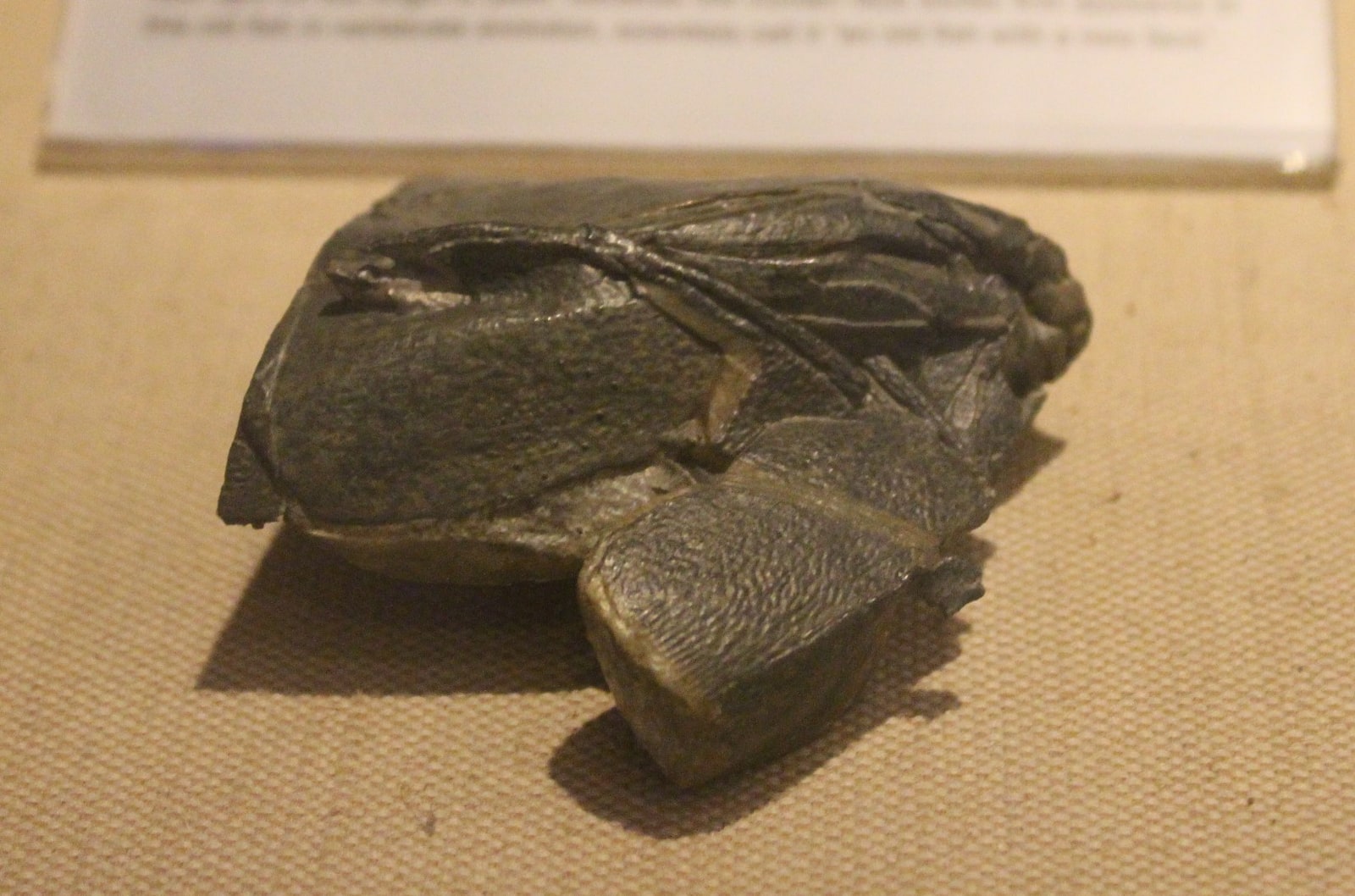
The museum photograph keeps that claim appropriately physical. It records a textured display identified by the photographer as the holotype, not a colored reconstruction with every suture made equally confident.[1][7] Some boundaries are easier to read from prepared surfaces, counterpart material, or scans than from the public-facing view. The photograph documents the display and its presentation; the anatomical paper supplies the comparative interpretation.
Qilinyu turned an exception into a transformation
One unprecedented fossil can be dismissed as a specialization or misread boundary. Qilinyu rostrata, described in 2016 from the same late Silurian fauna, made that response harder. It looked unlike Entelognathus in the proportions and construction of its head, yet it also combined placoderm armor with a premaxilla, maxilla, and dentary. The shared pattern appeared in two distinct animals rather than as a one-off anatomical trick.[2]
The revealing part was not just the names attached to the bones, but their two-sided construction. In both maxillate placoderms, the upper jaw bones contribute a facial lamina visible on the outside of the head and a broad palatal lamina extending into the mouth. That combination bridges the conspicuous external plates of osteichthyans and the inward-facing biting plates of more familiar placoderms. If the old placoderm gnathal plates represented an entirely separate inner arcade, then Entelognathus and Qilinyu ought to preserve those elements inside their newly identified marginal bones. They do not.[2][5]
Zhu and colleagues therefore proposed a more economical transformation. Their sequence starts with oral or palatal dermal jaw plates. Facial laminae were acquired on the lineage leading toward maxillate placoderms and crown gnathostomes, producing bones that extended onto the outside of the face; osteichthyans later reduced the palatal portions. Under this reading, the placoderm bite and the osteichthyan face are not rival inventions. They are divergent uses of an older dermal jaw module.[2]
This does not make an arthrodire jaw secretly human. Homology describes historical continuity, not identical shape, function, or development in every descendant. A forelimb can become a whale flipper or a bat wing without ceasing to be a forelimb. The jaw-bone proposal asks for a comparable transformation in plates: expansion on one surface, reduction on another, altered contact with the braincase, and different emphasis on biting edges.
Naming the same bone is a test, not a revelation
Fossils do not arrive with labels. Anatomists establish a provisional homology by comparing where a structure lies, what it touches, how it grows, which canals pass through it, and whether the proposed equivalent coexists elsewhere in the same animal. The last test matters here. One bone cannot simultaneously be both an outer maxilla and a separate inner dermopalatine if both structures are present together in the comparison animal.[5]
Benedict King and Martin Rücklin turned the competing identifications into an explicit model in 2021. Instead of fixing one jaw-bone homology before building the evolutionary tree, their Bayesian analysis allowed the alternative codings and tree to be estimated together. It strongly favored treating the arthrodire supragnathals as homologues of premaxillae and maxillae rather than as the osteichthyan vomer-dermopalatine series. In their reconstruction, the ancestral jawed vertebrate had upper marginal bones with both facial and palatal portions; core placoderms later reduced the facial part, while osteichthyans reduced the palatal part.[5]
That is a powerful result, but it is not a microscopic tag attached to a fossil. It depends on character definitions, taxon sampling, evolutionary-rate assumptions, and the tree model. One sensitivity test reassigned Yunnanolepis a Ludlow age to approximate missing Silurian antiarch sampling. The main results held, but support for placing maxillates beside the core placoderms fell, showing how a sparse early record widens the uncertainty.[5]
The careful claim is therefore layered. Direct observation establishes the arrangement of plates in the two maxillate placoderms. Comparative anatomy makes continuity with osteichthyan marginal bones a strong explanation. Phylogenetic modelling extends that explanation to the ancestral jawed-vertebrate condition. Each layer is informative; none should impersonate the others.
The shark condition stopped looking primitive
Once large facial bones are allowed on the jawed-vertebrate stem, the absence of those bones in living sharks changes meaning. It need not record a stage before dermal armor evolved. It can record a highly modified chondrichthyan trajectory in which a once more extensive dermal skeleton was reduced to small denticles or lost while the cartilaginous endoskeleton developed its distinctive mineralization. The shark is not a half-finished bony fish, but neither is it an untouched model of the common ancestor.[3]
The rest of Entelognathus has continued to reinforce that inversion. In 2023, Xindong Cui and colleagues described IVPP V32322, the first Entelognathus specimen known with a near-complete post-thoracic exoskeleton. Some of its thin, large, rhomboid scales have peg-and-socket articulations previously treated as characteristic of osteichthyans. Yet the same animal carries an anal-fin spine of a kind previously associated with the chondrichthyan stem. Its lateral-line scales retain an open groove rather than the enclosed canal seen in many bony fishes.[6]
This is not a confused animal awaiting assignment to the correct box. It is evidence that the boxes were assembled later. Marginal facial bones, scale joints, fin spines, armor, and sensory canals could circulate in different combinations along the jawed-vertebrate stem before the living lineages consolidated their familiar anatomies. A character found in a modern group may be older than that group; a character absent today may have been lost rather than never acquired.[6]
The mosaic also limits ecological storytelling. Its jaw margins lack large teeth, and its eye openings are small. Those observations can bound a reconstruction, but they do not reveal a complete diet or behavior. The lineage argument is carried by the skeleton's distribution of characters, not by animating the fish as a missing-link hero.[1][5]
The family tree remains a live part of the evidence
“Placoderm” once implied a single extinct branch just outside modern jawed vertebrates. Many parsimony analyses instead spread placoderm groups along the gnathostome stem, making the name a grade: several successive branches, some closer to the living crown than others. In that arrangement, an arthrodire-like fish with osteichthyan facial bones can mark a late stage in a relatively direct anatomical sequence toward the crown.[3]
The alternative has not gone away. A 2017 analysis by King and colleagues found that monophyly and paraphyly of the core placoderms were essentially equally parsimonious, while a tip-dated Bayesian morphological-clock model strongly favored a monophyletic core. That result depends partly on modelling rates through time and on correcting correlated or disputed character codings. It does not simply restore the old textbook tree: its definition of core placoderms excludes the maxillate Entelognathus, and the later dynamic-homology analysis likewise treats Qilinyu separately from the core clade.[4][5]
The 2021 dynamic-homology study likewise recovered the maxillate placoderms near the reconstructed ancestral condition, but explicitly did not identify them as sampled ancestors. They are specialized animals living alongside early osteichthyans such as Guiyu, not frozen grandparents waiting in a direct line. Their exact attachment shifts with the analysis, and the competing trees change how many times particular facial conditions must be gained, lost, or remodeled.[5]
New material can move the branch again. The 2023 body study placed Entelognathus and Qilinyu together as the immediate sister lineage to crown gnathostomes in its analysis, while noting that support for their grouping has varied across earlier datasets. Its fresh scale and fin characters strengthened the idea of a pre-crown mosaic without erasing the methodological dispute.[6]
What survives these alternatives is the important part. Large dermal jaw and cheek bones cannot safely be treated as a late novelty appearing fully formed inside Osteichthyes. The maxillate placoderms demonstrate anatomical continuity across what once looked like a categorical wall. Whether core placoderms form one branch or several, the bony face and the armored face now have to be explained in the same history.[1][2][4][5]
A face is a sequence of retained relationships
The human connection is real, but it is easy to phrase badly. Your maxilla is not an unchanged placoderm plate, and Entelognathus is not a portrait of the animal from which humans descended. Between its Silurian mouth and ours lie the origin of osteichthyans, the split of ray-fins and lobe-fins, the move onto land, and hundreds of millions of years of feeding, sensory, and developmental change.
What persists is subtler: a set of positional relationships capable of surviving radical redesign. A bone can broaden into an inner biting surface, become part of an external cheek, carry teeth, lose teeth, fuse with a neighbor, or shrink from view. The fossil record catches those transformations only when preservation is good enough to hold the contacts and comparative anatomy is disciplined enough not to confuse resemblance with ancestry.
In the museum case, the Entelognathus display still looks first like armor.[7] Look longer, and the seams around its mouth change the scene. The familiar vertebrate face did not arrive as a finished mask on the bony-fish branch. Its components were already being tried in an older armored world—and the most honest family portrait leaves a few branches in pencil.
Sources
- Min Zhu et al., “A Silurian placoderm with osteichthyan-like marginal jaw bones,” Nature 502 (2013)—the description of Entelognathus primordialis, its Kuanti Formation material, and its facial-bone mosaic.
- Min Zhu et al., “A Silurian maxillate placoderm illuminates jaw evolution,” Science 354 (2016)—the description of Qilinyu rostrata and the proposed transformation between placoderm gnathal plates and osteichthyan marginal jaw bones.
- Martin D. Brazeau and Matt Friedman, “The origin and early phylogenetic history of jawed vertebrates,” Nature 520 (2015)—open review of crown and stem relationships, Entelognathus, dermal skeleton evolution, and the placoderm problem.
- Benedict King et al., “Bayesian Morphological Clock Methods Resurrect Placoderm Monophyly and Reveal Rapid Early Evolution in Jawed Vertebrates,” Systematic Biology 66 (2017)—comparison of parsimony and tip-dated models for core placoderm relationships.
- Benedict King and Martin Rücklin, “A Bayesian approach to dynamic homology of morphological characters and the ancestral phenotype of jawed vertebrates,” eLife 9 (2020; version of record 2021)—explicit tests of alternative upper-jaw homologies and ancestral-state reconstructions.
- Xindong Cui et al., “Bony-fish-like scales in a Silurian maxillate placoderm,” Nature Communications 14 (2023)—the expanded post-thoracic record of Entelognathus, including its scales, fin spines, and updated phylogenetic analysis.
- Morosaurus millenii, “Entelognathus-Paleozoological Museum of China.jpg,” Wikimedia Commons (2019)—source page for the CC BY-SA 4.0 museum photograph identified there as the holotype display and used as the article image.