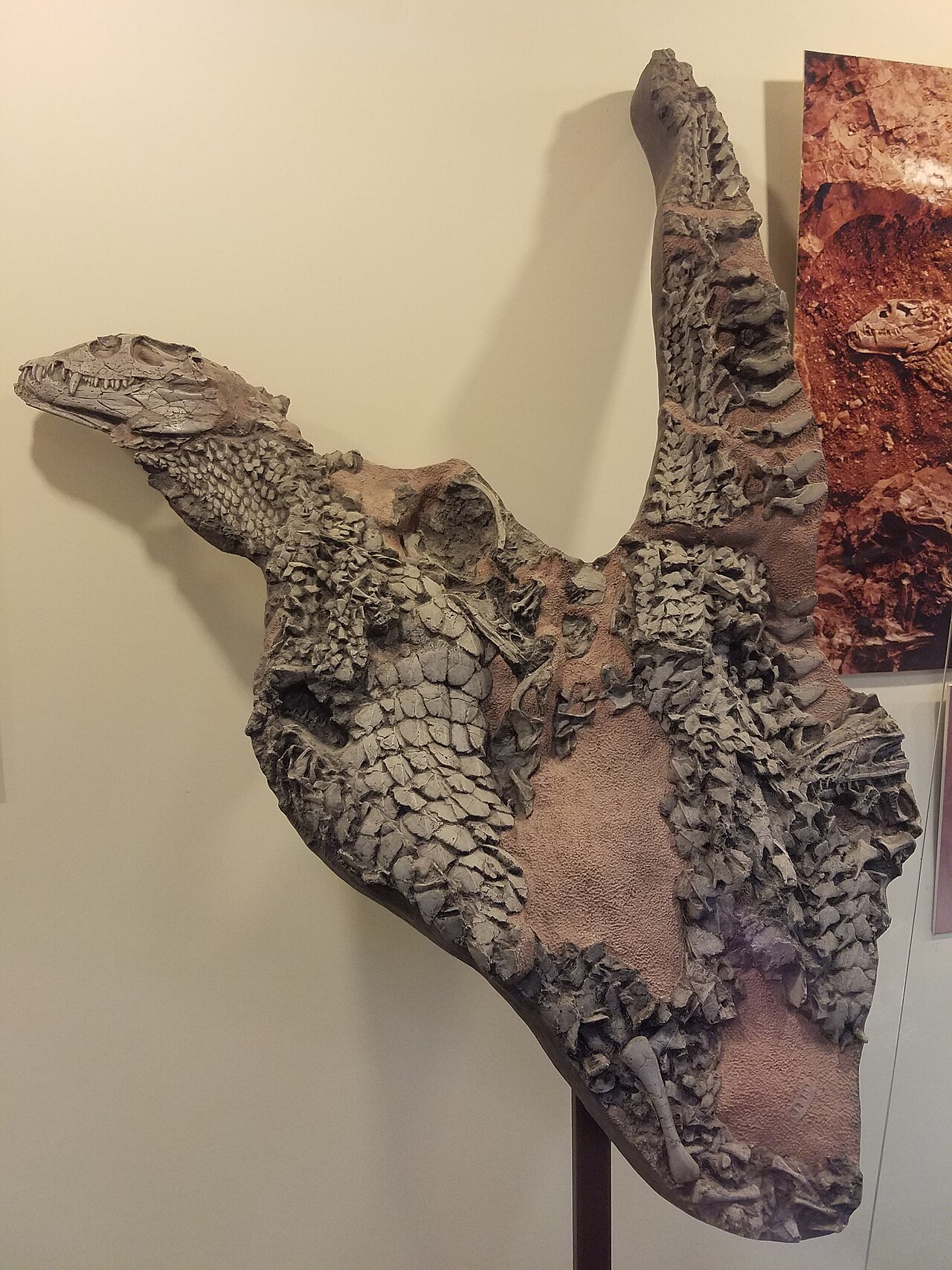
Much of the height in Vancleavea campi’s tail came from bones formed in its skin.
Along the upper edge of the tail, roughly 30 thin bones stood upright in a row. These were osteoderms—bones formed within the skin—not extensions of the vertebrae. Beneath them, the tail vertebrae also carried long, backswept neural spines, so the fin's bony framework combined familiar axial supports with unusual dermal ones. In the nearly complete skeleton GR 138, each osteoderm aligns with a tail vertebra, and the series reaches almost to the tail tip. Adjacent pieces would have been joined by soft tissue in life. Together the bones supported a deep vertical fin unlike the armored backs of crocodilians or aetosaurs.[1]
That distinction turns an eccentric Late Triassic reptile into a revealing evolutionary experiment. Vancleavea did not merely wear armor; it divided one bony material into region-specific structures around its throat, belly, flanks, limbs and tail. The skeleton preserves the fin's unusual dermal supports directly. How much flesh completed its outline, how powerfully it swam and how much time it spent in water remain inferences.
A specimen assembled before it was understood
The name Vancleavea campi rests on PEFO 2427, a partial skeleton collected as loose surface material over a period of years at Petrified Forest National Park in Arizona. Park naturalist Phillip Van Cleave gathered the pieces; the genus later carried his name. Because the bones had weathered out of their original positions, their association was less secure than that of a skeleton found articulated in rock. When Vancleavea was named in 1995, its place among reptiles was correspondingly uncertain.[1][2]
More material gradually made the animal coherent. Two partial skeletons from the Chinle Formation of Arizona showed that its characteristic osteoderms belonged with recognizable limb, hip and vertebral anatomy.[2] Then GR 138, excavated from the famous Coelophysis Quarry at Ghost Ranch in northern New Mexico, supplied the decisive reference body. It is nearly complete and articulated, with skull, trunk, limbs, tail and much of the armor still associated.[1]
GR 138 is not pristine. The carcass twisted during fossilization; its head and parts of its trunk face differently, the pelvis is disturbed, and compression deformed the skull. Another disarticulated individual lay beneath it, complicating the ownership of a few scattered elements. Even the published total length—about 1.25 metres—is a reconstruction with an estimated 5–10 percent error. Yet the specimen preserves enough of the armor in place to show that apparently miscellaneous plates from older finds were parts of a single anatomical system.[1]
The cast in the photograph is therefore both useful and easy to misread. It is a museum reproduction of GR 138, rather than original fossil bone or the species' name-bearing holotype. It shows the museum reconstruction of the articulated skeleton, while the primary evidence remains the prepared specimen and its anatomical description.[1][5]
Five regions carried five osteoderm geometries
“Armored” suggests a single shell. Vancleavea instead carried overlapping pieces that changed shape across the body. Small, mostly smooth teardrops ran from the shoulder region toward the lower jaws. One or two rows lay over the spine, while asymmetrical plates overlapped along the sides. Large, roughly oval plates covered the belly between the shoulder and pelvic girdles. Thinner osteoderms occurred around the forelimbs and hindlimbs, although their disarticulation leaves open whether they formed an unbroken sleeve.[1]
The categories are human labels imposed on a graded anatomy. At some boundaries one form shades into another, which is why a detached osteoderm can identify the genus more confidently than its exact address on the body. Still, GR 138 preserves a robust regional pattern: throat pieces, dorsal and lateral armor, ventral plates, limb-associated pieces and the upright tail series.[1]
This was not a turtle-like box fused into a single rigid carapace. Many plates overlapped their neighbours, and those contacts retained divisions between individual elements. Nor was every odd fragment necessarily part of the animal. A large “Stegosaurus-like spike” collected with the loose holotype is absent from GR 138, and the 2009 study treated its assignment as unresolved. The contrast is instructive: an articulated skeleton can establish an armor pattern; a dramatic isolated object found among surface float cannot automatically extend it.[1]
Vertical osteoderms deepened the tail
The dorsal tail osteoderms are not merely taller versions of the flank plates. Their exact starting point is unclear, though none lies in front of the pelvis; the anterior members are the largest, with bases expanded around the tail's midline. Farther back they become lower, narrower and more swept toward the tip. Their one-to-one alignment with successive caudal vertebrae gives the row a repeated internal structure rather than a chance pile of spines. A second row of keeled osteoderms lay below the vertebral column.[1]
What the fossil demonstrates is a sequence of bony fin supports. A continuous skin margin between adjacent supports is a strong anatomical reconstruction, because separated osteoderms could not by themselves push water as a single surface. The exact soft-tissue contour is not preserved. Describing the tail as a fin is therefore well grounded; drawing its edge to the millimetre is not.
The tail also shifts the likely mechanics of the animal. GR 138 has no paddle-shaped hands or feet. Its caudal joints permitted side-to-side movement more readily than vertical bending, and a deep, laterally compressed tail would have enlarged the surface available for lateral propulsion. These features support a tail-driven swimmer, perhaps capable of forceful starts. They do not preserve speed, hunting style or a percentage of life spent submerged.[1]
That evidentiary ladder matters. The vertical osteoderms are observed. The soft tissue joining them is reconstructed from their spacing and anatomy. Their role in making the tail deeper is a functional inference. A vivid scene of Vancleavea lunging after a particular prey would add another layer for which this skeleton supplies no direct meal, bite trace or trackway.
The semiaquatic case is cumulative
The fin is not the only aquatic-looking feature. Vancleavea had an elongated trunk, a low profile and nostril openings directed upward. A femur from the referred specimen UCMP 152662 also has thickened compact bone, a condition compatible with the skeletons of some animals that live in water. Taken together, these traits make a semiaquatic ecology a strong working interpretation.[1]
None is a private signature of one lifestyle. The limbs appear small against the long body, but their proportions are similar to those of the related Euparkeria; they were not demonstrably shortened from the ancestral condition. Upward-facing nostrils help an animal breathe near the water surface, but they also occur elsewhere on the archosauriform family tree. Heavy armor can be carried by terrestrial and aquatic animals alike.[1][3]
Histology sharpens the caution. Thin sections of Vancleavea osteoderms reveal dense, compact tissue, a condition broadly consistent with an aquatic or semiaquatic animal. But comparable compactness also occurs in fully terrestrial reptiles, so this tissue cannot be mapped to lifestyle on its own. The histological authors therefore treated lifestyle assignments from armor compactness as tentative rather than diagnostic.[4]
The best profile is consequently amphibious, not ocean-going: an animal anatomically equipped to move in water while retaining unreduced, non-paddle-like limbs. Its deep tail and dorsal nostrils carry more ecological weight together than either does alone. “Semiaquatic” summarizes converging evidence; it is not a preserved behaviour.
The skull belonged near archosaurs, not inside them
At the front of that armored body sat a short, highly ossified skull. GR 138 preserves upward-opening external nostrils, a large lateral temporal opening and the secondary absence of two other familiar skull openings, the antorbital and supratemporal fenestrae. Large recurved caniniform teeth sit toward the front of the jaws, followed by smaller crowns, some with serrated edges. The mouth is consistent with predation, but its menu is unknown.[1][3]
Vancleavea is often made to look vaguely crocodile-like in life restorations. That resemblance should not turn it into a crocodilian. It was an archosauriform—a member of the broader branch that also contains the crown group Archosauria—but it lived outside the last common ancestor of living birds and crocodilians and all that ancestor's descendants.[1][3]
Its precise address has changed with character matrices and newly described relatives. The 2009 analysis placed it closer to crown archosaurs than Proterosuchus and Erythrosuchus, but outside Archosauria.[1] A larger 2016 analysis grouped it within Proterochampsia, among the non-crown archosauriform lineages close to archosaurs.[3] Those alternatives alter the nearby branches, not the basic point: Vancleavea was neither a dinosaur nor an early crocodile.
One species name may hide a longer lineage
The clean silhouette supplied by GR 138 can also make the fossil record look more uniform than it is. Material assigned to Vancleavea occurs across widely separated Late Triassic localities in the western United States and spans close to 20 million years. Much of it consists only of diagnostic osteoderms or vertebral fragments. The holotype and the most complete referred skeletons share enough distinctive anatomy for referral to V. campi, but they often lack the same bones for direct comparison.[1][2]
That creates a taxonomic asymmetry. The armor is distinctive enough to recognize Vancleavea, yet variable enough across one body that isolated plates may be poor tools for separating species. Differences among the better skeletons could mark growth, individual variation or multiple closely related taxa. The 2009 authors kept the available material in one species while explicitly leaving open whether the long record actually represents a small clade.[1]
So the most familiar Vancleavea is one exceptional individual standing in for a patchy lineage. GR 138 securely reveals a body plan: compact skull, long trunk, non-paddle-like feet, regional armor and a tail whose fin was partly scaffolded by skin bone. It supports a persuasive semiaquatic interpretation. It does not erase uncertainty about every referred fragment, every ecological detail or the soft edge of the fin.
Armor is usually narrated as a shield. In Vancleavea, the same developmental material became tiles, overlapping plates, limb coverings and a repeated row of vertical struts. The fossil's most surprising lesson is not simply that an armored reptile could swim. It is that evolution could turn protection into profile—and make a tail taller without asking the vertebrae to do all the work.
Sources
- Sterling J. Nesbitt et al., “The osteology and relationships of Vancleavea campi (Reptilia: Archosauriformes),” Zoological Journal of the Linnean Society 157 (2009)—the principal description of GR 138, regional osteoderms, tail construction, ecology and taxonomic limits.
- William G. Parker and Bronson J. Barton, “New information on the Upper Triassic archosauriform Vancleavea campi based on new material from the Chinle Formation of Arizona,” Palaeontologia Electronica 11 (2008)—the holotype history and partial Arizona skeletons that preceded the GR 138 redescription.
- Martín D. Ezcurra, “The phylogenetic relationships of basal archosauromorphs, with an emphasis on the systematics of proterosuchian archosauriforms,” PeerJ 4 (2016)—comparative anatomy and the placement of Vancleavea within non-crown archosauriform relationships.
- Denis A. Ponce et al., “The osteoderm microstructure in doswelliids and proterochampsids and its implications for palaeobiology of stem archosaurs,” Acta Palaeontologica Polonica 62 (2017)—osteoderm histology and the limits of using compactness to infer lifestyle.
- Neil Pezzoni, “Vancleavea Ghost Ranch cast,” Wikimedia Commons (2019)—source page and CC BY 4.0 license for the museum photograph of the GR 138 cast.